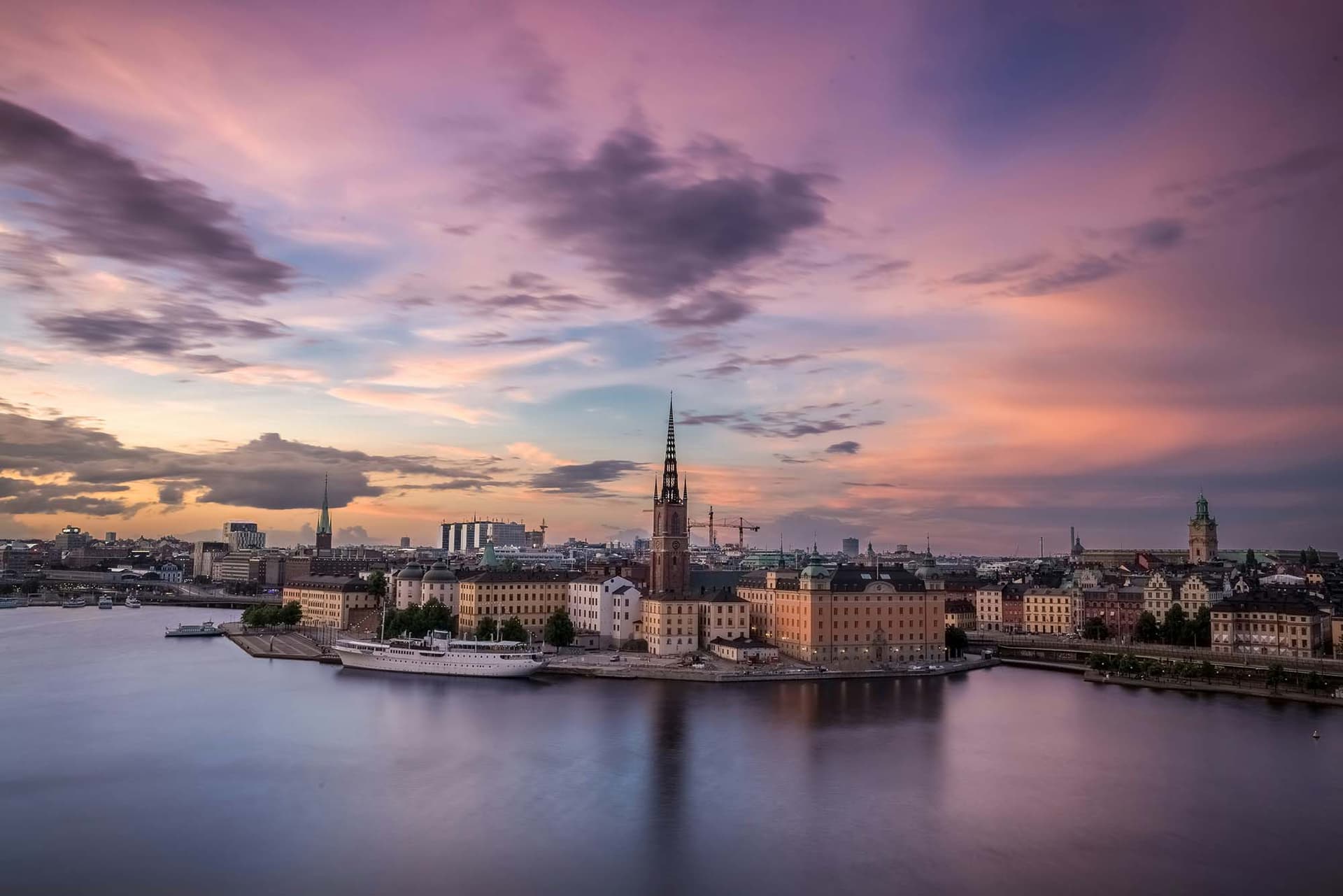
Capital on fourteen islands, between royal grandeur and contemporary design
Built on 14 islands linked by 57 bridges, Stockholm floats between Lake Malar and the Baltic Sea, a city of museums, waterfront walks and impeccable Nordic style.
Why Stockholm?
Built on 14 islands linked by 57 bridges, Stockholm floats between Lake Malar and the Baltic Sea, a city of museums, waterfront walks and Nordic style.
It is called the Venice of the North, yet Stockholm resembles no other city. Built across 14 islands connected by 57 bridges, the Swedish capital floats between Lake Mälar and the Baltic Sea in a striking balance of wild nature and masterful urban planning. Here, water is everywhere — it seeps into every view, every walk, every café terrace. It is a city best discovered on foot and by ferry, where each crossing reveals a new perspective on ochre facades and verdigris church spires.
But Stockholm is also — and perhaps above all — a world capital of design. From the clean lines of Scandinavian furniture to the concept stores of Södermalm, from the metro transformed into an underground art gallery to the tables of the New Nordic cuisine, everything here exudes effortless elegance. The city has the rare ability to blend medieval heritage preserved in amber with bold modernity, all at a profoundly walkable scale — you can cross the historic centre in twenty minutes, coffee in hand.
02The essential neighbourhoods
Gamla Stan — the medieval heart
This is where it all began, in the 13th century. Gamla Stan, the old town, unfurls its cobbled lanes between houses with saffron, rust and mustard facades. Despite the tourist crowds, you only need to step away from Västerlånggatan to find the silence and intimacy of forgotten little squares. The Royal Palace, Storkyrkan Cathedral, the Nobel Museum — everything is concentrated on a few hectares of dizzying historical density. Just opposite, on the peninsula of Blasieholmen, the Grand Hôtel has watched over the harbour since 1874, offering arguably the finest view in Stockholm over the royal quays.
Östermalm — bourgeois elegance
Stockholm’s upscale quarter, with broad avenues lined with lime trees and Swedish-style Haussmann-era buildings. Strandvägen, the boulevard along the waterfront, is one of Europe’s most beautiful addresses — the Hotel Diplomat sits there with Art Nouveau grace, facing the sailboats in the harbour. Further along, the Villa Dagmar embodies the new Stockholm luxury: contemporary design, Italian-inspired restaurant, discreet rooftop. It is also the neighbourhood of the Östermalms Saluhall, the city’s most refined covered market.
Södermalm, Norrmalm and Djurgården
Södermalm is creative, bohemian Stockholm — vintage shops, independent galleries, coffee shops by local roasters and panoramic views from the heights of Monteliusvägen. Norrmalm concentrates commercial and cultural energy around Sergels Torg and the central station — this is where you’ll find the Generator Stockholm for urban travellers and the Clarion Hotel Sign for those who want to stay connected to the city’s pulse. Finally, Djurgården, the garden island, houses Stockholm’s greatest museums in a green setting accessible by tram or ferry from Slussen — a bucolic interlude in the heart of the city.
03What to do in Stockholm?
Stockholm is a city of museums, and some rank among Europe’s finest. The Vasamuseet displays a 17th-century warship found almost intact at the bottom of the harbour — an astonishing experience regardless of your interest in maritime history. Fotografiska, housed in a former customs warehouse in Södermalm, has become one of the world’s temples of contemporary photography, with a rooftop restaurant that justifies the visit on its own. For a dose of Swedish pop culture, the ABBA The Museum on Djurgården is far more than a fan museum: it is a brilliantly staged interactive immersion.
Skansen — the world’s oldest open-air museum, with traditional farms, Nordic animals and artisans at work
The Archipelago — 30,000 islands accessible by ferry from the city centre, ideal for a day trip (Vaxholm, Sandhamn, Grinda)
Fika — the sacred coffee-and-pastry ritual, best experienced at Drop Coffee, Johan & Nyström or the historic salons of Vete-Katten
Design shopping — Svenskt Tenn for iconic interior design, Acne Studios and COS for fashion, and the independent boutiques of SoFo (south of Folkungagatan)
The archipelago insider tip
For a unique experience, book a night at Yasuragi, a Japanese spa nestled in the archipelago just 20 minutes from Stockholm. Outdoor onsen overlooking the Baltic, kaiseki cuisine and absolute silence — the perfect contrast after the city’s buzz.
04Where to eat in Stockholm?
Stockholm is one of the epicentres of New Nordic cuisine. The city boasts over a dozen Michelin-starred restaurants, but the real excitement lies in the bistronomic scene. Mathias Dahlgren, based at the Grand Hôtel, offers Rutabaga — a plant-based Nordic restaurant that revolutionised Swedish fine dining. For a more everyday immersion, the Östermalms Saluhall is a must: beneath its renovated brick roof, you can taste Smögen shrimp, smoked reindeer and Jämtland cheeses at the counter.
On the street food side, the food halls at K25 in Norrmalm and Hornstulls Marknad in Södermalm offer a relaxed, multicultural alternative. For tighter budgets, the dagens lunch (lunch specials) at 120–150 SEK are an institution: nearly every restaurant, even ambitious ones, offers a full set lunch with soup, salad, coffee and unlimited bread. It is the best way to taste Stockholm’s cuisine without breaking the bank.
05Getting around Stockholm
From Arlanda Airport, the Arlanda Express reaches the central station in 20 minutes (book online for a reduced fare). Once in the city, the SL network (metro, bus, tram, ferry) is impeccable. The 24-hour or 72-hour SL card is the must-have pass — it even covers ferries to Djurgården and some inner-archipelago lines. The Tunnelbana (metro) is an attraction in itself: over 90 of its 100 stations are decorated by artists — it is often called the world’s longest art gallery. T-Centralen (blue vaults), Solna Centrum (red forest) and Kungsträdgården (archaeological relics) are worth a detour on their own.
Stockholm on foot and by sea
The city centre is remarkably compact: Gamla Stan, Norrmalm, Östermalm and Södermalm are all easily walkable. For trips between the islands, the SL ferries (included in the transport card) offer free urban mini-cruises — line 82 between Nybroplan and Djurgården is particularly photogenic.
Âme Bohème exists thanks to you
Some links in this article are affiliate links. This means that if you book or purchase a product through these links, we receive a small commission — at no extra cost to you. It's thanks to this support that we can continue creating free, quality content.
You can also buy us a coffee, or follow us on Instagram and Facebook.
Thank you
Share
Comments
Share your thoughts
Leave a comment
Looking for more information for your trip? Book a personalised video call with us, or join the Curious Souls community on Discord.
Your email address will not be published. Required fields are marked with *