
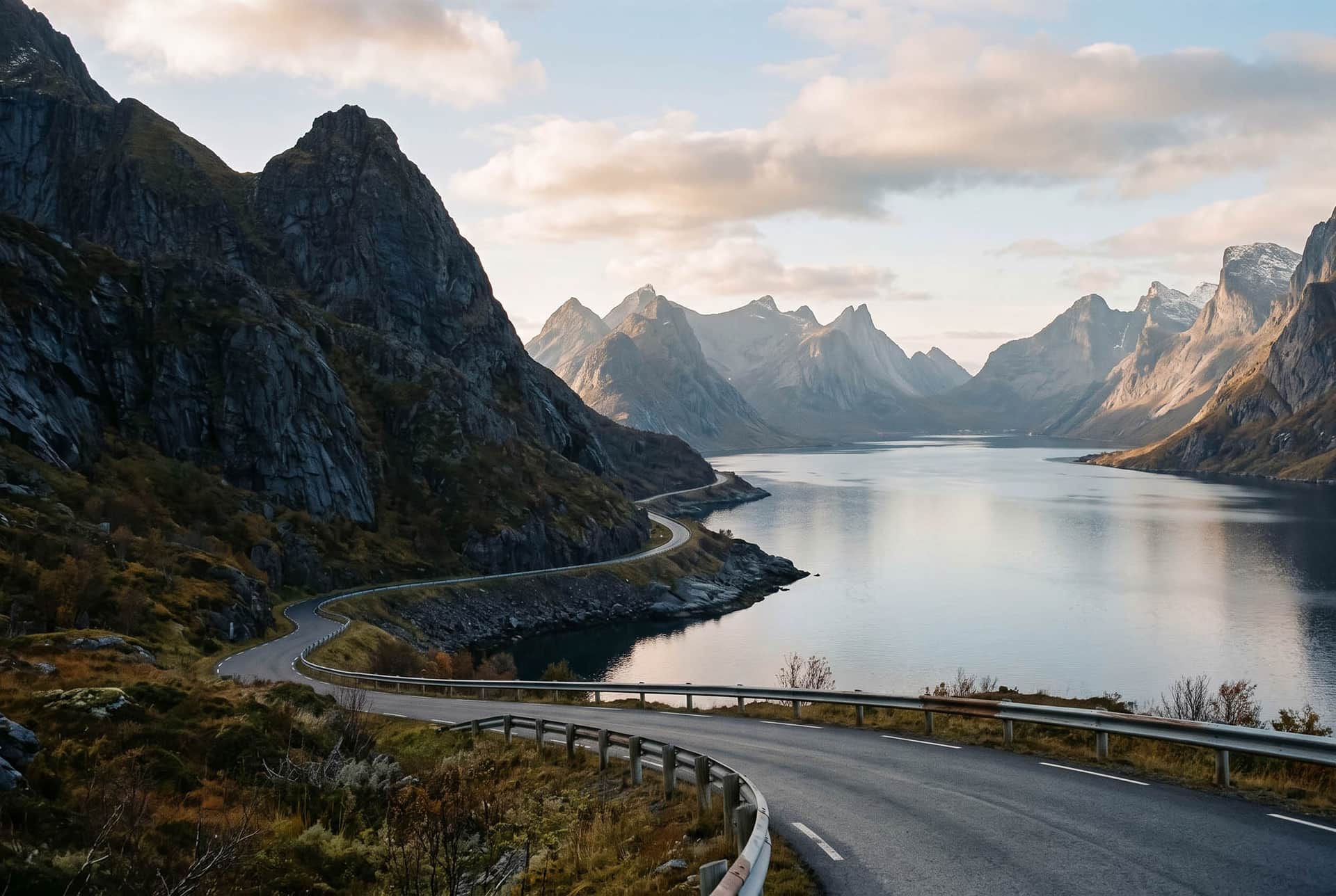

I remember the very first bend on the E10 after Evenes, precisely. A black mountain plunging straight into still water, a red rorbu perched on stilts, and that low, raking light that exists nowhere else in Europe. I cut the engine on the verge without even thinking. We were still an hour and a half from the archipelago, and I'd already understood that the plan I'd prepared wouldn't survive the day.
Five days in Lofoten is short. Enough to see the essentials, not enough to see it all. And that's exactly why a Lofoten road trip of this length needs to be planned, not improvised. Here's how I'd break down these five days if I set off again tomorrow morning, with the trade-offs I'd make again and the ones I wouldn't.
In short: the essentials of this Lofoten road trip
| Ideal duration | 5 full days on the ground (4 days = condensed version, see below) |
| Recommended direction | North to south, from Evenes to Å |
| Total distance | around 350 to 400 km on the E10 |
| Arrival airport | Harstad/Narvik (Evenes), the most convenient |
| Alternative | Fly to Bodø then the Bodø–Moskenes ferry (about 3 hr 15) |
| Vehicle | Essential, unlimited mileage a must |
| Rough budget | €180 to €300 per day per person, excluding flights |
| Best time to go | June and July for hiking and the midnight sun |
| Recommended overnight stops | Henningsvær (1), Ballstad or Leknes (1), Reine or Hamnøy (2) |
| Signature hike | Reinebringen, around 1,500 steps, 2 hr 30 to 3 hr round trip |
The itinerary at a glance
The route is simple because the geography leaves no choice. Lofoten is five main islands lined up and linked by a single road, the E10, above the Arctic Circle. You enter from the north, you leave from the south. There is no alternative route.
- 01Day 1: Evenes to Henningsvær. Around 180 km, allow 3 hr with stops. Crossing Austvågøy, passing through Svolvær and Kabelvåg. Overnight in Henningsvær.
- 02Day 2: Henningsvær to Ballstad. Around 70 km, but a full day. The beaches of Vestvågøy: Haukland, Uttakleiv, Unstad. Overnight in Ballstad or Leknes.
- 03Day 3: Ballstad to Reine. Around 60 km. Flakstadøy: Nusfjord, Ramberg, and the hike to Kvalvika or Ryten. Overnight in Reine or Hamnøy.
- 04Day 4: Moskenesøy. Around 20 km of driving, a lot of walking. Reinebringen in the morning, then Sakrisøy, Hamnøy and Å. Second night in Reine.
- 05Day 5: your choice. Bunes Beach, the island of Værøy, or the leisurely drive back up to Evenes.
This plan assumes decent weather. In Lofoten, that's not a reasonable assumption. Keep some mental slack on every leg, and treat the order of the days as a guide, not something set in stone.
Should you do the road trip north to south or south to north?
It's the first question to settle, and curiously almost no one raises it. Yet it shapes your flights, your car rental and your ferry budget.
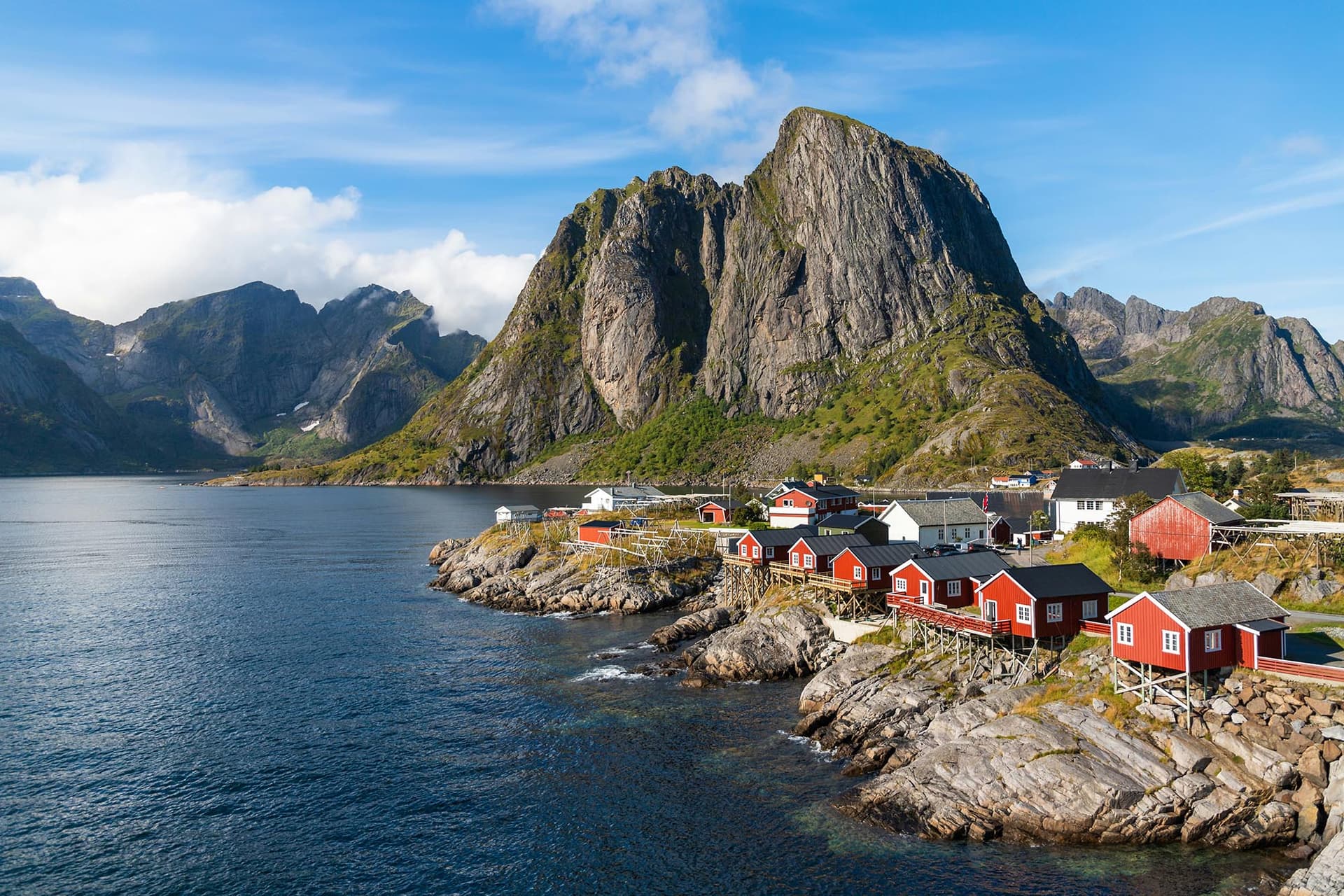
North to south: beauty in crescendo
You land at Harstad/Narvik (Evenes airport), pick up your car at the counter, and off you go. No ferry, no timetable to catch, no queue.
And above all: the landscapes build in intensity. Austvågøy is beautiful, Vestvågøy is spectacular, Flakstadøy is wild, and Moskenesøy blows you away. Reine, Hamnøy, Sakrisøy and Å come in the final days, when your eye is trained and you have the time to savour them.
South to north: the instant shock, then the comedown
You fly to Bodø, take the ferry to Moskenes, and you're in the postcard scenery the moment you step off the gangway. It's overwhelming, in the best way.
The problem comes afterwards. Everything else winds down in intensity, and you end up in Svolvær, which is a small service town. On a week-long trip, you can manage it. On five days, it's a waste of dramatic build-up.
The real advantage of the south: the Oslo–Bodø train, one of the most beautiful rail journeys in Europe, and sometimes a gentler airfare.
On five days, what you're protecting above all is your time. A three-hour queue at the Moskenes terminal on 14 July is a fifth of your trip going up in smoke on the tarmac of a car park.
My verdict, plainly: north to south. For a 4-to-5-day road trip, the Evenes option is more reliable, faster and more rewarding in terms of progression. For everything on the flight options, I've laid it all out in the guide how to fly to Lofoten.
Day 1: Evenes, Svolvær and the first night in Henningsvær
The road from Evenes to Svolvær
Google Maps says 2 hr. Allow 3 hr. The difference is your stops.
The E10 leaves the mainland, crosses the Tjeldsundet bridges, runs alongside fjords that look as though they were designed to be photographed, then passes through the undersea tunnels that form the backbone of the archipelago. You'll drive beneath the sea without realising it, apart from a slight pressure in your ears and a descent that seems to go on forever.
Fill up before entering the islands. Petrol stations are far apart, and fuel is more expensive on the archipelago.
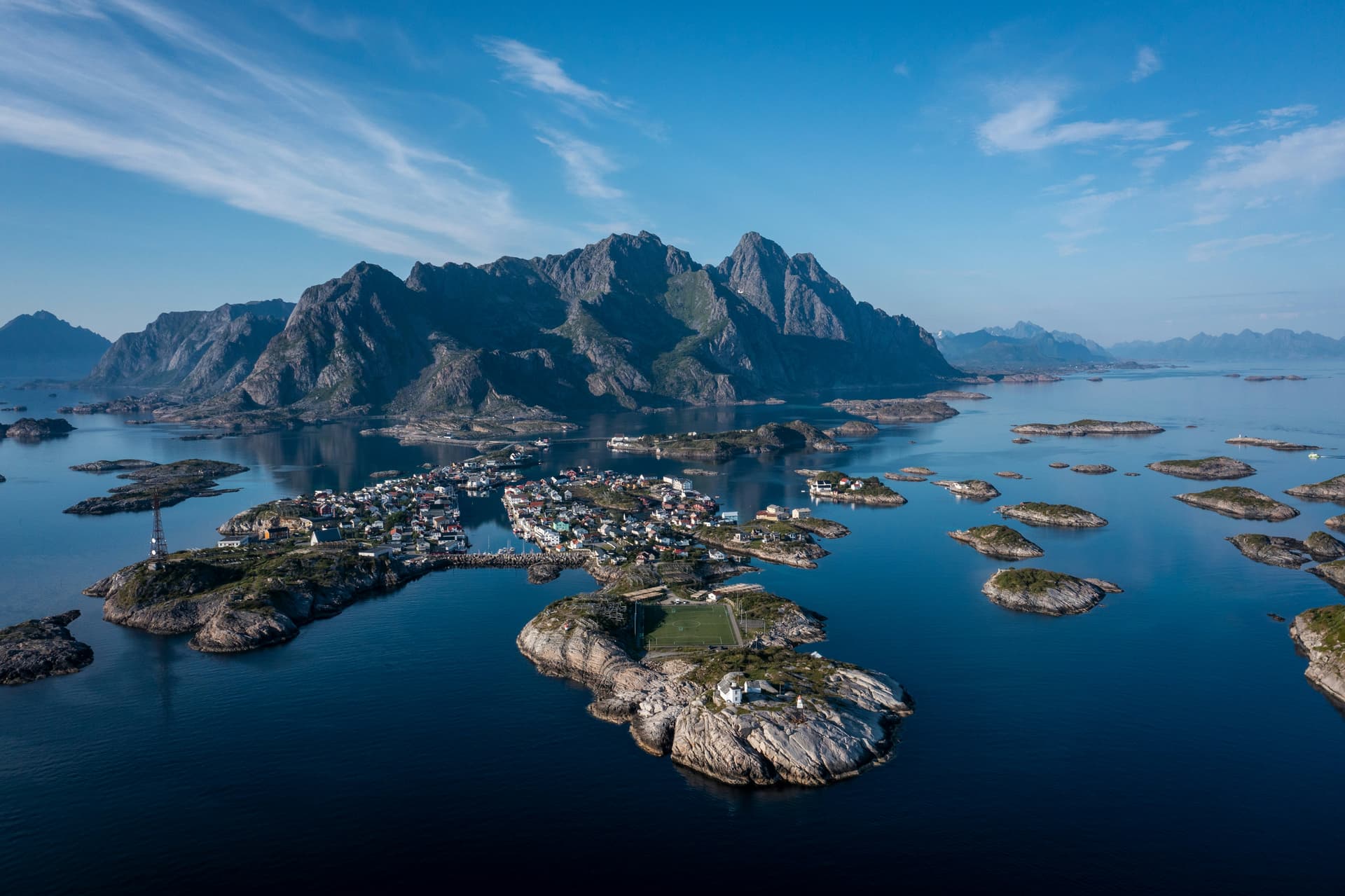
Svolvær: to pass through rather than visit
I'll be blunt. Svolvær is not a must-see. It's the administrative capital of Lofoten, with a decent supermarket, hotels, and architecture that tells no particular story.
What's worth the detour:
- Svinøya, the historic island connected by a small bridge, with its original rorbuer
- The Svolværgeita, the famous “Svolvær Goat,” two twin rock pinnacles visible from town
- The departure point for the Trollfjord cruise, if you have a half-day to spare
The Trollfjord is a case apart. It's a 100-metre-wide gash in the rock, and approaching it aboard a silent electric boat is one of the most powerful experiences in the archipelago. If your day 1 is sunny and you've arrived early, go for it. I've laid it all out in the guide to the silent Trollfjord cruise.
Kabelvåg, the stop everyone skips
Ten minutes past Svolvær, there's a village no one mentions. Kabelvåg was the historic centre of Lofoten long before Svolvær existed.
It's quiet to the point of being unsettling. I walked there for a whole June afternoon without passing more than five people. The stroll along the fjord to the lighthouse takes forty minutes, and the wooden church of Vågan, the largest in Northern Norway, rises in the middle of nowhere like a stranded cathedral.
Henningsvær: sleeping in the most photogenic village in the archipelago
You arrive on a narrow road that hops from islet to islet, and the village appears all at once: white and ochre houses clustered around a harbour, cod-drying racks slicing the sky, and a smell of dried fish that catches in your throat the first time. It's raw, it's alive, and it's still a real fishing village.
Spend the evening walking. The harbour, the workshops, the galleries. And if you have a drone, head up to the right of the bridge, towards the drying racks and the football pitch.
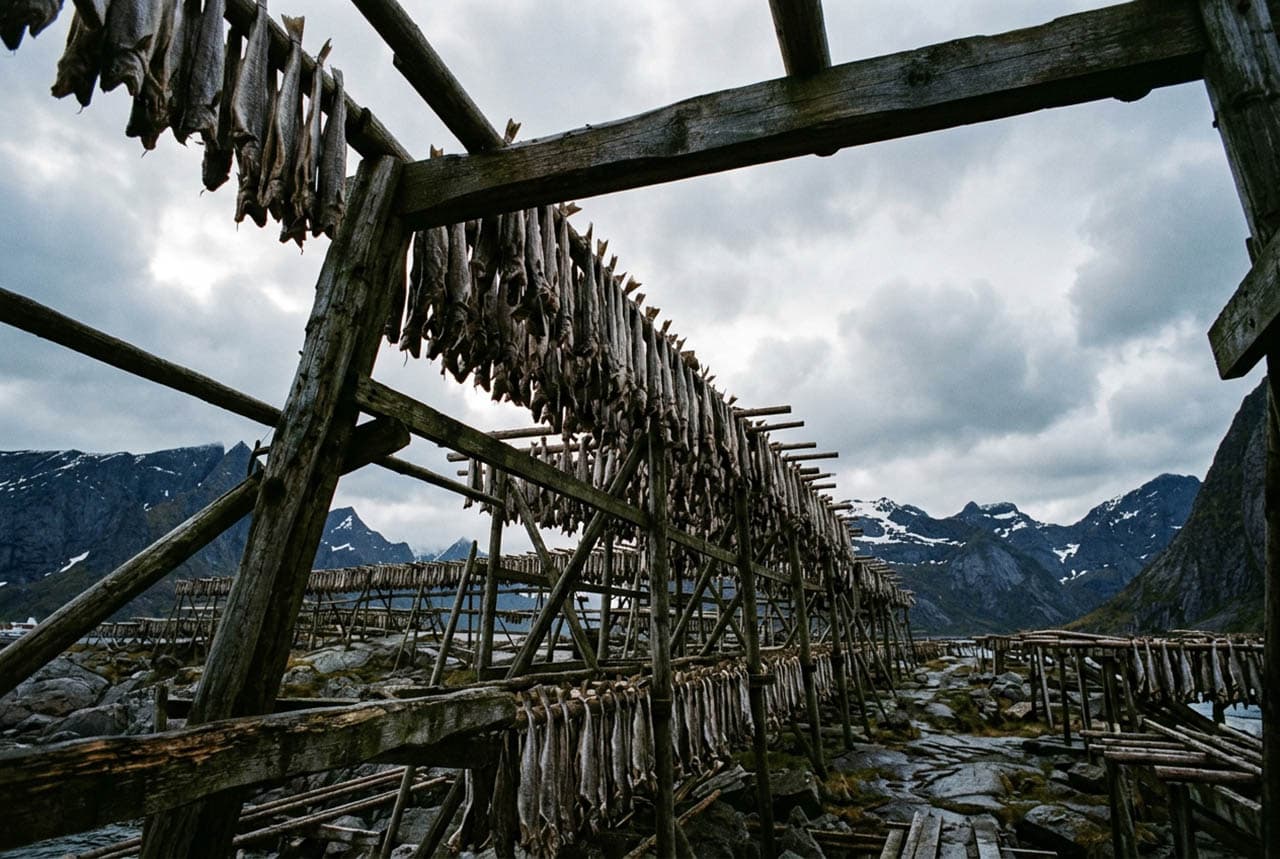
If you want to dig deeper into the village, it's all in the complete guide to Henningsvær. And on the road between Svolvær and Henningsvær, the Lofotr Viking Museum is a good fallback if the sky closes in.
Day 2: Vestvågøy, the Arctic beaches and Uttakleiv
This is the day that shatters the most assumptions. You're at 68 degrees north and you're about to see turquoise water.
Haukland Beach, Caribbean water at Baltic temperatures
You come round a bend, and there it is: a crescent of white sand, water turning emerald green, and black mountains hemming it in on both sides. It takes the brain a moment to reconcile the two.
The water is 10 or 12 degrees in July. People swim in it. I was one of them, once, briefly, and I only recommend the experience to people who enjoy remembering their bad ideas.
Parking is now paid, as at most major sites in the archipelago. Expect a few dozen kroner, payable by app or ticket machine.
Just above, the Mannen trail climbs in about an hour. The effort-to-panorama ratio is the best in the whole archipelago: from the summit, you take in Haukland and Uttakleiv at once.
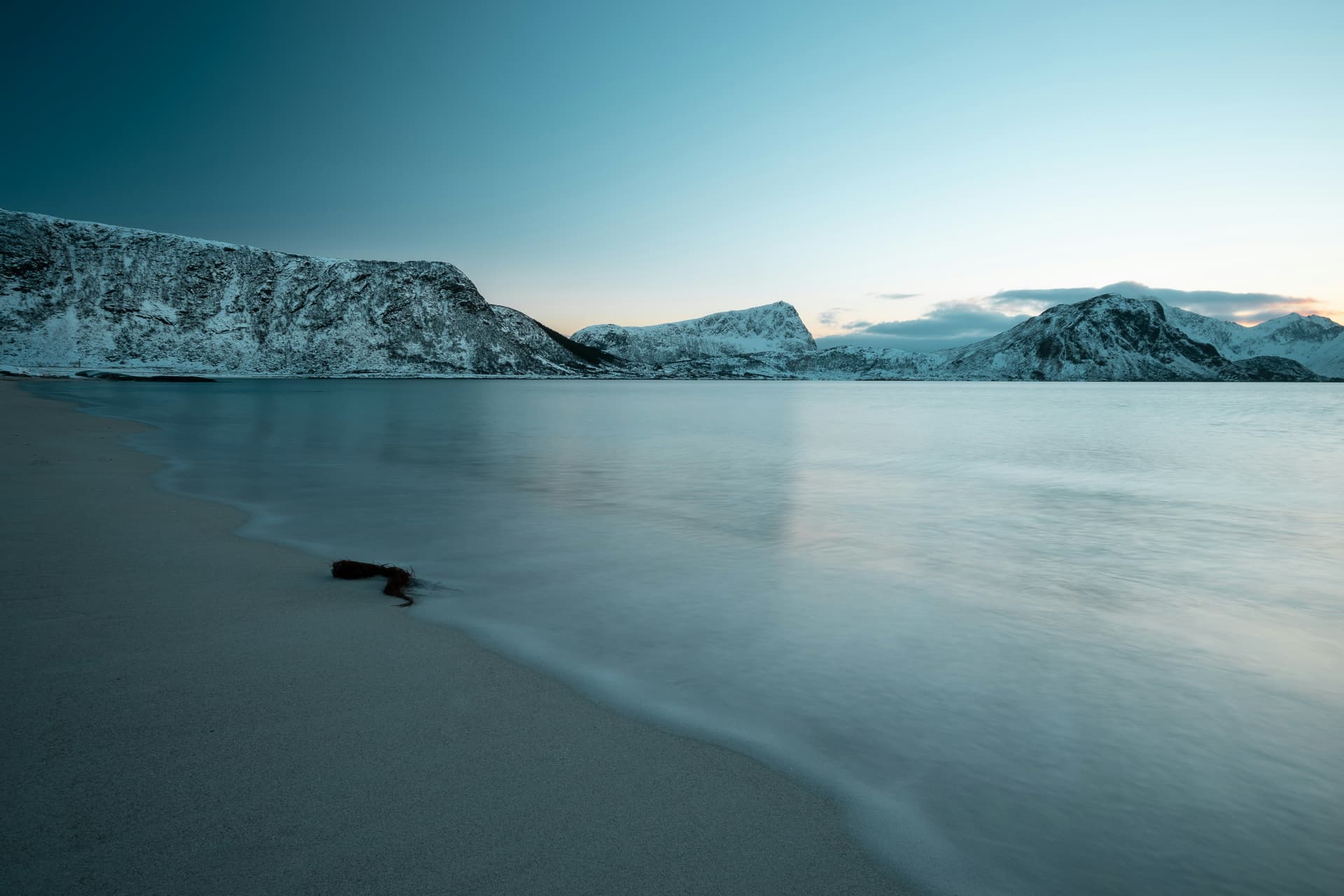
Uttakleiv, the photographers' spot
A narrow tunnel separates Haukland from Uttakleiv, and it's another planet. Where Haukland is gentle, Uttakleiv is raw and mineral. Tall swaying grasses, polished rocks, the famous Dragon's Eye, that circular water-filled hollow that mirrors the sky.
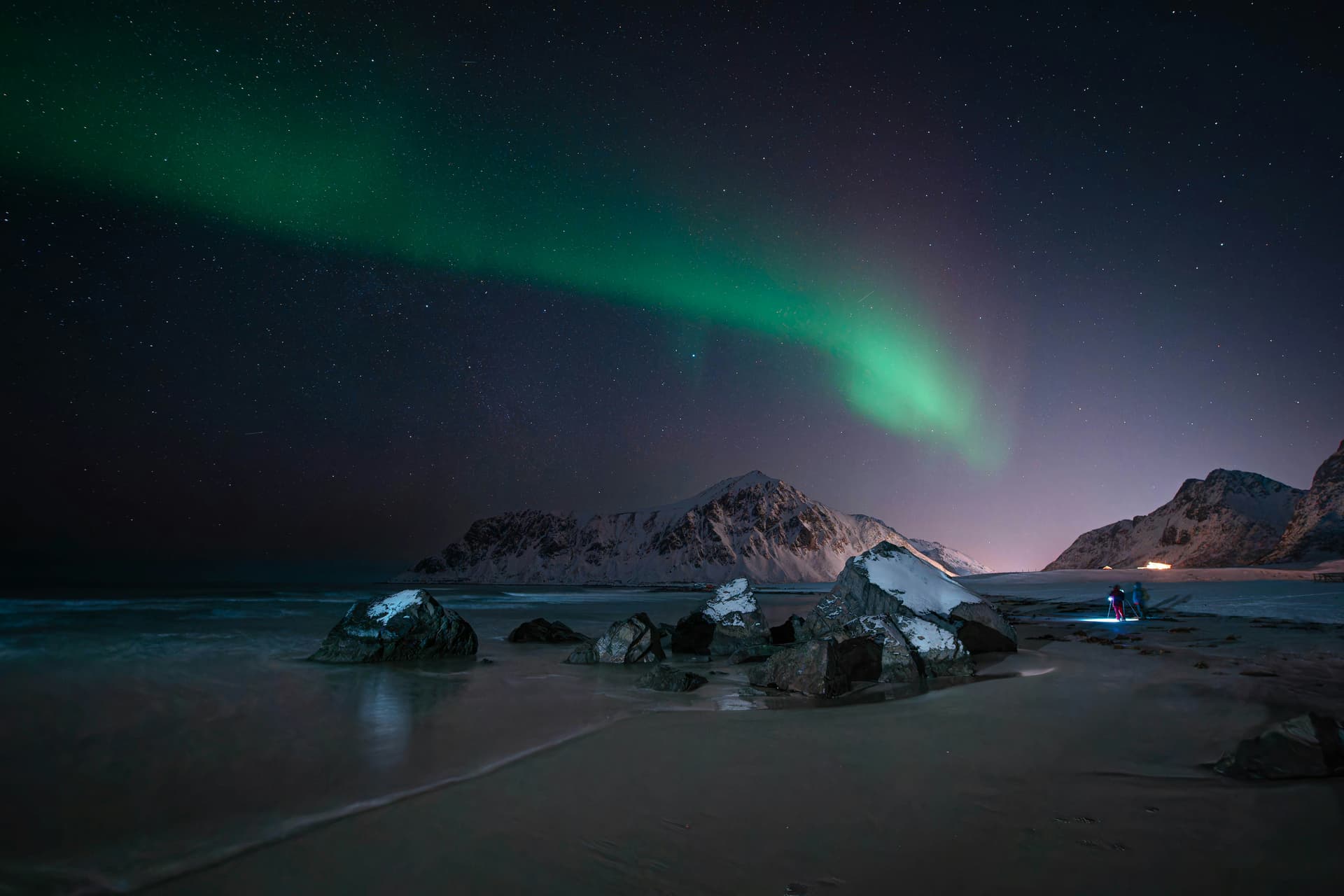
Its due-north orientation makes it the best northern-lights spot in the archipelago in winter. In June, under the midnight sun, it's a different show: the light circles around you for hours without ever disappearing.
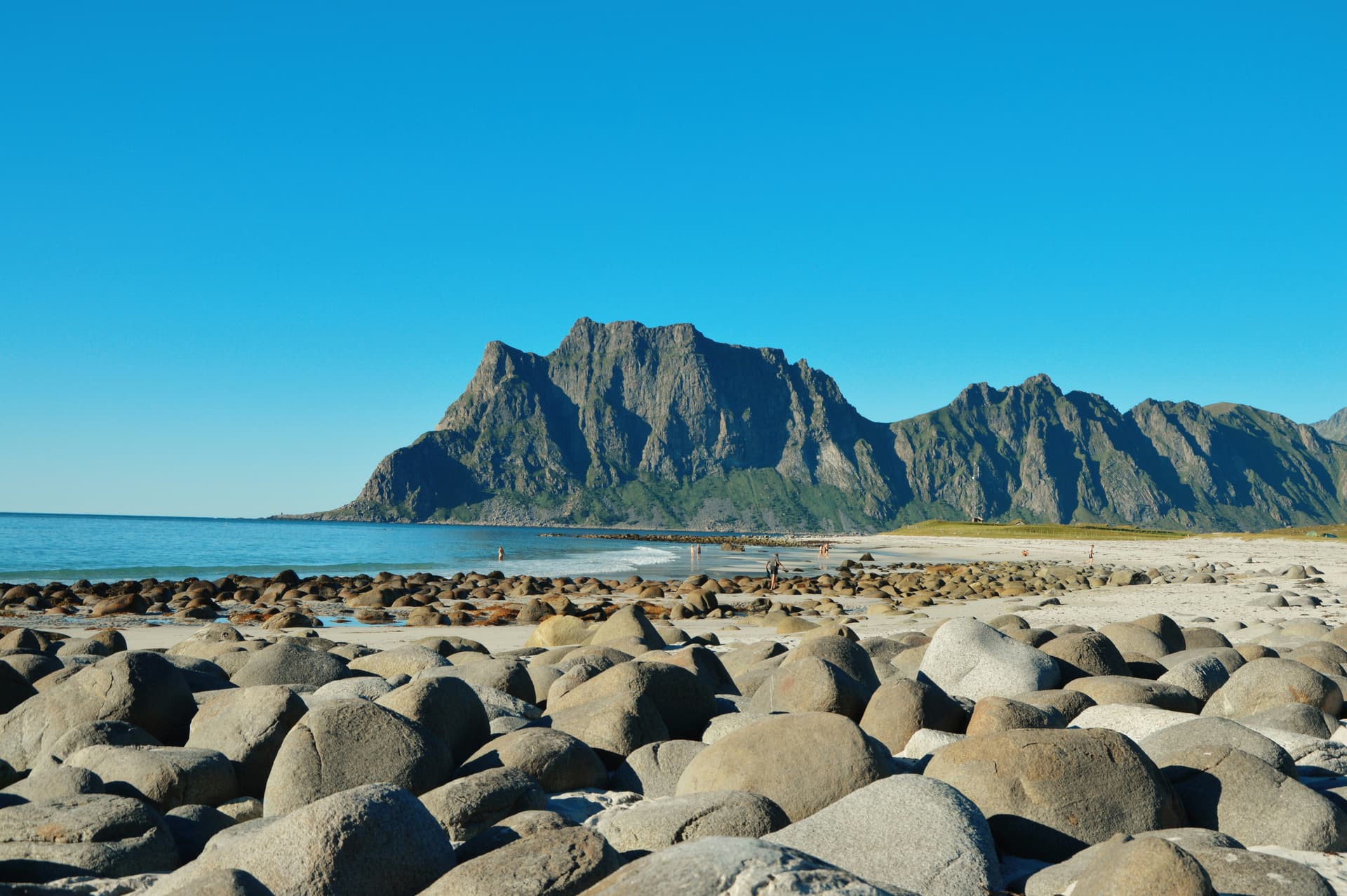
Unstad and Arctic surfing
A valley opening onto the ocean, a surf camp, a café, and people in thick wetsuits wading into freezing water with a smile. Unstad is one of the northernmost surf spots in the world, and the vibe is offbeat, almost Californian, under a sky that's anything but.
If the weather's with you, the coastal trail between Eggum and Unstad is superb. Allow 2 to 3 hr for the most beautiful stretch.
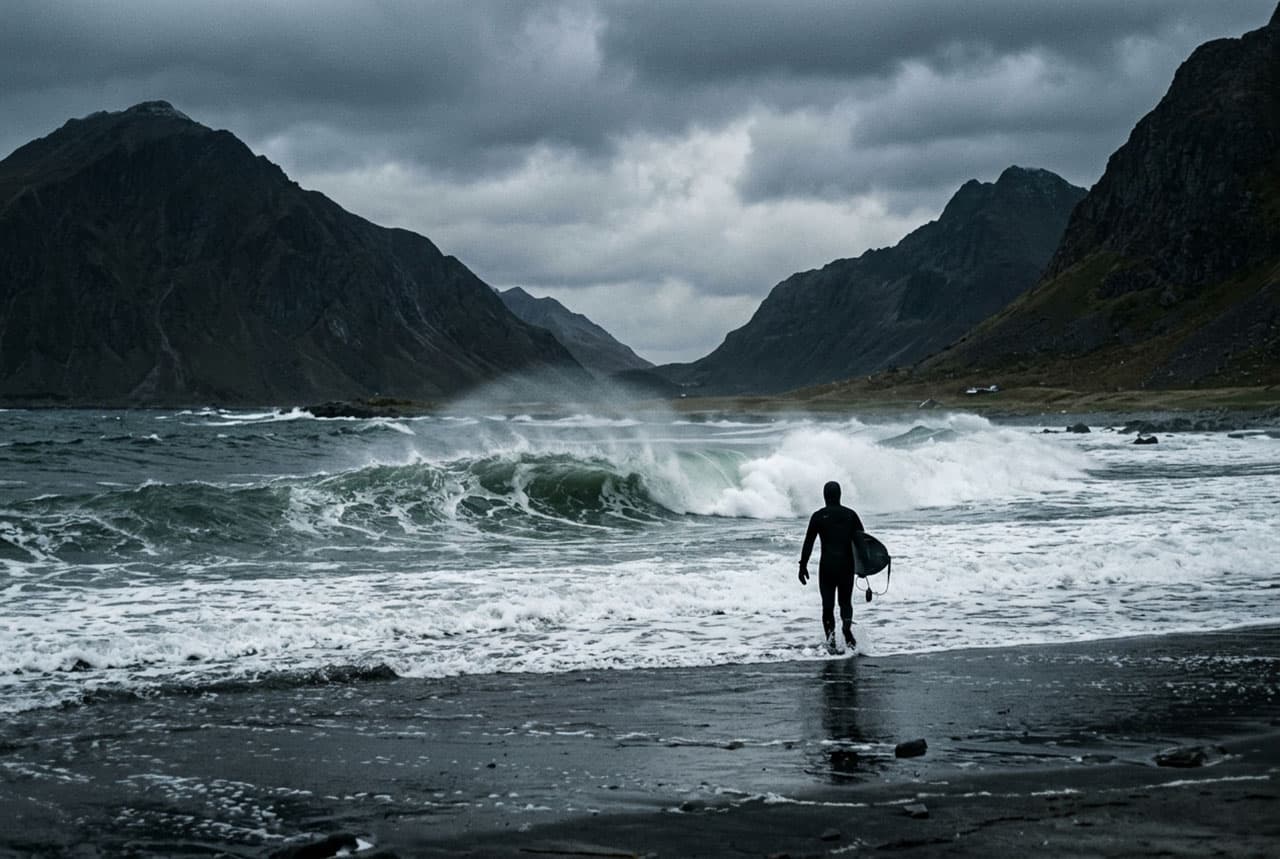
Alternatives if the weather gives out
Statistically, you'll have at least one grey day out of five. Here are the fallbacks that hold up on Vestvågøy:
- The Lofotr Viking Museum at Borg, a reconstruction of a Viking chieftain's longhouse. Well done, indoors, and informative.
- Lofoten Glas, a glassblowing workshop where you can watch the craftsman at work. It's very warm inside, which is no small argument.
- Leknes, for supplies. The Huset Kafe there is well above the local average.
- Ballstad, a still-active fishing port, less touristy than Henningsvær.
To go further on the beaches, I have a guide dedicated to Haukland Beach, another on Uttakleiv Beach, and a full ranking of the most beautiful beaches in Lofoten. If you're travelling with children or without mountain experience, look instead at the best beginner hikes in Lofoten.
Day 3: Flakstadøy, Nusfjord and the hike to Kvalvika
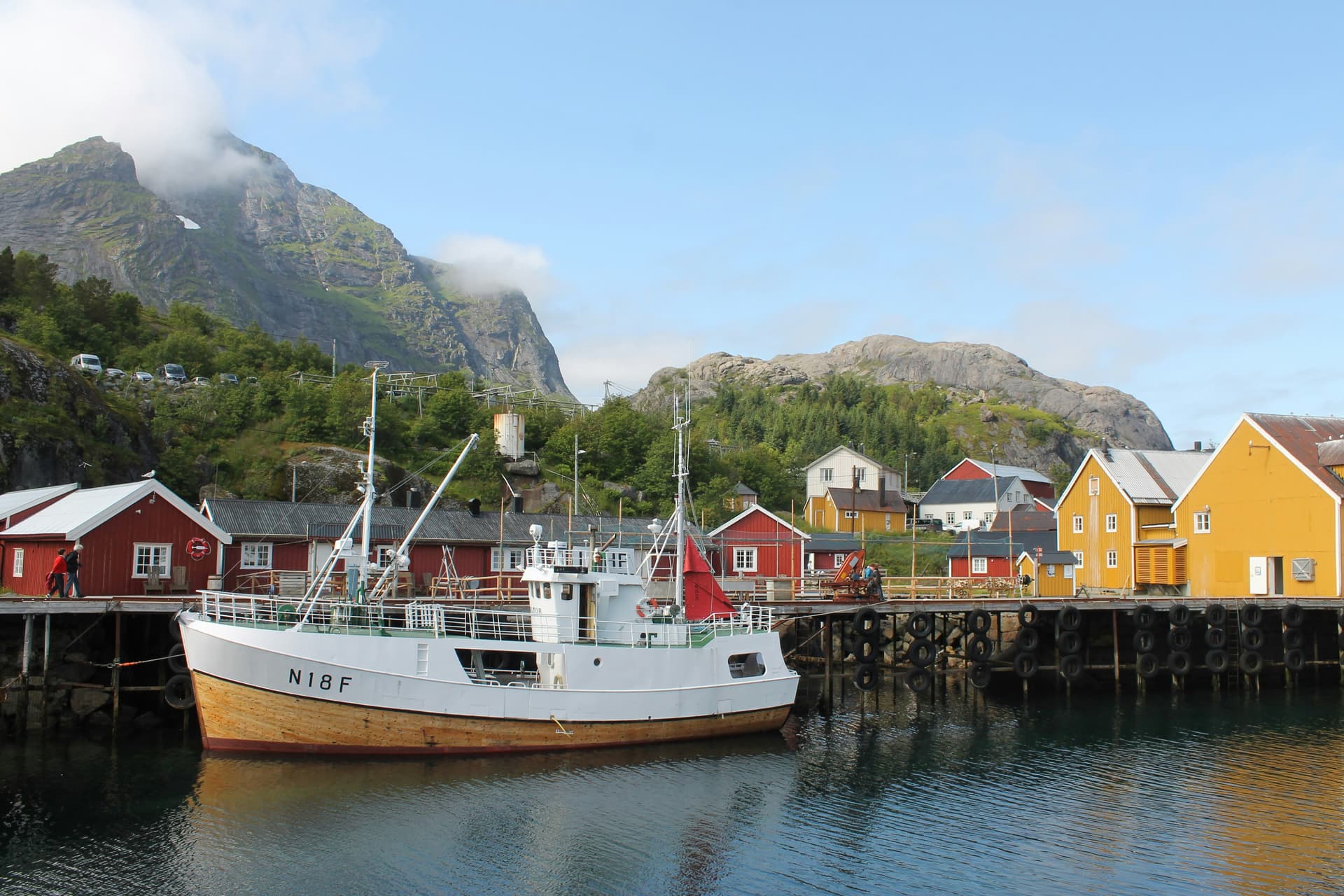
Nusfjord, the museum-village
Nusfjord is the best-preserved fishing village in Lofoten. It's listed, restored, immaculately maintained. And you visit it for an entrance fee.
Let's be honest: it's surprising, and slightly annoying. You pay to walk around a village. But Nusfjord is no longer quite a village; it's a heritage ensemble maintained by a foundation, and the entrance fee funds that upkeep. Once you accept the principle, the place is magnificent: the tucked-away harbour, the rorbuer in a row, the silence, and one of the best cafés in the archipelago.
Ramberg and Flakstad, the beach no one photographs
Ramberg is a service village with a petrol station and a supermarket. Right next to it, a white-sand beach almost no one shoots, because it's lined by the road.
That's precisely what makes it interesting. You park on the verge, cross over, and you have an Arctic beach to yourself. Two kilometres away, the red church of Flakstad, in painted wood, stands out against the mountains like an exclamation mark.
Kvalvika Beach and Mount Ryten
This is the flagship hike of Flakstadøy, and you have two options.
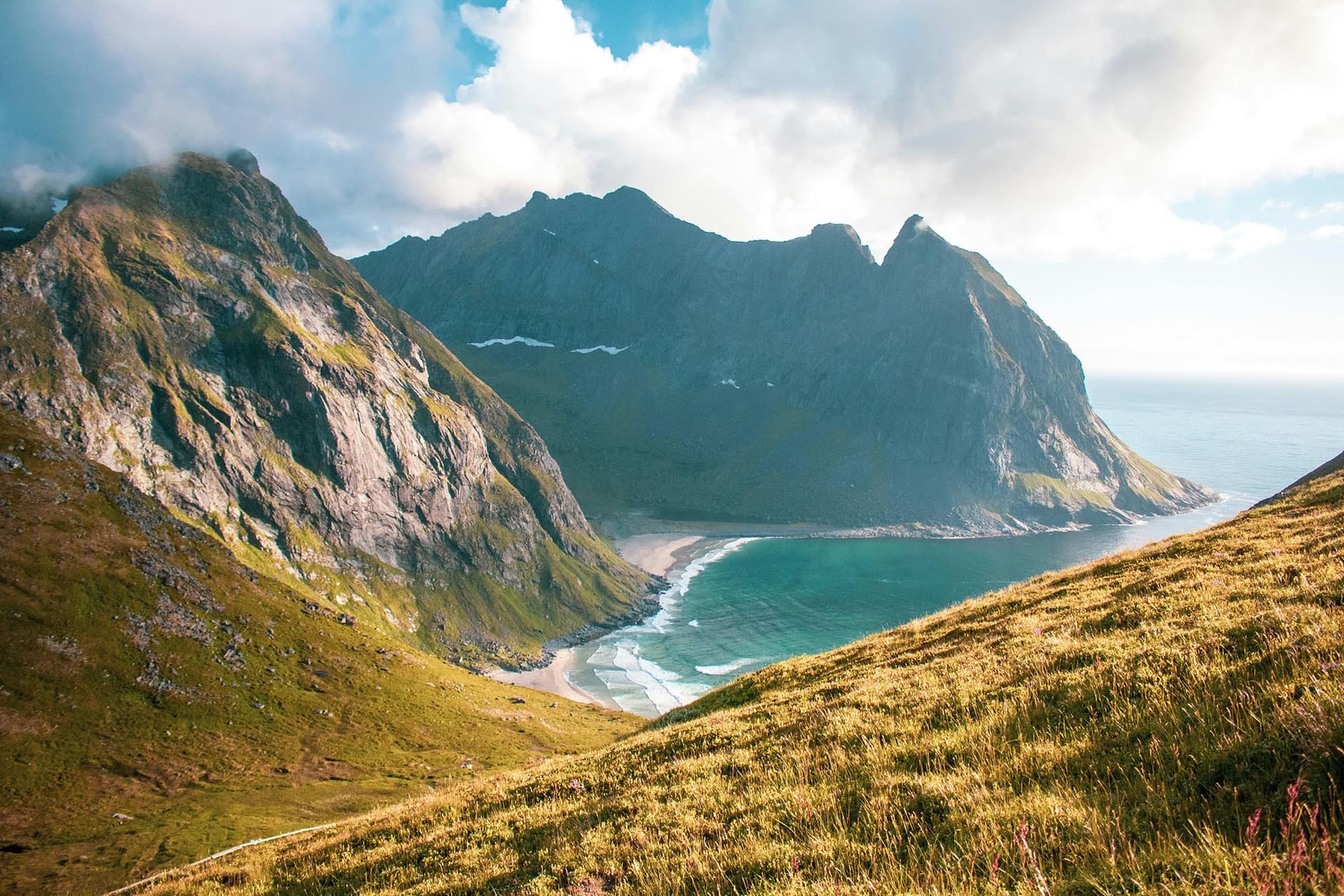
Kvalvika alone: about 2 hr round trip from the Torsfjord car park, with a pass to cross. The beach is completely isolated, reachable only on foot, and the contrast between the effort and the reward is striking. This is where two Norwegians spent nine months in a cabin made of driftwood, a story told in the documentary North of the Sun.
Kvalvika plus Ryten: allow 4 to 5 hr in total. The summit of Ryten offers the plunging view over Kvalvika that has become one of the most reproduced images of Lofoten. The climb is real but gradual, with no technical section.
Day 4: Moskenesøy, Reinebringen, Reine and Å
This is the day you've been waiting for since the very first bend on the E10.
Reinebringen: the steps and the most famous view in Norway
Reinebringen used to be climbed by a churned-up mud path that regularly sent people to hospital. Since the work carried out by teams of Nepalese sherpas, a stone staircase climbs the mountainside. Around 1,500 steps, cut and set by hand.
What to know before you set off:
- Park at the Reine visitor centre car park. Parking near the Ramsvik tunnel is prohibited and ticketed.
- Allow 1.5 km of flat walking to the foot of the steps. Think of it as the warm-up.
- Ascent: 45 min to 1 hr 15 depending on your fitness. Descent: 40 min, and that's when the knees start talking.
- Realistic total with breaks and time at the top: 2 hr 30 to 3 hr.
On timing, everyone will tell you to go early in the morning. My experience says otherwise: in June and July, with the midnight sun, late afternoon is often quieter. I climbed at 5 pm on a glorious day expecting to queue on the steps. There were people, nothing unmanageable, and the light was incomparably better than at 9 am.
All the practical details are in the Reinebringen hiking guide.
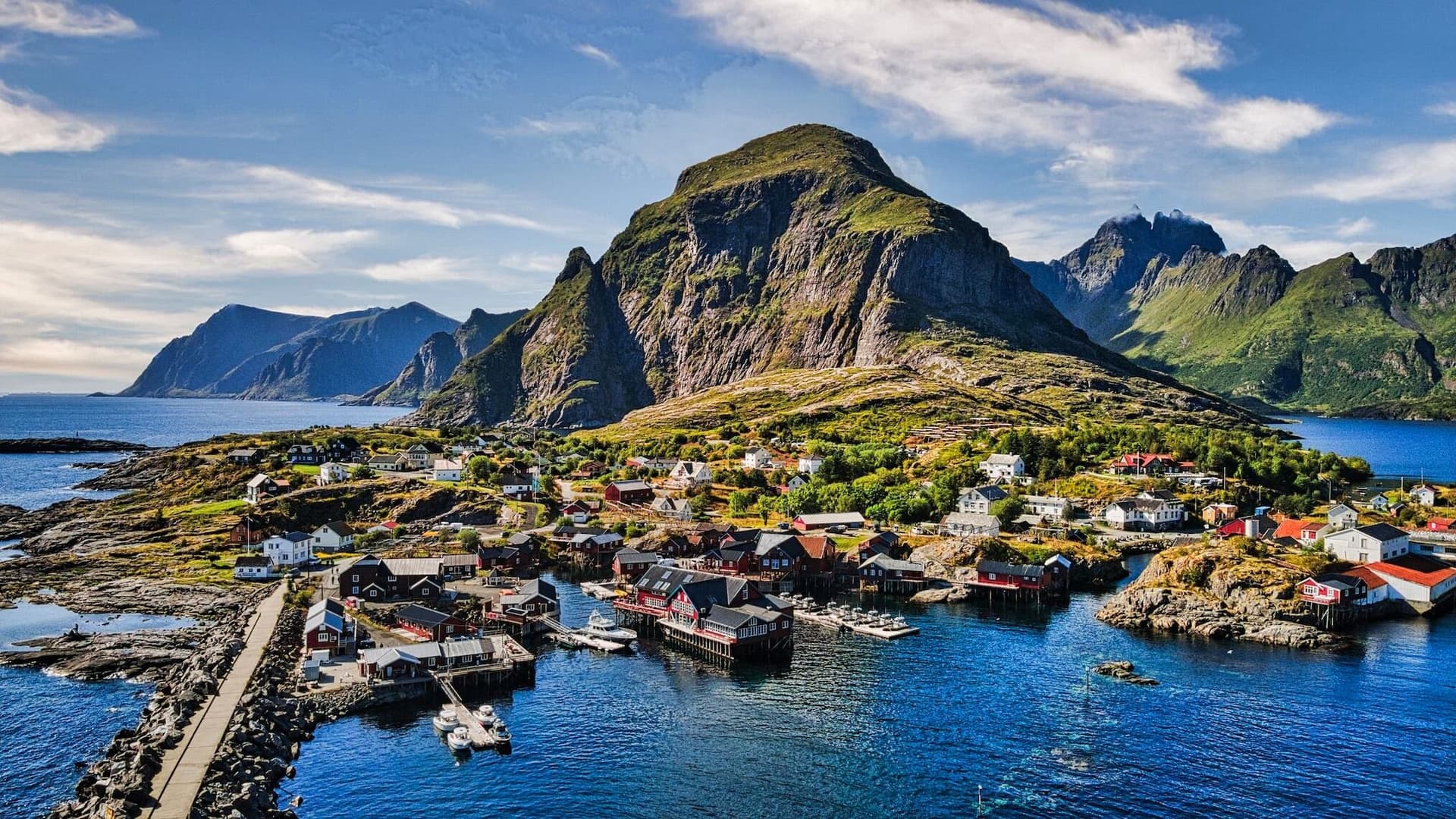
Reine, Sakrisøy and Hamnøy: the postcard triangle
Three villages over three kilometres, linked by bridges, and a density of beauty that becomes almost absurd.
Hamnøy and its bridge. The photo spot is on the bridge itself, looking at the red rorbuer at the foot of the mountains. It's the image of Lofoten. Park in the designated car park, not on the bridge.
Sakrisøy and its ochre houses, a colour that contrasts with the dominant red. The village fits on a pocket handkerchief.
Reine, the harbour, the bay, the jagged sawtooth mountains all around. It's the village that made the archipelago's reputation, and it doesn't disappoint.
Å, the village at the end of the road
The shortest name in Norway, and the last letter of the Norwegian alphabet. It's also, literally, the end of the E10: the road stops, there's nothing beyond.
The fishing-village museum occupies the original buildings: the cannery, the forge, the bakery that still bakes its cinnamon buns in the historic oven. It's small, it's authentic, and you can visit it in an hour.
Good places to eat on Moskenesøy
- Anita's Sjømat in Sakrisøy, for the smoked-salmon burger. It's the local institution, and deservedly so.
- Bringen Kaffebar in Reine, for the cinnamon rolls. Seriously.
- Gammelbua in Reine, for a proper sit-down meal, with fish that hasn't travelled far.
The complete guide to visiting Reine covers the whole area in detail.
Day 5: three ways to end the road trip
Day 5 is your free day. It's also the day the weather will decide for you. Three scenarios, in order of preference.
Option 1: Bunes Beach, the beach no one reaches
Ferry from Reine to the hamlet of Vindstad, then about 1 hr of easy walking through a valley. At the end: an immense sandy beach set between cliffs, with no road, no car park, no one.
It's the closest experience to what Lofoten was before Instagram. Check the ferry times the day before, there are few of them, and plan your return with a margin.
Option 2: Værøy, the island beyond
Ferry from Moskenes, a little over an hour's crossing. Good news: the service is now free, including for cars.
Once there, the Håen hike is short (about 3 km) and opens onto a panorama unlike anything else in the archipelago. There are also puffin colonies and secret beaches reachable by boat.
It's the option for those who want to play the “nobody goes there” card. The risk: the ferry timetable is restrictive, and a day on Værøy costs you your entire day 5.
Option 3: the leisurely drive back to Evenes
The sensible choice, and probably the right one if your flight leaves the next morning. Allow 5 hr of driving from Reine, not counting stops.
Use it to revisit the places you skipped on the way down: the Fv888 road on the north-western tip of Austvågøy, a detour via Stamsund, or simply driving with no goal and stopping when the mood takes you. It's often the best day of the trip.
The 4-day version: what you have to sacrifice
Only have four days? It's doable. Here's how I compress it, and above all what I drop.
| Day | 5-day version | 4-day version |
|---|---|---|
| 1 | Evenes, Svolvær, Kabelvåg, overnight Henningsvær | Evenes, Henningsvær late in the day, overnight Henningsvær |
| 2 | Vestvågøy beaches, overnight Ballstad | Haukland, Mannen, Uttakleiv, then drive straight to Reine. Overnight Reine |
| 3 | Flakstadøy, Nusfjord, Kvalvika, overnight Reine | Reinebringen, Hamnøy, Sakrisøy, Å. Overnight Reine |
| 4 | Reinebringen, Reine, Å, overnight Reine | Drive back to Evenes with a stop at Ramberg and Flakstad |
| 5 | Bunes, Værøy or the drive back | Cut |
What you actually sacrifice: Nusfjord, Kvalvika and Ryten, Unstad, Værøy and Bunes. And above all Kabelvåg, which is always the first to go even though it's one of the prettiest villages.
What you keep: Henningsvær, the Vestvågøy beaches, Reinebringen, and the whole Reine–Hamnøy–Å triangle. In other words, the essentials.
In four days, you'll see Lofoten. In five days, you'll live it. The difference comes down to one thing: weather margin. On four days, a rainy day costs you 25% of your trip. On five, you absorb it.
How to get to Lofoten
By plane via Harstad/Narvik (Evenes)
The option I recommend. Air France generally runs a direct flight from Paris from mid-June to late August, around 3 hr 40 of flying. Outside that window, you go via Oslo, with a stopover that lengthens the day but stays simple.
The airport is small, you get out quickly, and the rental desks are in the hall. You're on the E10 twenty minutes after landing.
By plane via Bodø, then ferry
Bodø is well served from Oslo and Bergen, with daily flights. The airport is about 3 km from the ferry terminal, which is almost negligible.
The Bodø–Moskenes line is operated by Torghatten Nord. Allow about 3 hr 15 for the crossing. The fare for a standard car under 6 metres, driver and passengers included, is around 950 to 1,100 NOK, or about €90 to €105. Foot passengers travel free if they turn up without a booking; they simply take your name at boarding.
The critical point: only part of the capacity can be booked online, the rest works first-come, first-served. In July, that means arriving very early and waiting. The booking supplement guarantees your place and costs a few hundred kroner depending on the ticket type. On a five-day trip, it's money well spent.
The Leknes and Svolvær airports
They exist, they're in the heart of the archipelago, and they're convenient. But rotations are infrequent, the planes are small, and fares are high. Only worth considering if you find a connection that works well from Oslo or Bodø.
By train to Bodø
Oslo–Bodø, an overnight train, and Bodø is the terminus of the Norwegian rail network. It's slow, it's beautiful, and it genuinely makes sense if you combine Lofoten with the south of the country. On a 4-to-5-day format, it eats too much time.
Renting a car for your Lofoten road trip
Exploring Lofoten without a car is a real challenge. There are buses, they're infrequent, and they don't serve any of the trailheads that make the archipelago worth it. A car isn't a comfort option, it's the entry requirement.
What you absolutely need in the contract
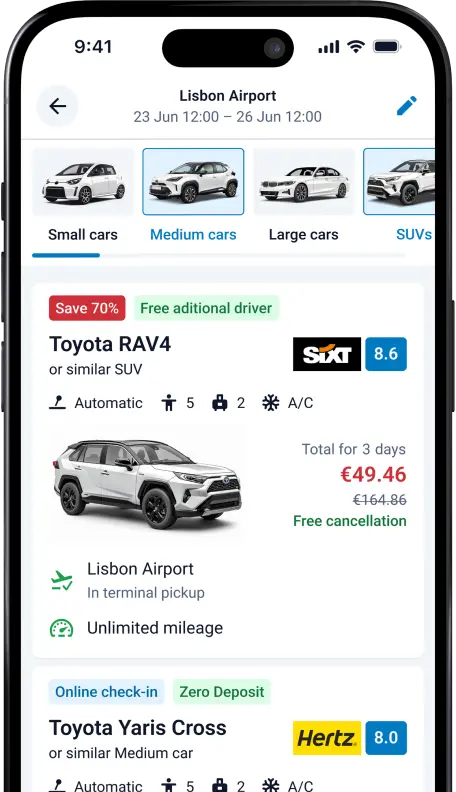
- Unlimited mileage. Non-negotiable. You'll cover between 400 and 600 km over five days, and Norwegian mileage packages are punishing.
- Free cancellation. Flights to northern Norway get cancelled or shifted. You want to be able to move.
- A bank card in the main driver's name. No rental company bends on this, and it's the number-one reason for refusal at the counter.
- Suitable tyres if you travel outside the summer season. They're mandatory and checked.
Where to rent
Evenes offers the best choice-to-price ratio and saves you the ferry. Bodø is often a little cheaper but you add the cost and constraint of the crossing. Leknes and Svolvær are convenient but the fleet is limited and prices soar in summer.
Book early. The fleet available on the archipelago is finite, and in July it's entirely sold out weeks in advance.
The toll trap
Norway runs on AutoPASS, an automatic barrier-free toll system. You drive through, a camera reads your plate, and the bill arrives later. The problem: your rental company passes it on to you, often with an admin fee per transaction.
Ask at the counter how they handle tolls. Some offer a flat rate, others charge per toll with an administrative surcharge. The difference can reach several tens of euros over a trip.
DiscoverCars
Car rental comparison — 150+ countries
Compare prices from Hertz, Avis, Sixt and local providers. All fees included, free cancellation. Rated 4.6/5 on Trustpilot.

For all the details, I have a complete guide on how to rent a car in Lofoten, and another on the driving rules in Norway that will save you a few surprises. If you're considering an electric car, which is increasingly tempting in Norway, it's all explained in the guide to charging stations in Lofoten.
Budget for a 5-day Lofoten road trip
Let's say it straight away: Lofoten is expensive. Not “European expensive”, Norwegian expensive. Here are realistic ranges, per person, based on two travellers sharing the car and the accommodation.
| Item | Range over 5 days | Note |
|---|---|---|
| Return flights | €250 to €500 | Depending on the season and how far ahead you book |
| Car rental | €60 to €110 | Share per person, compact category |
| Fuel | €40 to €70 | About 500 km, petrol around €2 a litre |
| Ferry (if Bodø option) | €45 to €55 | Share per person, round trip |
| Accommodation | €350 to €700 | Rorbu €150 to €300 a night, guesthouse €90 to €150 |
| Food | €150 to €350 | Depending on the cook/restaurant ratio |
| Activities and parking | €50 to €150 | Trollfjord cruise, museums, parking |
| Total excluding flights | around €700 to €1,400 | That's €180 to €300 a day |
The Norwegian tourist tax: what you're told and what's actually true
You'll read everywhere that Lofoten has applied a 3% tourist tax since summer 2026. It's a shortcut, and a misleading one.
Here's what actually happened. In June 2025 the Norwegian Parliament passed the visitor contribution act, the besøksbidragsloven, which came into force on 1 July 2026. This law imposes nothing. It authorises municipalities to apply for permission to levy a contribution, capped at 3% of the net price of the overnight stay.
The points that change everything:
- It's voluntary. Each municipality must file an application and demonstrate that tourism is straining its infrastructure. Then obtain approval.
- The six municipalities of Lofoten (Røst, Værøy, Moskenes, Flakstad, Vestvågøy and Vågan) are preparing a joint application. The Lofotrådet, their inter-municipal council, hired a dedicated person for this file in May 2026.
- The real timeline: even by filing as soon as the law takes effect, processing takes time. The first traveller to see the line item on their Lofoten bill will more likely be there in 2027 than in 2026.
- The exemptions: campsites, tent pitches, private campervans and private boats are not affected. The law targets hotels, guesthouses, rorbuer and short-term rentals.
- The money is earmarked. The revenue must go to tourist infrastructure: trails, public toilets, waste management, parking. Not to the municipality's general budget.
And to put the proportions back in perspective: on a 2,000 NOK night, 3% is 60 NOK, or less than €6. That's not what's going to blow up your budget. The line that will blow it up is the restaurant.
I've laid out the full picture in the article on the Norwegian tourist tax 2026. And if you're wondering why everyone is suddenly heading north, it's explained in our piece on the boom in Scandinavian coolcations.
The Norwegian krone, the real hidden cost
Here's what no one talks about: in Lofoten, you'll barely ever touch a banknote. Everything is paid by card, including trailhead parking via app, the ferry, the AutoPASS tolls and the €6 coffee.
Multiply that by five days, and your regular bank's currency conversion fees become a real budget line. Norway isn't in the eurozone, every transaction goes through an exchange rate, and the gap between a good rate and a bad one adds up to tens of euros over a trip.
It's one of the rare trips where the question of which bank card to use isn't an optimisation detail but a genuine cost. I've used Wise across the whole of Scandinavia for years, precisely for this.
Wise Card
Travel smart with the best exchange rate
Say goodbye to banking hassles abroad with Wise, the multi-currency card with superpowers!

The full detail is in our review of the Wise card for travellers.
When to go for a Lofoten road trip
| Period | Daylight | Temperatures | Crowds | Verdict |
|---|---|---|---|---|
| January–February | 2 to 4 hr of daylight | -5 to 2 °C | Low | Aurora, but not this road trip |
| March–April | Daylight returning fast | -2 to 5 °C | Moderate | Aurora and skiing, roads still tricky |
| May | 18 to 20 hr of daylight | 4 to 10 °C | Low | Underrated, but still snow at altitude |
| June | Midnight sun | 8 to 15 °C | Moderate | Our recommendation |
| July | Midnight sun | 10 to 18 °C | High | Our recommendation |
| August | Nights returning | 10 to 16 °C | High | Good compromise, wetter |
| September | 12 hr of daylight | 6 to 12 °C | Low | An alternative if you're escaping the crowds |
| October–December | Daylight collapsing | 0 to 6 °C | Very low | Many closures |
June and July: the window to aim for
This is when to go, and the argument isn't only about climate.
The midnight sun changes the nature of the trip. From late May to mid-July, the sun doesn't set. In practice, that means your day no longer has an end. You can climb Reinebringen at 10 pm, walk on Uttakleiv at midnight, and find yourself alone in golden light six hours after the buses have gone. It's the best anti-crowd weapon in the whole archipelago, and it's free.
Every trail is open. Kvalvika, Ryten, Reinebringen, the Mannen, Eggum–Unstad. In May, snow still blocks the high passes. In October, mud and black ice make the descents dangerous.
June is statistically the best weather window of the year. Early summer is the driest period in Lofoten. “The driest” is very relative, but on a five-day trip, slightly better odds change everything.
July is the opposite of a compromise. Temperatures are at their mildest, the beach water reaches its warmest, everything is open, everything is running. The price to pay is the campervans on the E10, the full car parks at Haukland by 11 am, and accommodation sold out since February.
If I had to choose between the two: June. You get the midnight sun at its peak, clear trails, and the crowds not yet at their maximum. July is still excellent, provided you're organised and shift your timing.
September, the alternative for those escaping the crowds
The trails are still walkable, the first northern lights return, prices drop, and you have the archipelago almost to yourself. The trade-off: no more midnight sun, more rain, and days that shorten fast. It's a different trip, more contemplative, less about ticking things off.
Winter, and why this itinerary doesn't apply
A five-day Lofoten road trip in February isn't the same trip with gloves on. You get four hours of usable light, icy roads where I've seen several cars in the ditch, and half the sites on this itinerary are either closed or inaccessible.
Winter in Lofoten is magnificent, but it calls for a different itinerary, slower, more geographically concentrated, and often with guided excursions rather than driving on your own. If that's your plan, start by reading why Lofoten is the ideal archipelago for the northern lights.
Where to stay on this itinerary
The overnight logic, in short: Henningsvær on day 1, Ballstad or Leknes on day 2, Reine or Hamnøy on days 3 and 4. You keep the suitcase unpacking down to three moves, and each time you sleep less than twenty minutes from the next morning's first stop.
The rorbu, the experience not to miss
A rorbu is a traditional fisherman's cabin, built on stilts over the water, painted in iron-oxide red. Historically, it was the seasonal lodging for the men who came to fish for cod.
Today, a good number have been converted into tourist accommodation, with a fitted kitchen, heating and sometimes a sauna. Sleeping in a rorbu at Hamnøy, waking to the water lapping under the floor and a mountain in the window, is the kind of memory that justifies the price.
And the price is real: expect €150 to €300 a night in summer for a decent rorbu. Guesthouses and rooms in private homes drop to around €90 to €150. Campsites, at around €40 a pitch, remain the most economical option, and they're exempt from the future tourist contribution.
Driving in Lofoten: what you need to know
- The E10 is the only road. There's no alternative route. If it jams, you jam. If it closes, you don't get through.
- The undersea tunnels and bridges connect the islands. Some are long, steeply graded, and impressive the first time.
- The single-lane stretches with passing places exist on the secondary roads. The rule is simple: whoever has the passing place on their side stops.
- Parking is now paid at most major sites: Reinebringen, Haukland, Kvalvika, Uttakleiv. Have a payment app ready and a little patience with the network.
- Wild parking is ticketed. Locals have had enough of cars parked on the verges and people relieving themselves in gardens. It's not a caricature, it's the official reason put forward by the six Lofoten mayors for demanding the tourist tax.
- Norwegian fines are a deterrent. A modest speeding offence can cost several hundred euros. Drive at the limit, it's low, and that's fine: you're not in a hurry.
- The campervans. In July, they're everywhere, they're slow, and you won't overtake them. Factor them into your journey times.
Mistakes to avoid on a 5-day road trip
- 01Trying to see everything. Røst, Værøy, Senja and the Vesterålen in the same week is a map-lover's fantasy. You'll spend your trip in the car.
- 02Booking the car at the last minute. The archipelago's fleet is finite. In July, it's gone.
- 03Believing the Instagram photos. Blue-sky days and turquoise water are the exception, not the rule. The statistical everyday of Lofoten is grey and wind.
- 04Underestimating driving times. Google Maps doesn't count your forty photo stops. Add 50% to every estimate.
- 05Sleeping in Reine on the last night with an early flight from Evenes. Five hours of driving at 5 am after five days of hiking is a sad way to end a trip.
- 06Not stocking up in Bodø or Leknes. Village mini-markets are expensive and poorly stocked.
- 07Setting off without waterproof hiking boots. It's not about comfort, it's what decides whether you do your hikes or not.
To round it out, the guide to the 10 things to know before going to Lofoten covers the logistical points I haven't gone into here.
What no one tells you about Lofoten
I have to be honest with you, because otherwise this article would be worthless.
The weather is the number-one factor, and you don't control it. In Lofoten I met a traveller who'd driven 3,000 km by van from Austria to spend two months there. He left after six weeks, worn down by the cold, the rain and the wind. The perfect images you see circulating are extremely cherry-picked. Over five days, you might draw a blue week. You might also draw five days of white cloud ceiling and horizontal drizzle, and see nothing of what's in this article.
The archipelago has become very busy, and the locals say so. They're not grumps. Public toilets have had to close in the middle of the summer season because they were out of order. Twenty-four thousand inhabitants spread across tiny villages absorb, every summer, a flow that has nothing to do with what the infrastructure can handle. When you park properly and pay for your parking, it's not obedience, it's basic respect.
And it's expensive. A five-day Lofoten road trip for two, flights included, easily comes to €2,500. On a bad weather draw, it becomes a big €2,500 disappointment.
I'm not telling you this to put you off. I'm telling you because it's exactly why you should go with a flexible itinerary rather than a fixed programme. In Lofoten, rigidity is the only real enemy.
The traveller who comes home happy from Lofoten isn't the one who got lucky. It's the one who planned to swap their days around, who had a covered plan B for every leg, and who knew that a fjord in the mist is another form of beauty, not a failure.
Extending the trip: what comes after Lofoten?
If you have more time, or if Lofoten is one stage of a bigger journey:
- The Vesterålen and the Andøya scenic route: about 2 hr from Svolvær. Less spectacular, much quieter, and one of the best places in Norway for watching sperm whales. See the Andøya scenic route guide.
- Senja: about 3 hr. The island the Norwegians keep for themselves. The detail is in our article on the Senja scenic route.
- Tromsø: about 4 hr 30 from Svolvær. The capital of the Arctic, and a perfect base for winter. It's all in the complete guide to Tromsø.
And if you want to widen your list of stops on the archipelago itself, I've compiled 25 things to do in the Lofoten Islands.
FAQ: Lofoten road trip
How many days do you need to visit Lofoten?
Five full days on the ground is the right length for a first trip. Four days is still doable by compressing, but you lose all weather margin. Below four days, you only skim the archipelago. Seven days or more let you add Værøy, Røst or the Vesterålen.
Can you visit Lofoten without a car?
Technically yes, but the experience is greatly impoverished. The bus network exists but is infrequent and serves no trailheads. Taxis are very expensive. Without a car, you have to base yourself in one village and rely on guided excursions, which is a different way of travelling, not a road trip.
What's the best airport for Lofoten?
Harstad/Narvik (Evenes) is the most convenient. You pick up your car on arrival and you're about 2 hr from Svolvær with no ferry. Bodø is a good alternative if you want to enter from the south, but it means the Bodø–Moskenes crossing of about 3 hr 15.
Do you need to book the Bodø–Moskenes ferry in advance?
In high season, yes, without hesitation. Only part of the capacity can be booked online, the rest works first-come, first-served, and the July queues can cost you several hours. The booking supplement is modest compared with the time it saves you. In low season, turning up at the terminal is generally enough.
What budget should you plan for 5 days in Lofoten?
Expect around €700 to €1,400 per person excluding flights, or €180 to €300 a day based on two travellers sharing car and accommodation. Flights add €250 to €500. Accommodation and food are the two items that make the total swing from single to double.
Is there a tourist tax in Lofoten in 2026?
Not concretely yet. The Norwegian visitor contribution act came into force on 1 July 2026, but it only authorises municipalities to apply to levy up to 3% on overnight stays. The six Lofoten municipalities are preparing a joint application. Realistically, the contribution will appear on bills more likely in 2027. Campsites, tents and private campervans are exempt.
What's the best time for a Lofoten road trip?
June and July. The midnight sun gives you endless days, every trail is open, and June is statistically the driest window of the year. July is warmer but noticeably busier. September is the good alternative if you prefer calm to optimal conditions.
Is Reinebringen difficult?
It's physical but not technical. Around 1,500 stone steps cut by Nepalese sherpas, climbed in 45 min to 1 hr 15 depending on your fitness. There's no exposed section or scrambling. The descent is harder on the knees than the ascent. Allow 2 hr 30 to 3 hr in total, including the 1.5 km approach walk from the visitor centre car park.
In summary
Five days in Lofoten isn't enough to see everything. It's more than enough to understand why people keep coming back.
Enter from the north, come down slowly, keep your days interchangeable, and accept that the weather will write part of the script. The rest, the archipelago takes care of.

Âme Bohème exists thanks to you
Some links in this article are affiliate links. This means that if you book or purchase a product through these links, we receive a small commission — at no extra cost to you. It's thanks to this support that we can continue creating free, quality content.
You can also buy us a coffee, or follow us on Instagram and Facebook.
