
Chiang Mai is said to have more than 300 temples, several dozen of them inside the square of the old city alone, between the moat and what remains of the walls. You cannot see them all, and you do not need to: around fifteen are enough to understand the former capital of the Lanna kingdom, from its 14th-century brick chedis to an ubosot clad in silver by today's silversmiths.
I spent nearly three weeks in Chiang Mai, from 31 March to 19 April 2024, and a good part of my days in its temples. This guide covers the ones I photographed, in the old city, in the Wualai area and to the west: a little history, what to look at, the fee, opening hours, the rules and the best time to go. Then come two routes and my honest verdict.
Chiang Mai's temples at a glance
The rating out of 5 is my own: it reflects how interesting the place is, its condition and how crowded it gets.
| Temple | Area | Foreigner fee | Time to visit | My rating |
|---|---|---|---|---|
| Wat Chedi Luang | Old city, centre | About 50 baht | 1 hr | 5/5 |
| Wat Phra Singh | Old city, west | 40 baht | 45 min | 4.5/5 |
| Wat Sri Suphan | Wualai, south of the walls | 50 baht | 30 to 45 min | 4.5/5 |
| Wat Umong | Foot of Doi Suthep, west | Free | 1 to 1.5 hrs | 4.5/5 |
| Wat Chiang Man | Old city, north-east | Free | 30 min | 4/5 |
| Wat Phan Tao | Old city, centre | Free | 20 min | 4/5 |
| Wat Chet Yot | North-west, near the Superhighway | Free | 45 min | 4/5 |
| Wat Suan Dok | West, Suthep Road | Free | 30 min | 3.5/5 |
| Wat Lok Moli | North, just outside the moat | Free | 20 min | 3.5/5 |
| Wat Chet Lin | Old city, south-west | Free | 20 min | 3.5/5 |
| Wat Muen Tum | Old city, centre | Free | 15 min | 3/5 |
| Wat Phuak Hong | Old city, south-west | Free | 10 min | 3/5 |
| Wat Phra That Doi Suthep | Mountain, about 15km away | 30 baht | 1.5 hrs (plus travel) | 5/5 |
Wat Chedi Luang, the great collapsed chedi
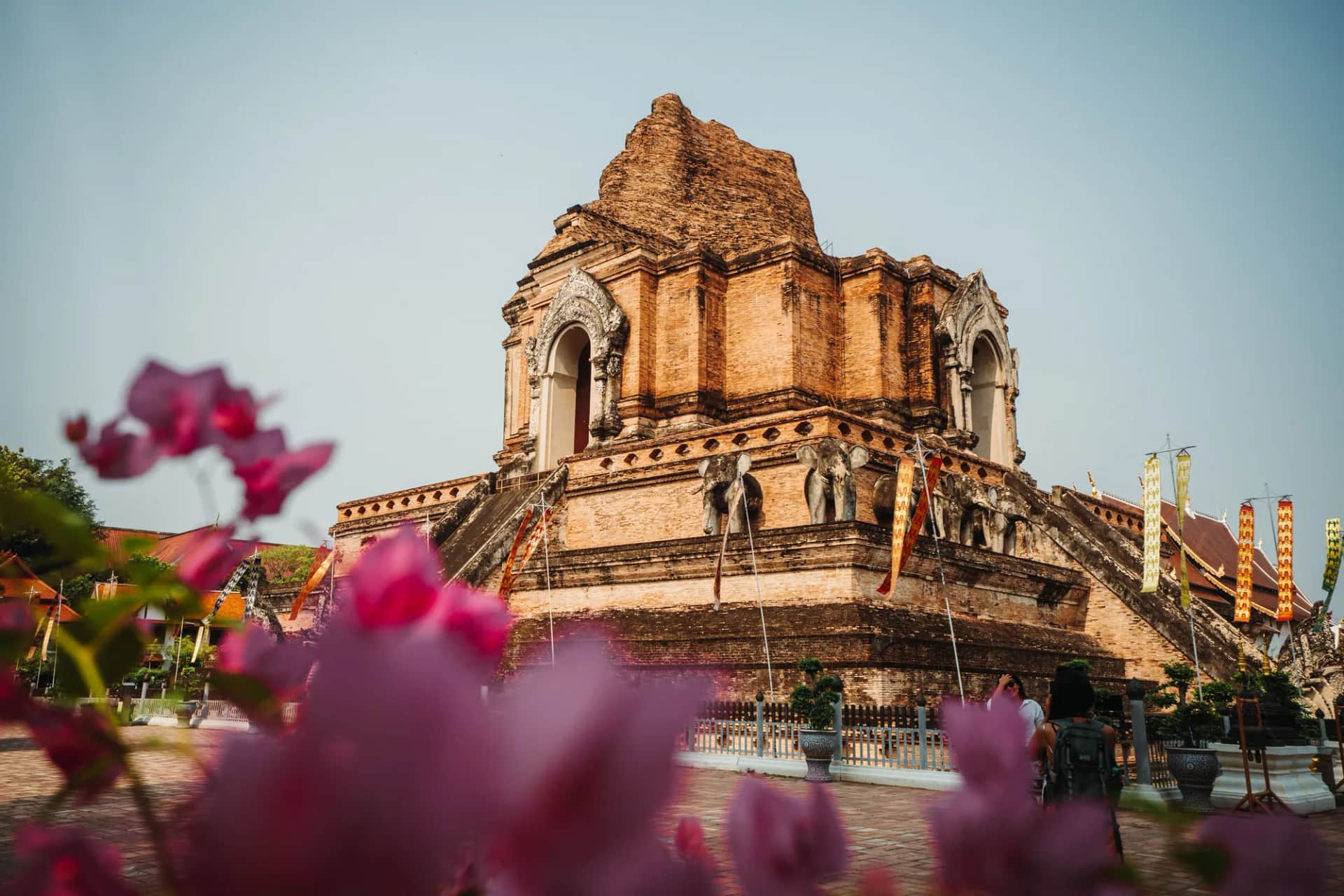
The great chedi of Wat Chedi Luang was begun at the end of the 14th century by King Saen Muang Ma, who wanted to enshrine his father's ashes there. It was only completed in the mid-15th century, under King Tilokarat. At that point it stood 82m high with a base 54m across: the largest building in the Lanna kingdom.
Photos : Pierre Bouyer
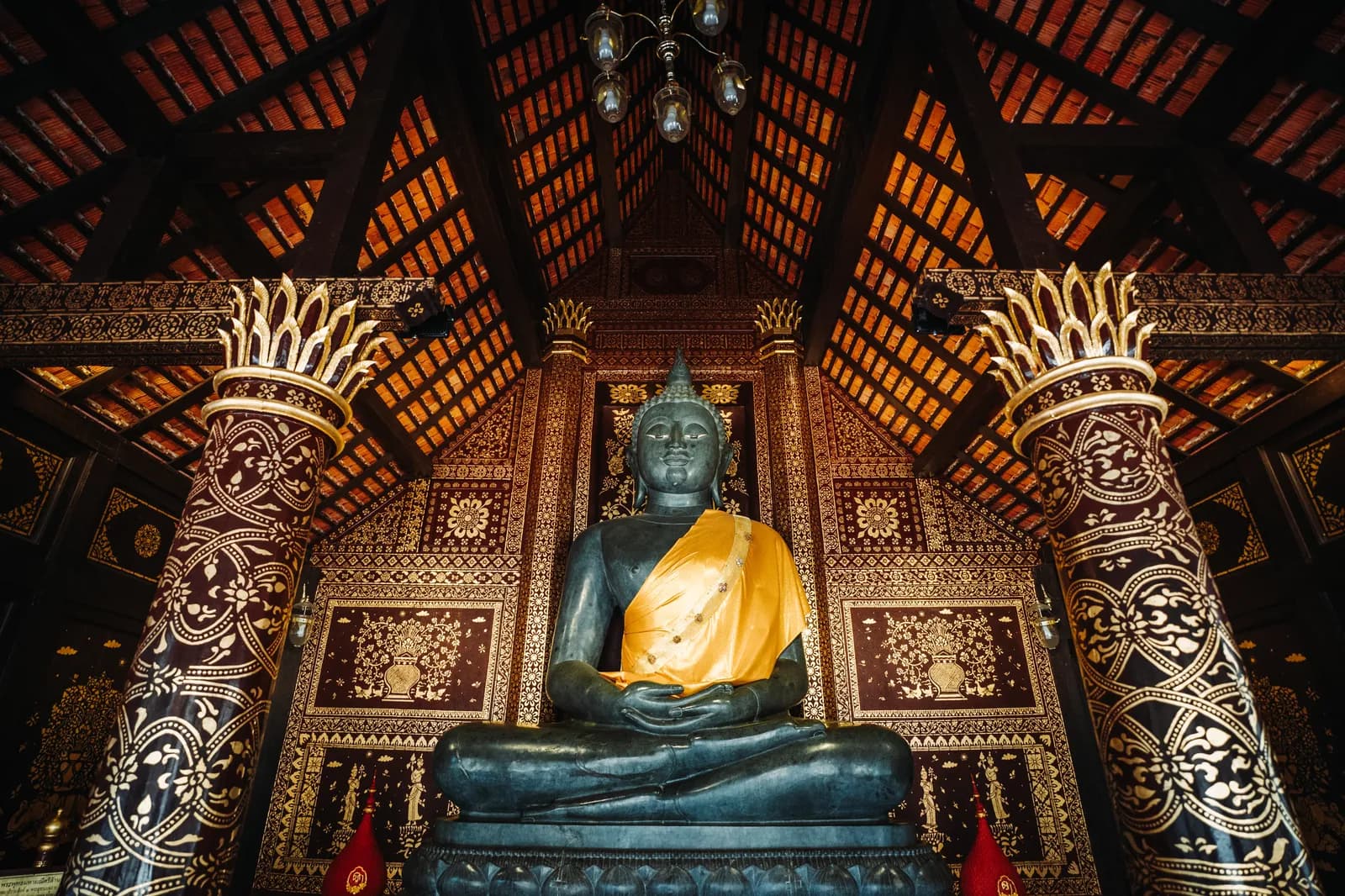
In 1468 the Emerald Buddha, now in Wat Phra Kaew in Bangkok, was installed in the eastern niche. Then, in 1545, an earthquake brought down the top 30m. The Buddha left Chiang Mai for Luang Prabang in 1551. The chedi stayed in ruins until a partial restoration in the early 1990s, funded by UNESCO and Japan. For the temple's 600th anniversary in 1995, a black jade copy of the Emerald Buddha was placed in the restored eastern niche.
What to look at
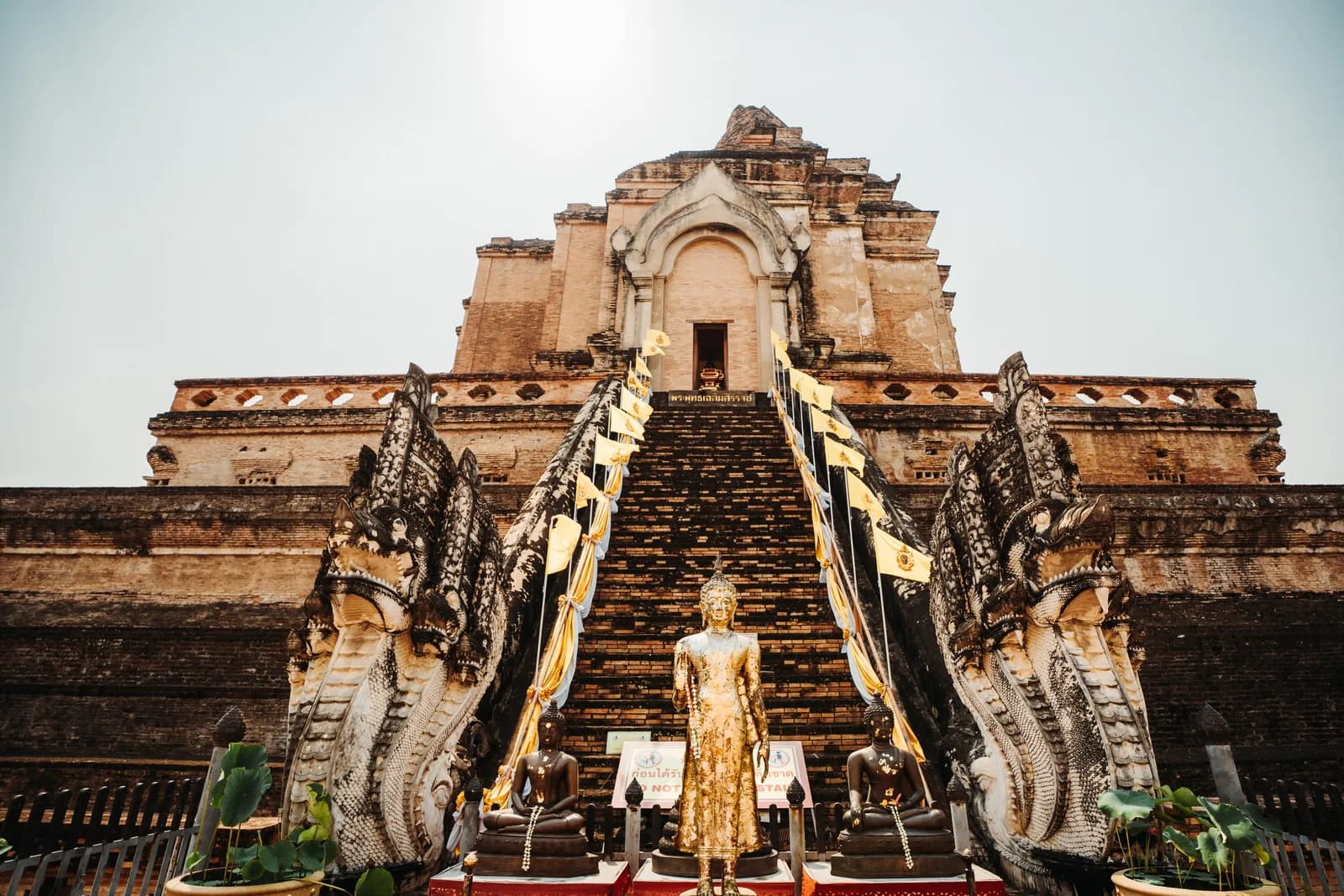
- The naga stairways: each face of the chedi is climbed by a stairway guarded by two mythical serpents. The east one, the most photogenic, starts from a small row of golden Buddhas.
- The elephants at the base: on the south side, stucco elephants emerge from the masonry, largely rebuilt during the restoration.
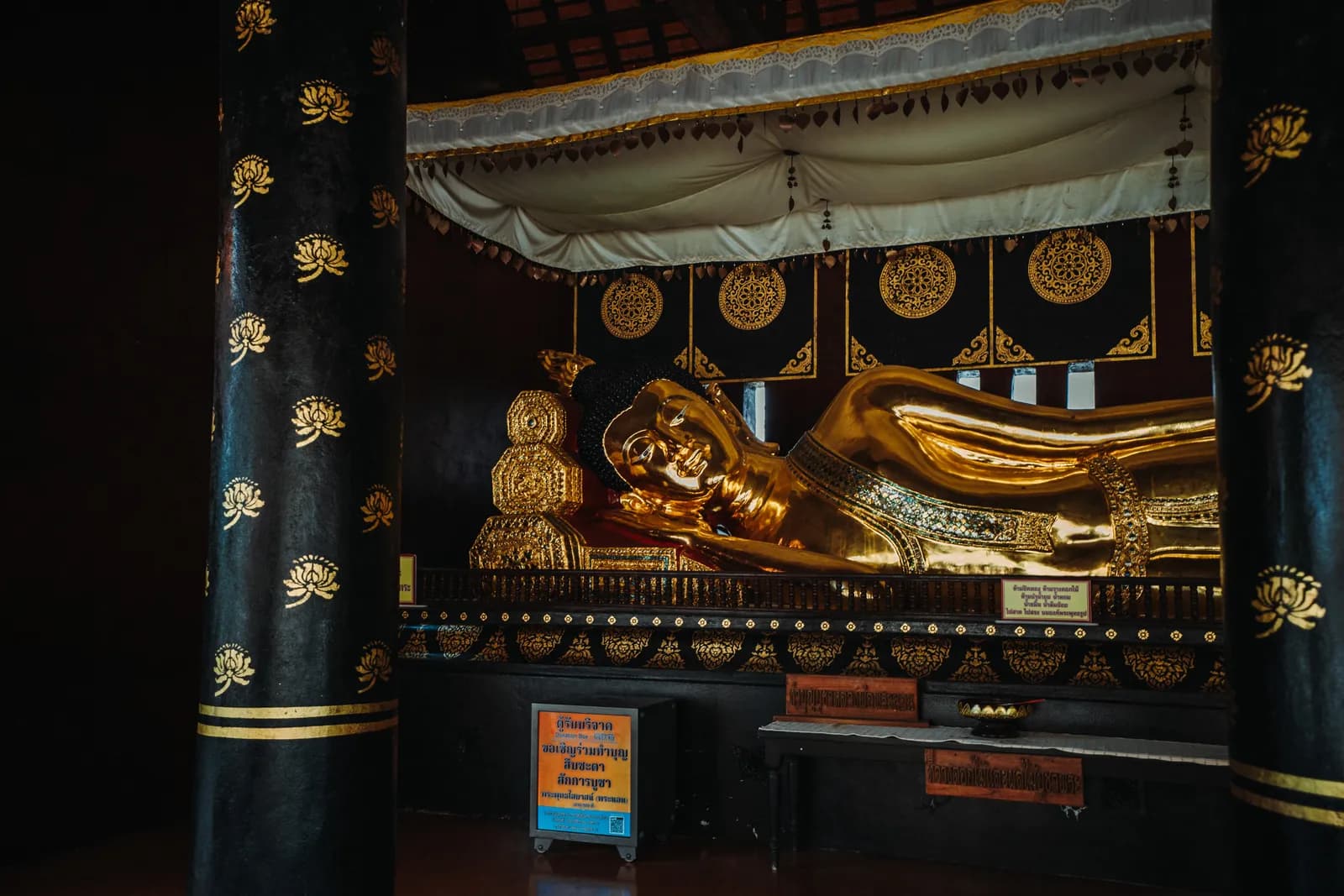
- The reclining Buddha, in a pavilion with black columns scattered with golden lotuses, and the hall dedicated to a revered monk, shown as a strikingly lifelike wax figure.
- The city pillar shrine (Sao Inthakin), moved here in 1800 by King Kawila, and the tall dipterocarp trees that guard it. Its festival takes place every year in May.
On 31 March 2024 there were people about but no crush, and pink bougainvillea in flower around the forecourt, perfect as a foreground.
Fee: about 50 baht for foreigners (some 2026 sources still give 40), free for Thais. Hours: roughly 6am to 6pm. Best time: at opening, or after 4pm when the low light warms the bricks.
Wat Phra Singh, the most revered temple
At the end of Ratchadamnoen Road, on the west side of the old city, Wat Phra Singh is Chiang Mai's first-class royal temple. It was founded in 1345 by King Phayu to house the ashes of his father, Kham Fu. Around 1400 it received the Phra Buddha Sihing statue, which gave it its current name.
Photos : Pierre Bouyer
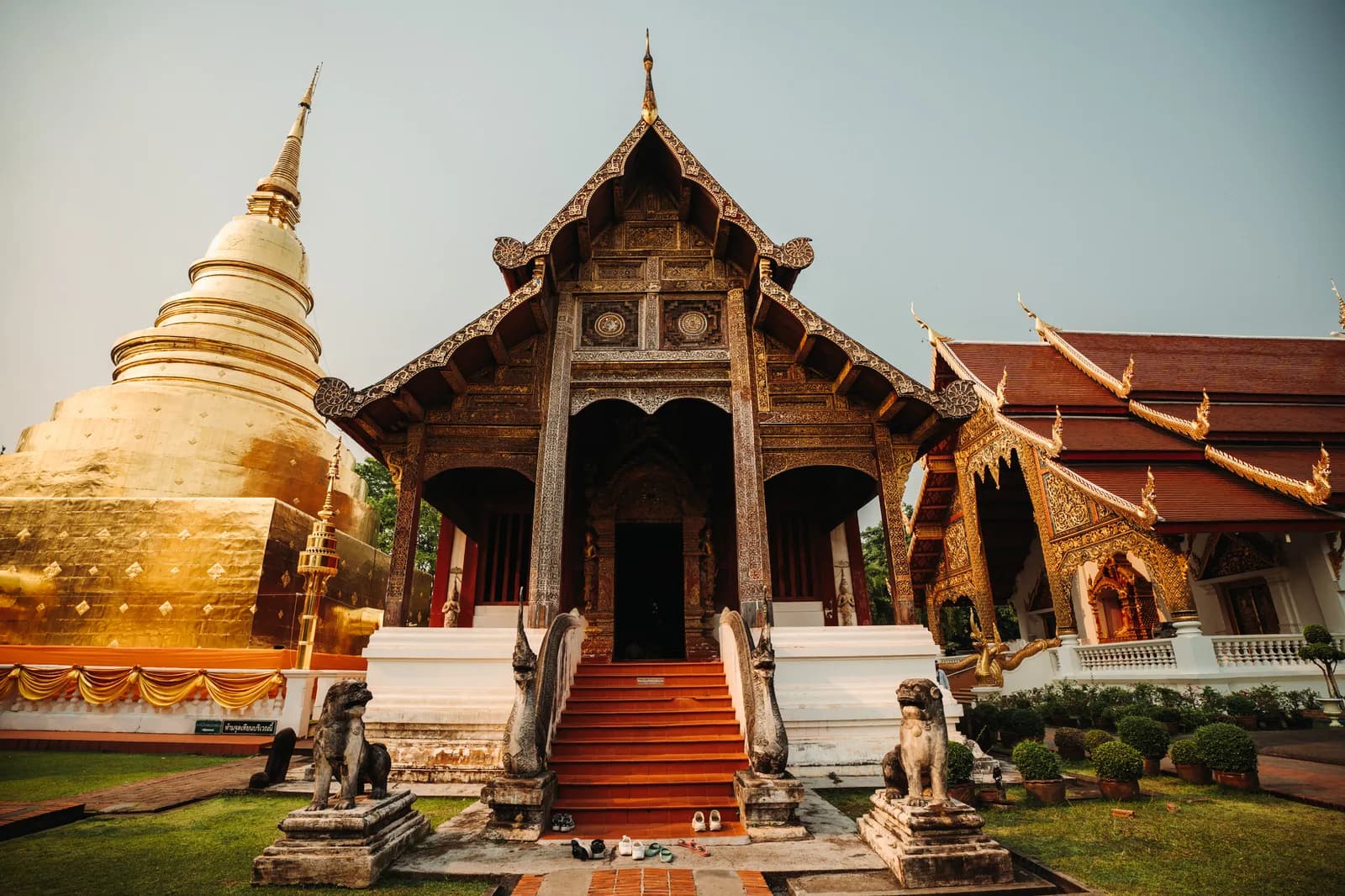
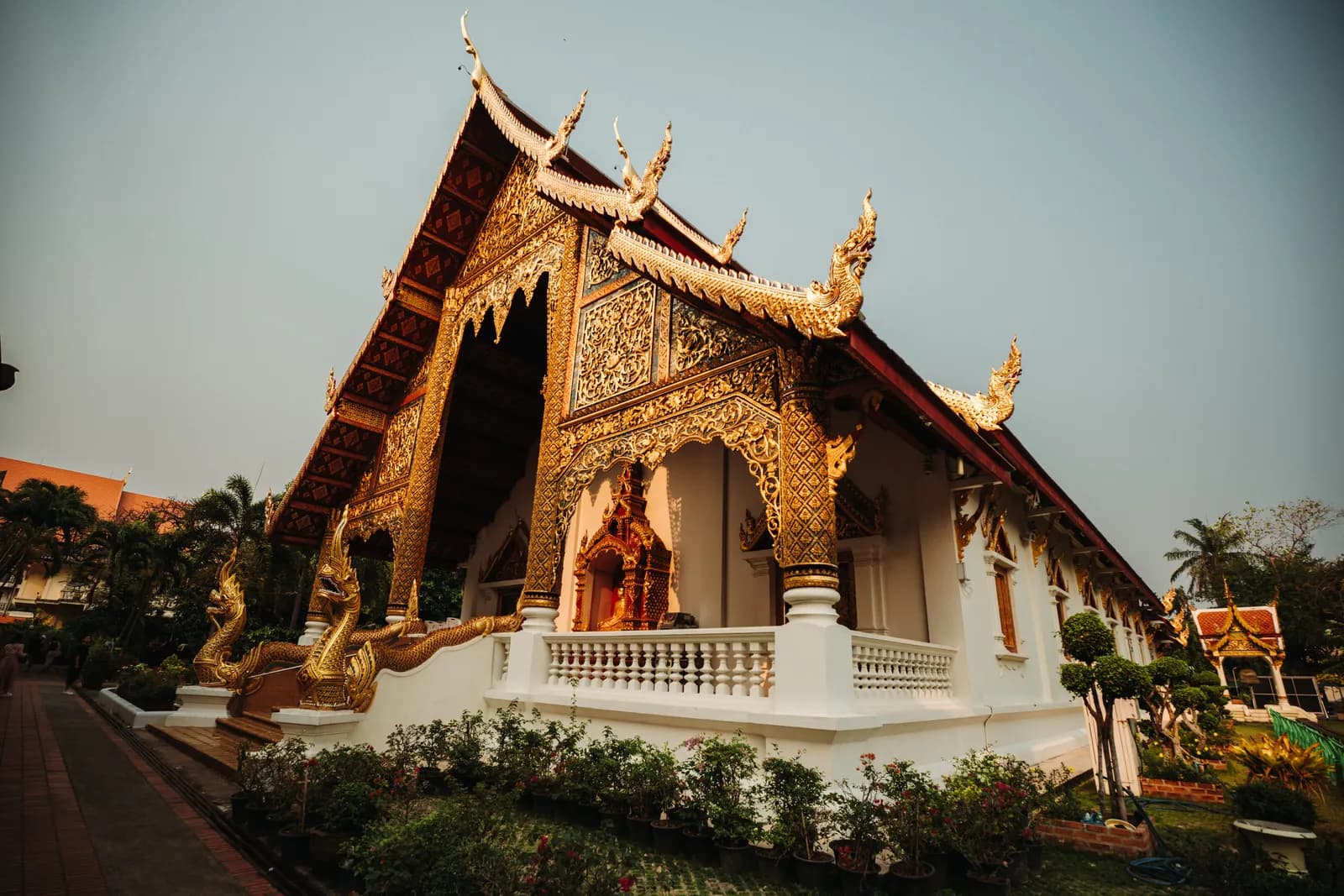
The building to see is the Viharn Lai Kham, a small chapel behind the main viharn, on the left. Its facade is covered in gold-on-lacquer patterns, and its inner walls carry 19th-century murals telling two folk tales, Sang Thong and Suwannahong. This is where the Phra Buddha Sihing sits.
Take time to walk round the golden chedi too, glowing at the end of the day, and along the avenue of palms and bougainvillea that lines the grounds: on 5 April 2024 it was in bloom, and it is the quietest part of the temple.
Fee: 40 baht for foreigners, free for Thais. Hours: roughly 6am to 5pm for the halls, with the grounds open later. Best time: before 9am or late afternoon.
Wat Chiang Man, the oldest in the city
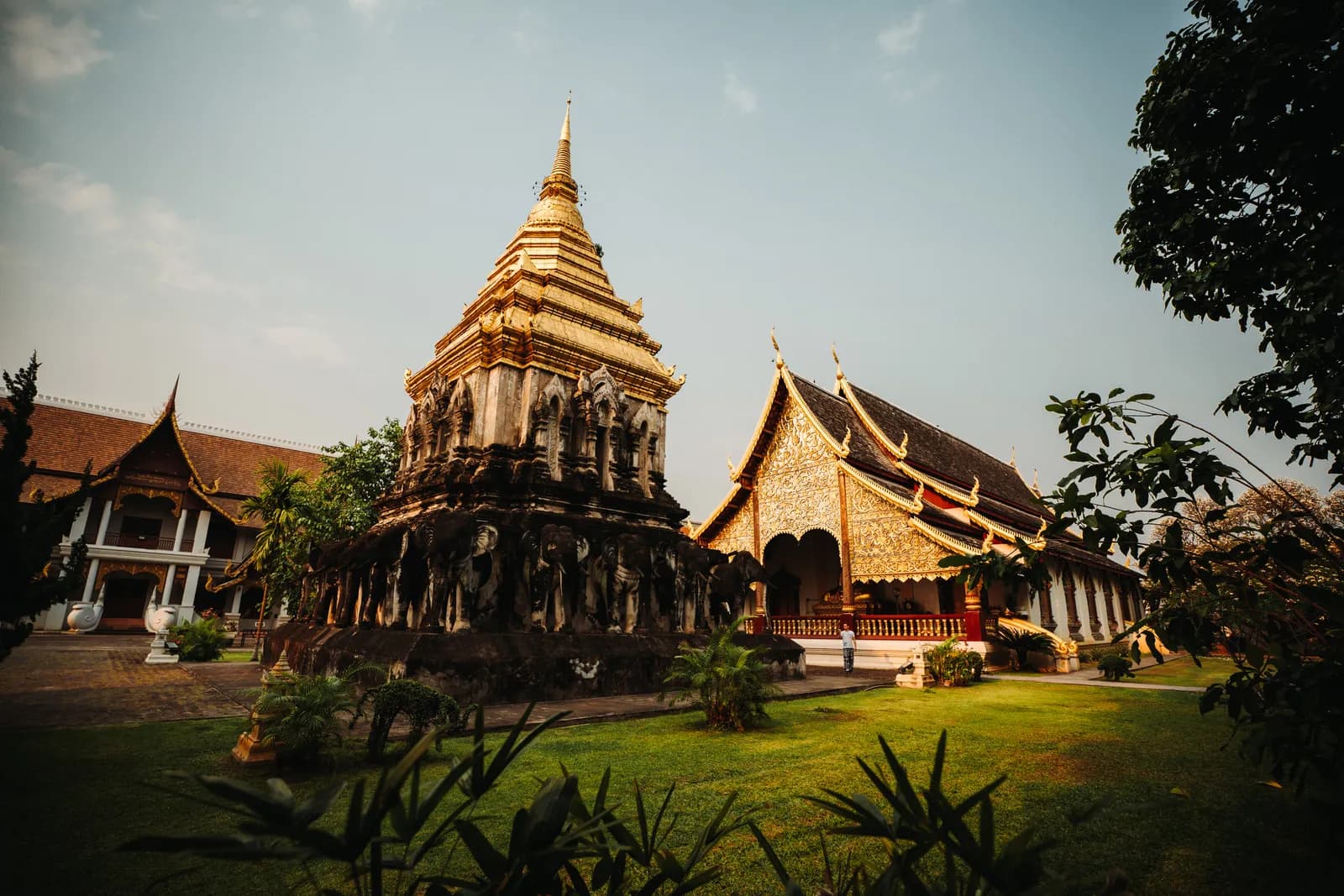
Wat Chiang Man is Chiang Mai's first temple, founded by King Mangrai in 1297 on the site of Wiang Nopburi, an old fortified town of the Lawa people. A stone inscription of 1581, kept in the grounds, gives the oldest record of Chiang Mai's founding: 12 April 1296, at 4am.
Photos : Pierre Bouyer
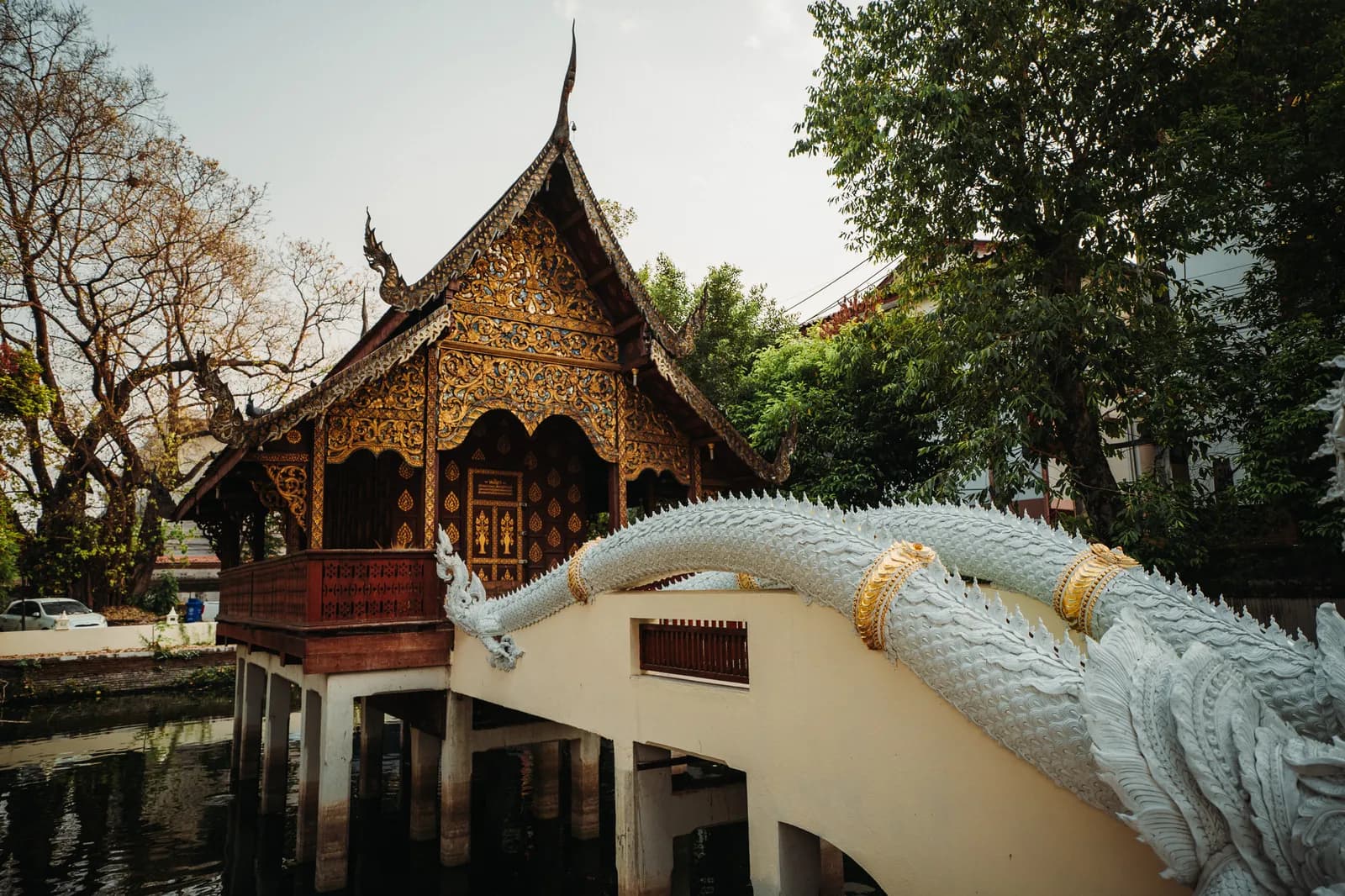
Its chedi is, to my eye, the finest in the old city: the Chedi Chang Lom, whose base is carried by 15 life-size brick and stucco elephants, topped with a gilded upper section. The new viharn houses two deeply revered images: the Phra Sila, a stone bas-relief, and the Phra Sae Tang Khamani, a tiny 10cm crystal Buddha. Do not miss, off to one side, the carved wooden library (ho trai) set on stilts above a pond, with its white nagas.
On 1 April 2024 the grounds were almost empty, with broad lawns and trees shading the buildings.
Fee: free. Hours: during the day, roughly 6am to 5pm. Best time: the afternoon, when the light falls on the viharn's gilded facade.
Wat Sri Suphan, the Silver Temple
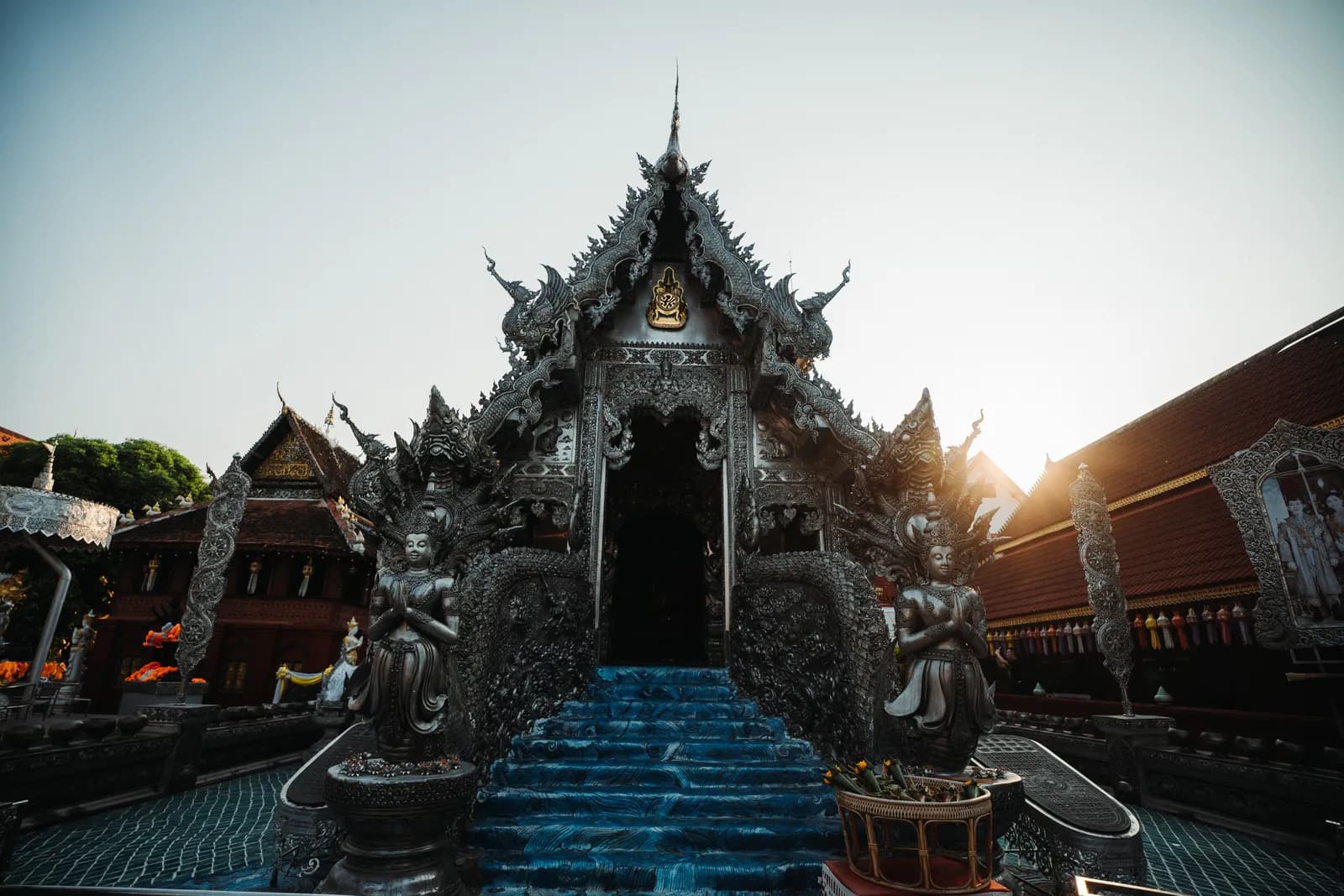
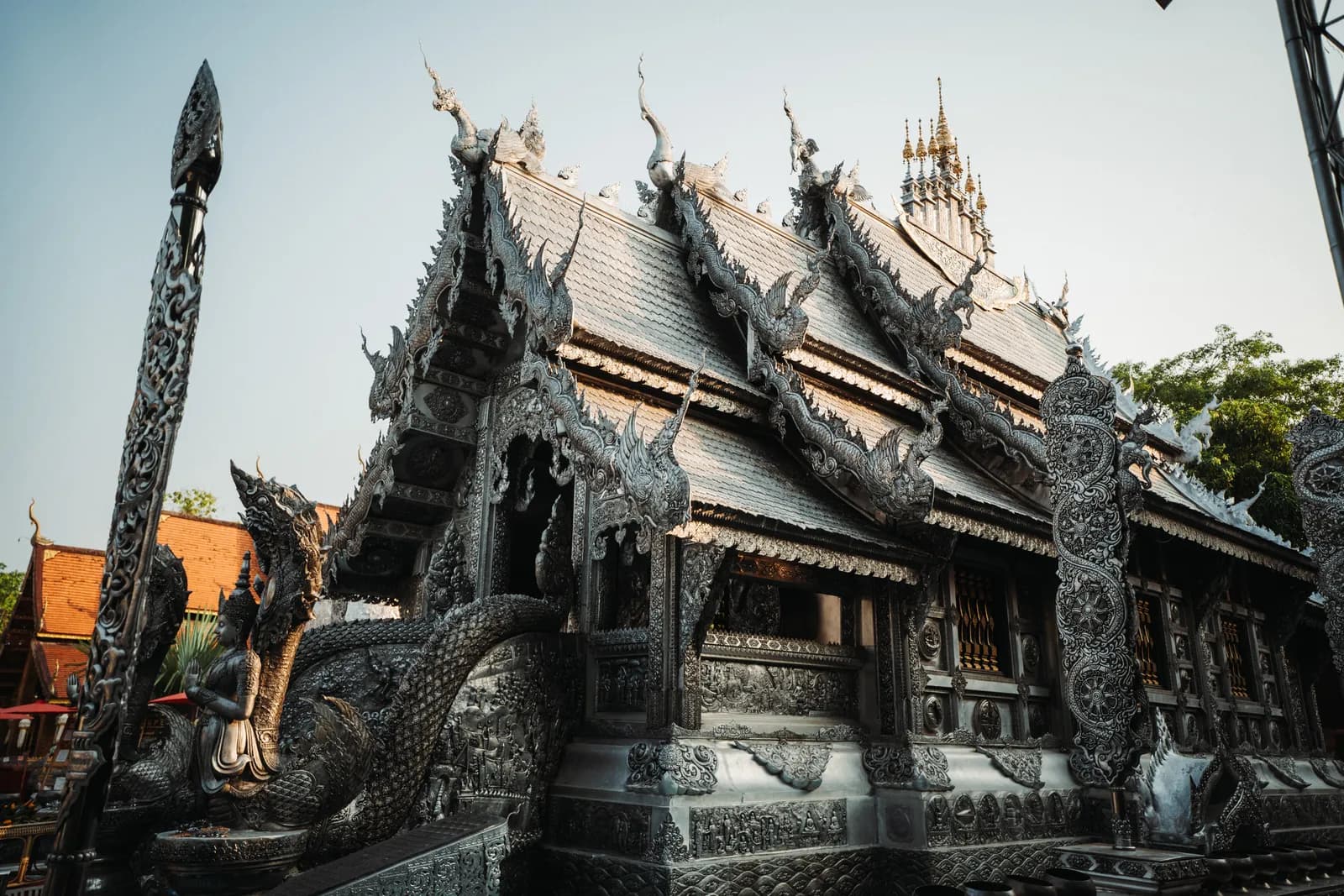
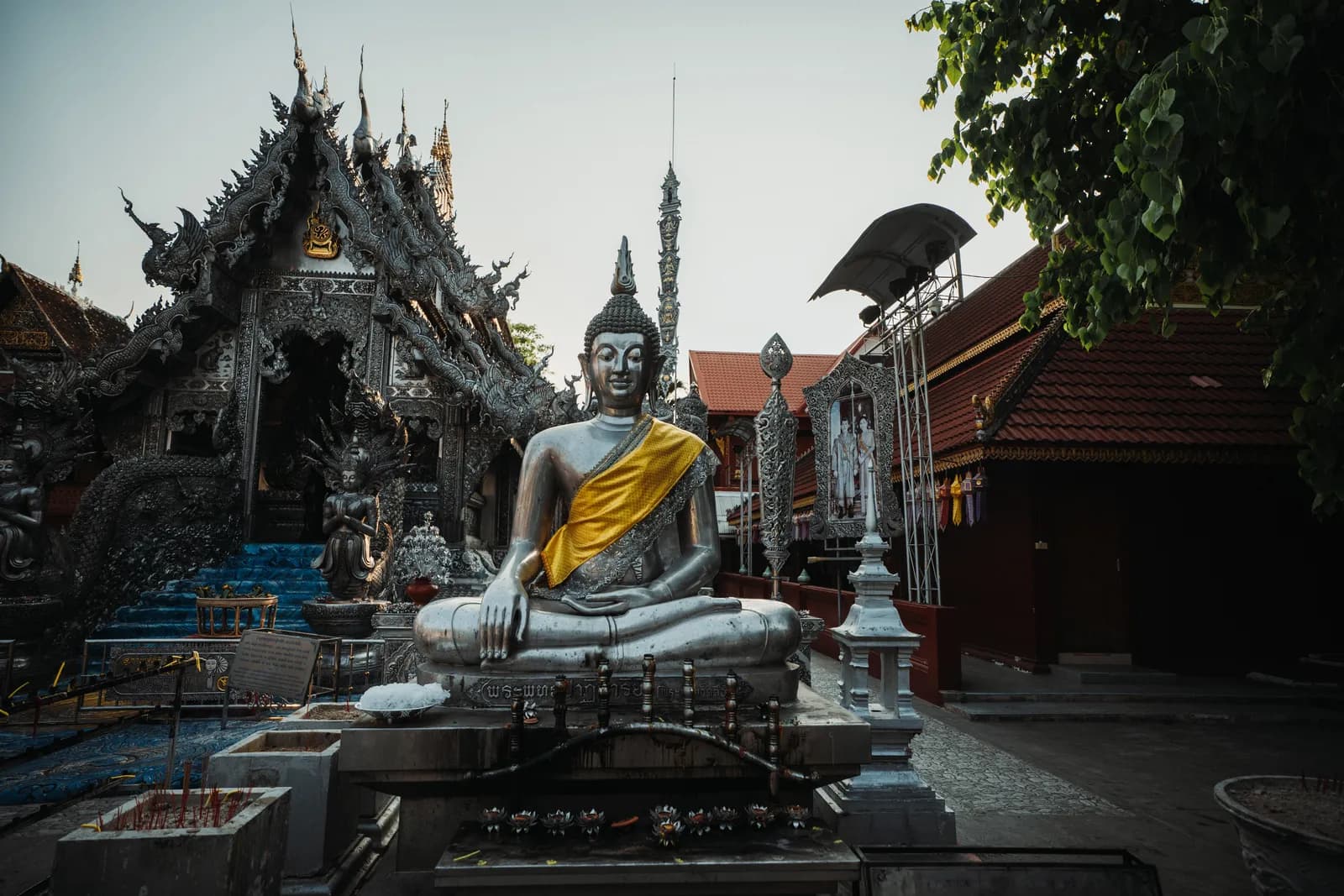
Just south of the walls, on Wualai Road in the silversmiths' quarter, Wat Sri Suphan was founded around 1500 under King Mueang Kaeo. What makes it famous is recent: its ubosot (ordination hall), entirely covered in panels of silver, nickel and aluminium, embossed and engraved by local craftsmen.
Photos : Pierre Bouyer
I went on 11 April 2024 late in the day, and that is the right time: the setting sun was passing behind the gable, and the metal changed colour with every step. A large silver Buddha draped in yellow cloth sits in front of the hall. At the entrance, a workshop shows how the silver is worked.
Fee: about 50 baht for foreigners. Hours: roughly 9am to 6pm for the ubosot, with the grounds open earlier. Best time: the last hour before closing. Good to know: meditation and monk chat sessions are held on some evenings of the week, usually from 5.30pm; check on the spot.
Beyond the walls: Suan Dok, Umong and Chet Yot
West of the old city, at the foot of Doi Suthep, three temples tell another story: one of scholar monks, forests and great councils. You need a Grab to link them, but the atmosphere is far calmer.
Wat Suan Dok, the white chedis
About 1.5km from Suan Dok Gate, this temple was founded in 1370 by King Kue Na for the monk Sumana, on the former royal flower garden that gives it its name. Legend says a relic of the Buddha split in two here: one part stayed, the other was carried by a white elephant to the top of Doi Suthep, where the animal stopped.
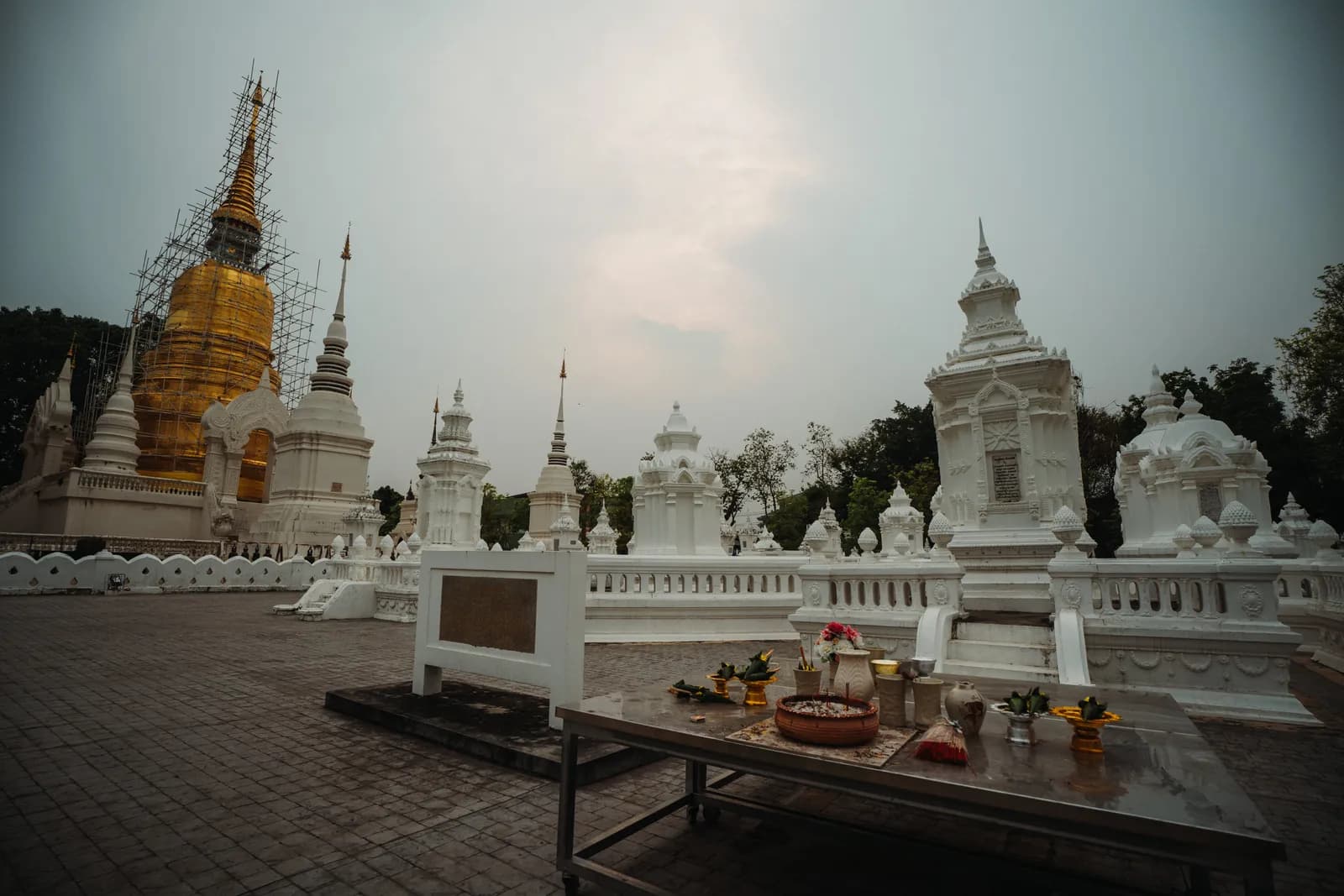
What you come for is the field of white chedis holding the ashes of Chiang Mai's princely family, gathered here in the early 20th century by Princess Dara Rasmi, around the great 48m golden chedi. On 9 April 2024 that chedi was under scaffolding and the sky was grey with smoke: the ensemble still looked fine, but I would check on the works before making the trip just for it.
Fee: free. Hours: roughly 6am to 5pm. Best time: late afternoon, just before the monk chat.
Wat Umong, the tunnels in the forest
This is my favourite beyond the walls. Wat Umong was founded in 1297 by King Mangrai for monks from Sri Lanka, in a bamboo forest at the foot of Doi Suthep. In the 14th century, King Kue Na had brick tunnels dug here for the monk Thera Chan, who liked to meditate in seclusion. Abandoned under Burmese rule, it was revived in 1949 as a meditation centre.
Photos : Pierre Bouyer
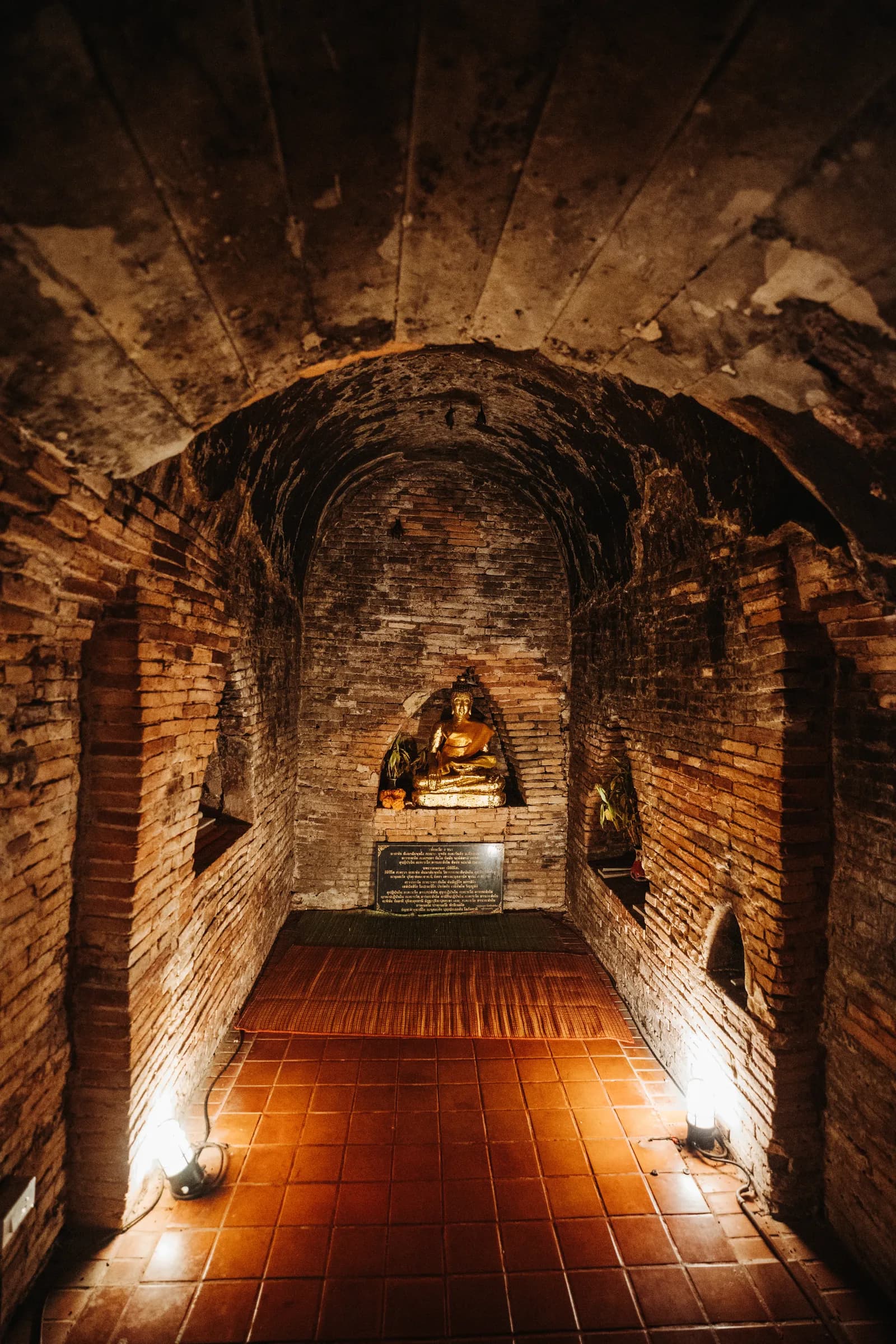
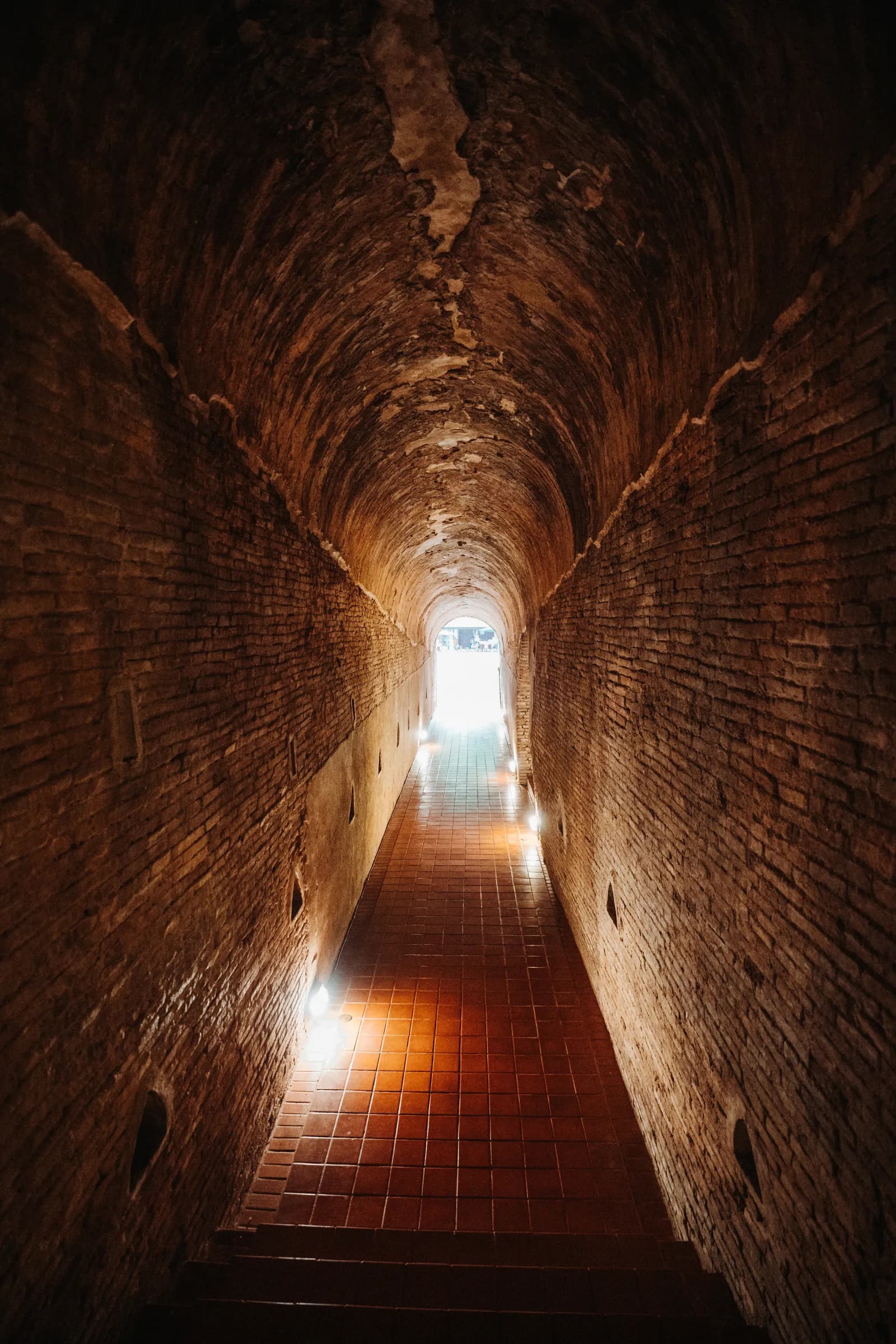
The tunnels are short but striking: long vaulted brick corridors, lit by a few lamps, leading to niches where Buddhas sit. Above them, the great ancient chedi dominates a clearing. All around is forest: a brick staircase rising to two white Buddhas, a naga stairway under the trees, a lotus pond in front of a copy of an Ashoka pillar. On 12 April 2024 it was grey and close, and the forest made the visit bearable while the city sweltered.
Fee: free, donations welcome. Hours: roughly 8am to 5pm. Best time: the morning, while the forest is cool. Afterwards: Chom Café, a misty garden café a few minutes away, makes a good break.
Wat Chet Yot, the seven spires
In the north-west, near the Superhighway, Wat Chet Yot was built from 1455 by King Tilokarat, modelled on the Mahabodhi temple in Bagan, itself inspired by the one at Bodh Gaya in India, where the Buddha attained enlightenment. Its brick viharn carries seven spires, hence its name. In 1477 the temple hosted the eighth World Buddhist Council, which revised the Pali canon.
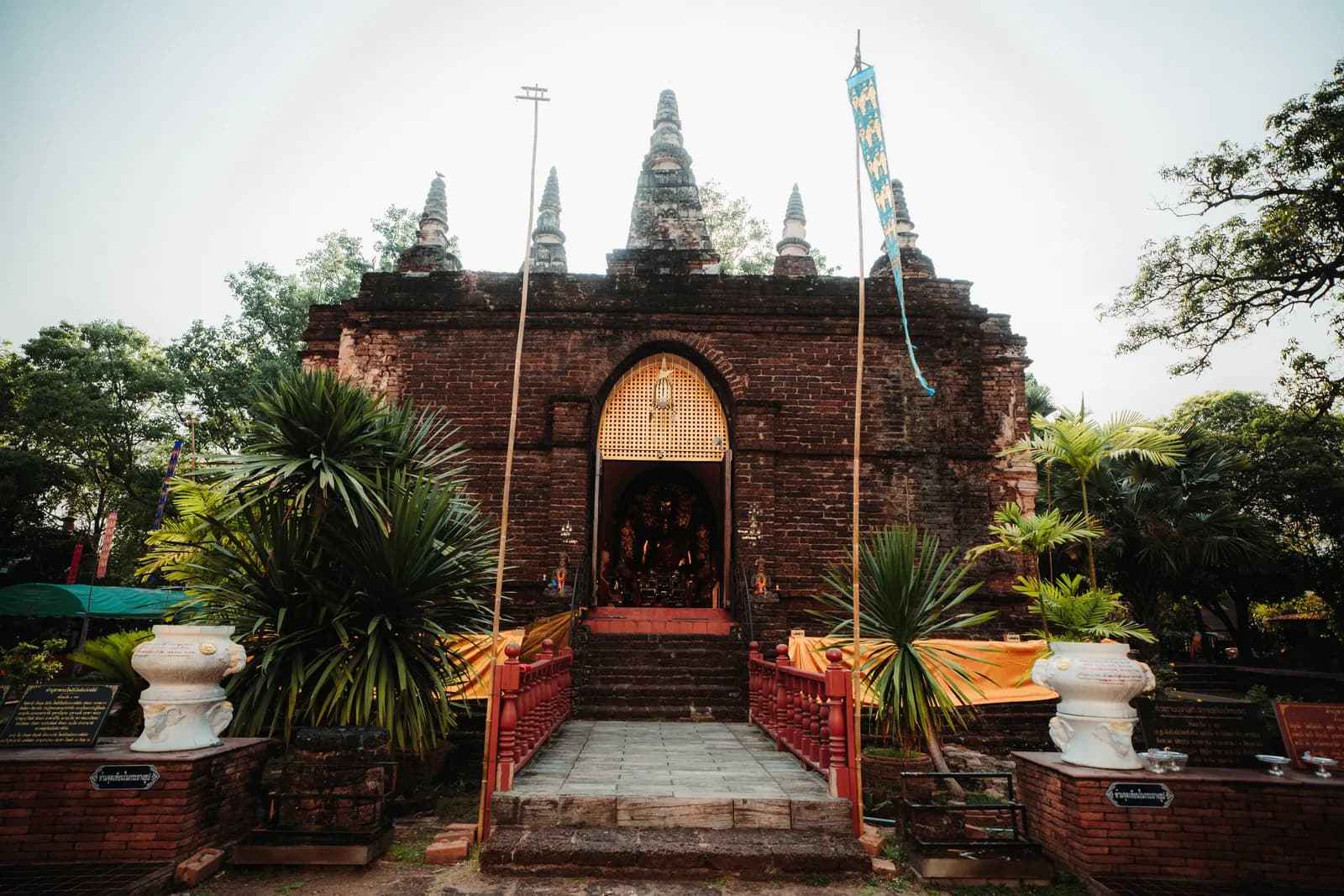
Walk round the viharn to see the stucco frieze: about 70 deities (thewada) in relief, whose faces are said to be modelled on the king's relatives. The grounds hold other ruined chedis, including one thought to contain Tilokarat's ashes. On 16 April 2024 there was barely anyone there.
Fee: free. Hours: during the day. Best time: late afternoon, when the low sun lights up the stucco.
Wat Phra That Doi Suthep, on the mountain
I have no photos of Doi Suthep, but it cannot be left out: it is the most sacred temple in northern Thailand, set more than 1,000m up on the mountain overlooking the city, about 15km from the old city.
You reach it by a 306-step staircase lined with nagas, or by a funicular for a few dozen baht more. At the top: a golden chedi and, on a clear day, the whole valley.
Fee: 30 baht for foreigners. Since October 2025, Doi Suthep-Pui National Park has charged foreign visitors 100 baht at certain sites (Pha Lat trail, waterfalls, Doi Pui), but not for driving up to the temple on the main road. Best time: early morning, before the tours. My advice: avoid smoky days in March and April, when the view vanishes completely. My article on Chiang Mai's burning season explains when the air clears.
The little-known temples I photographed
Walking around the old city, you come across an almost empty temple every couple of hundred metres. Here are the ones I photographed along the way.
Wat Phan Tao, the teak hall
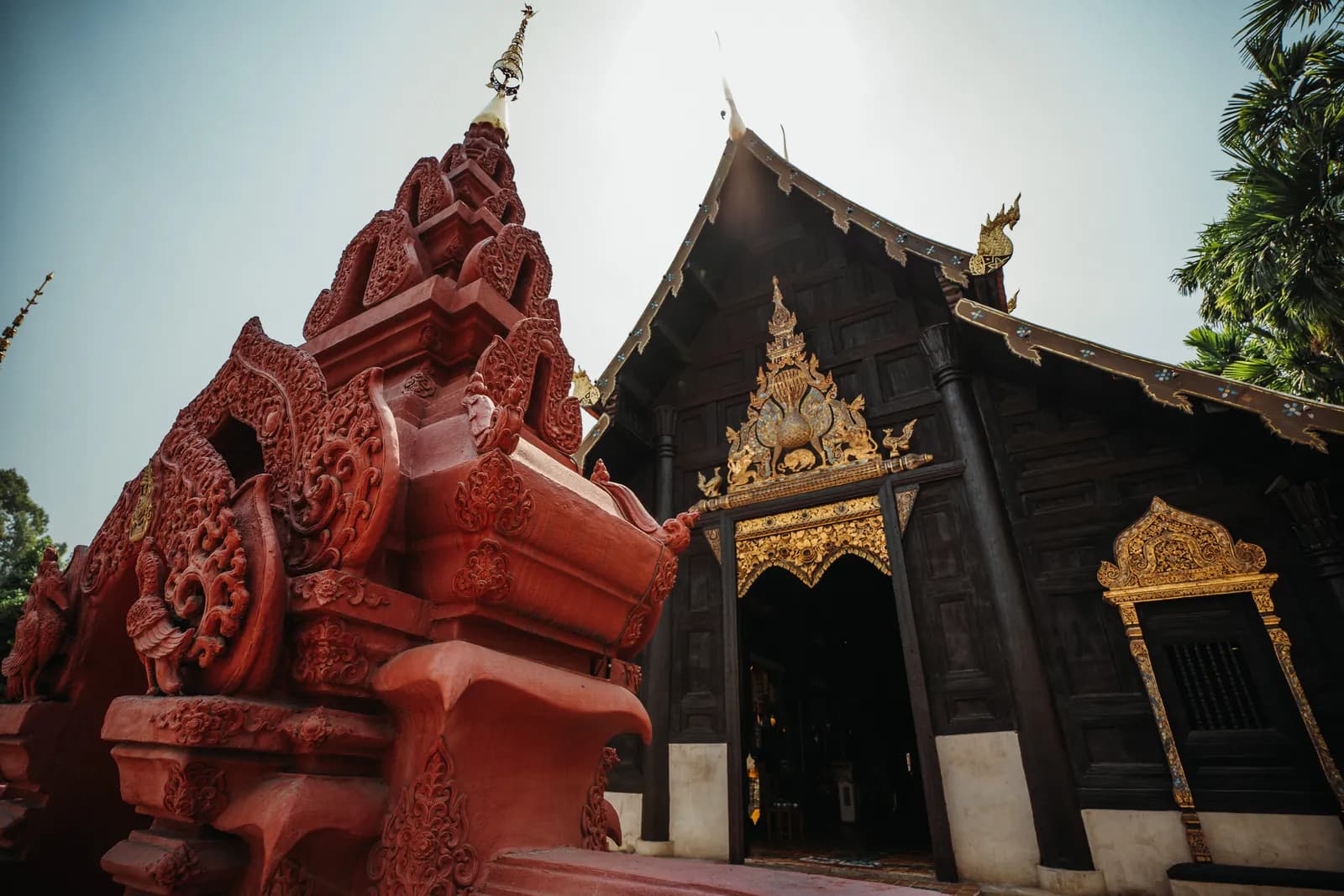
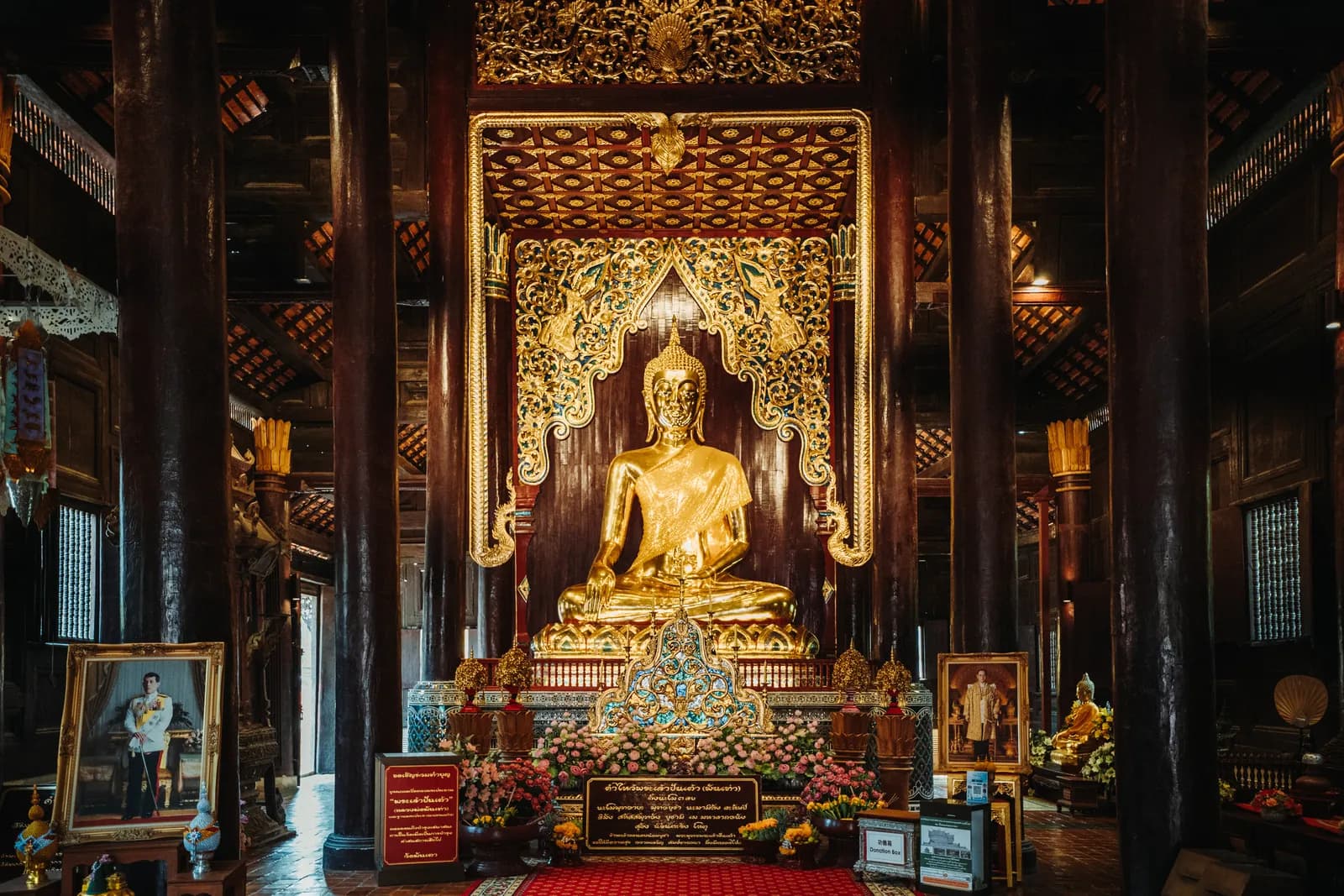
Right next to Wat Chedi Luang, Wat Phan Tao is a temple many visitors miss as they leave its neighbour. Its name means "a thousand furnaces": Buddha images were cast here. Its viharn is a rarity: a former royal residence made entirely of teak, built for the ruler Mahotaraprathet (1846 to 1854) and moved here in 1876. Its 28 dark wooden pillars, the glass-inlaid peacock above the door and the golden Buddha of 1498 at the far end make it one of the finest interiors in the city. Free.
Photos : Pierre Bouyer
Wat Muen Tum and its wall of lanterns
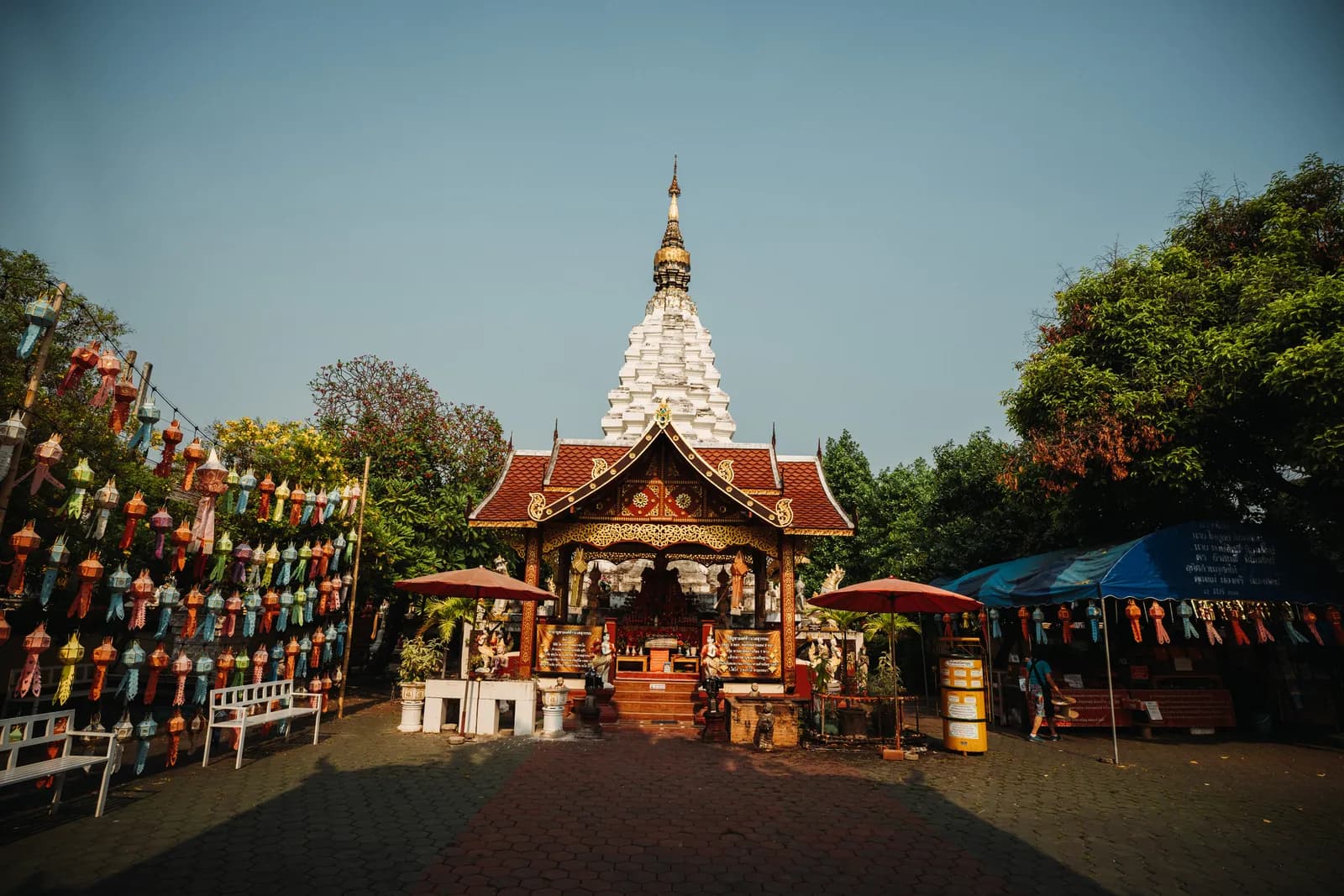
A few streets from Chedi Luang, Wat Muen Tum announces itself with an ornate white and gold gateway bearing the words "Wat Muentoom". On 31 March 2024 the grounds were lined with hundreds of paper Lanna lanterns, blue, pink and orange, hung like a curtain in front of the white chedi. There is also a large stone Buddha head and some old wooden carts. It is one of the most photogenic spots in the old city. Free.
Wat Chet Lin and its bamboo bridge
In the south-west of the old city, Wat Chet Lin already existed before 1517. King Mekut Sutthiwong, ruler of Chiang Mai from 1551 to 1564, is said to have been crowned here: the name is thought to refer to the seven pipes through which lustral water was poured during coronations. The temple is surrounded by a pond once reserved for the royal family's ritual baths.
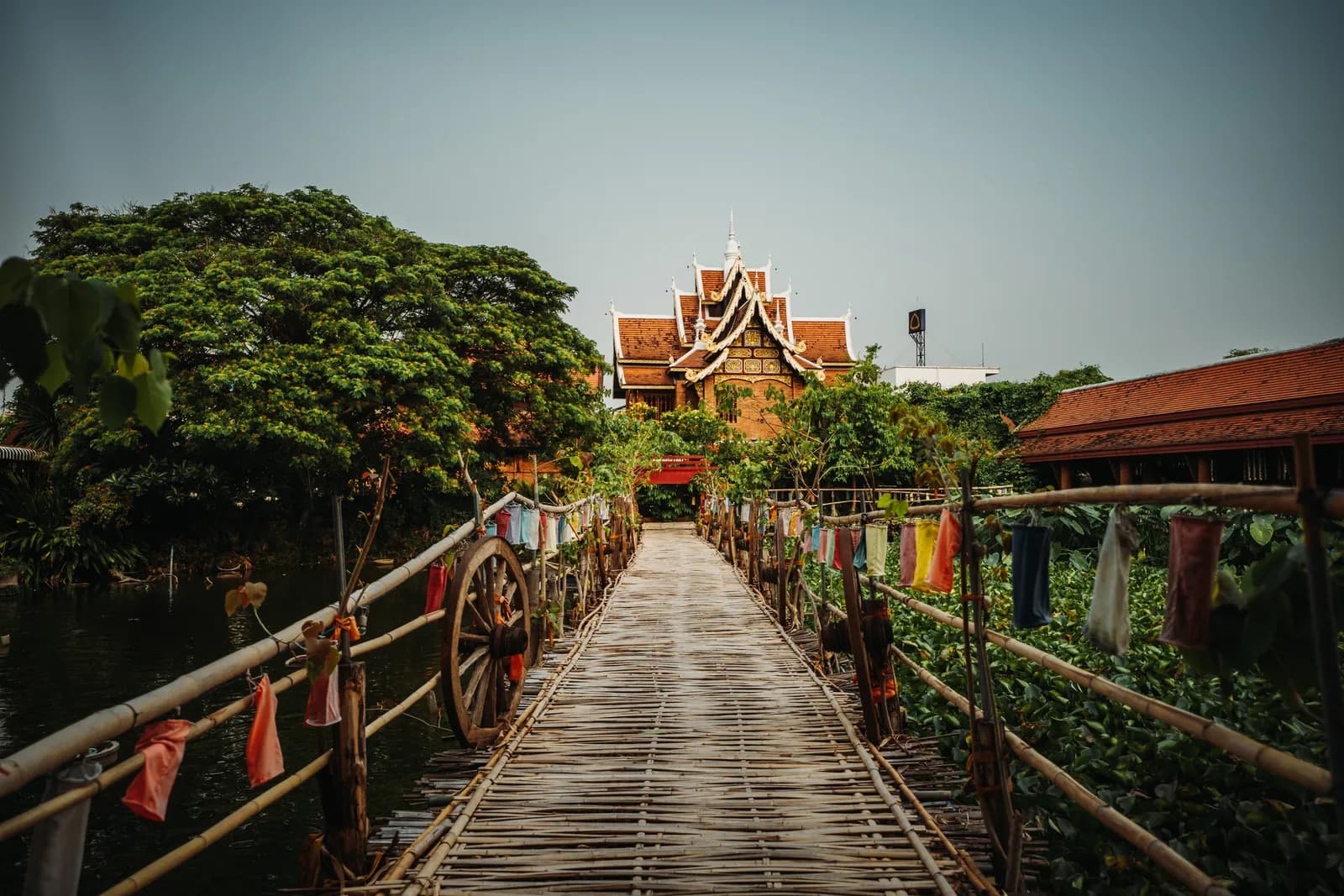
Today you reach it over a long woven bamboo bridge, the "saphan to wa", laid across the water hyacinths and decorated with cartwheels and pennants. A gallery roofed with dried leaves runs along the pond. It is the most peaceful temple I saw within the walls. Free, roughly 8am to 5pm.
Wat Phuak Hong, the round chedi
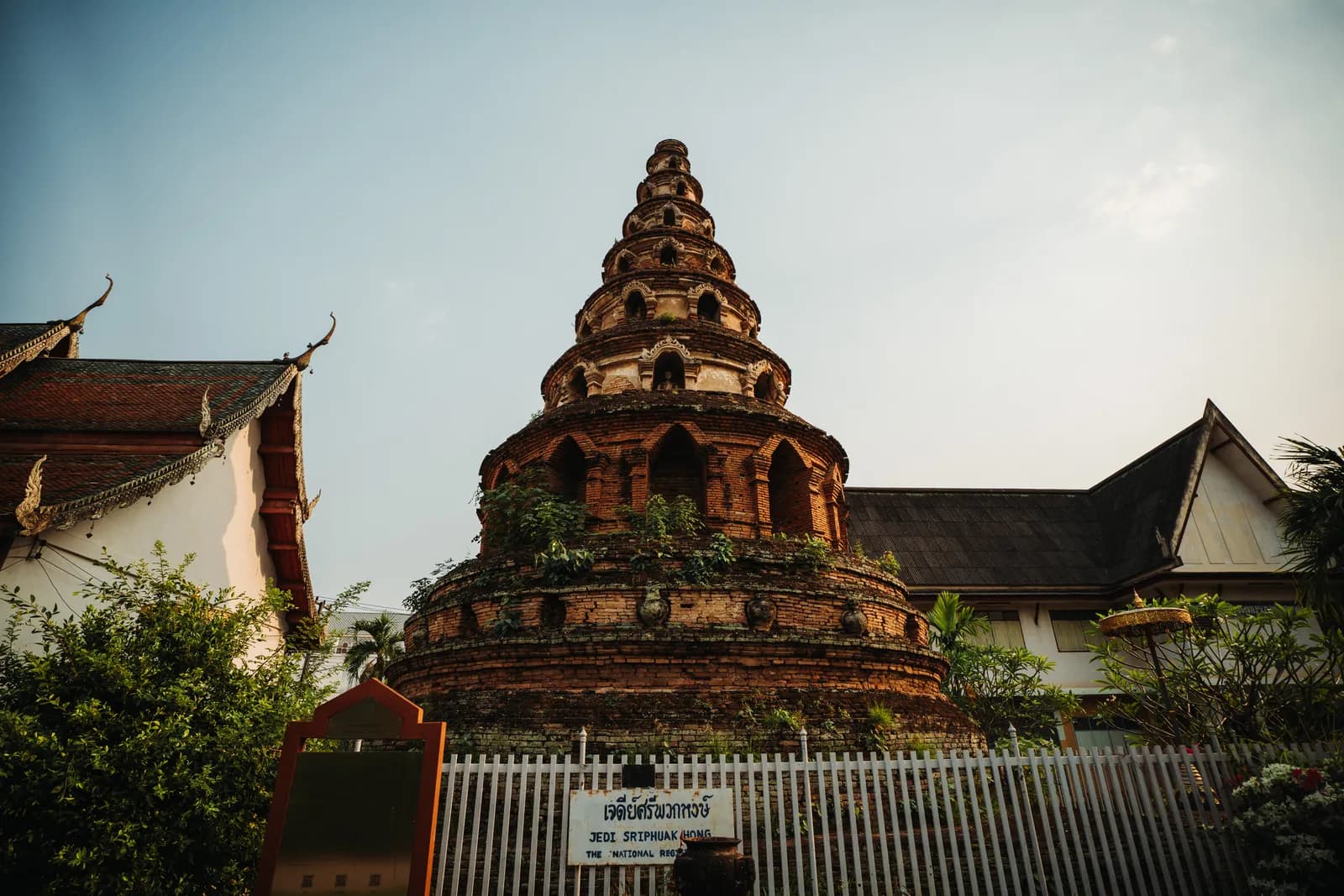
A stone's throw from Nong Buak Haad park, Wat Phuak Hong hides a chedi unique in the city: round, with seven tiers pierced by 52 Buddha niches, and dated to 1517. Only three chedis of this type exist in the province. It is fenced off, so you view it through the railings, but it is worth the ten-minute detour. Free.
Wat Lok Moli, the bare-brick chedi
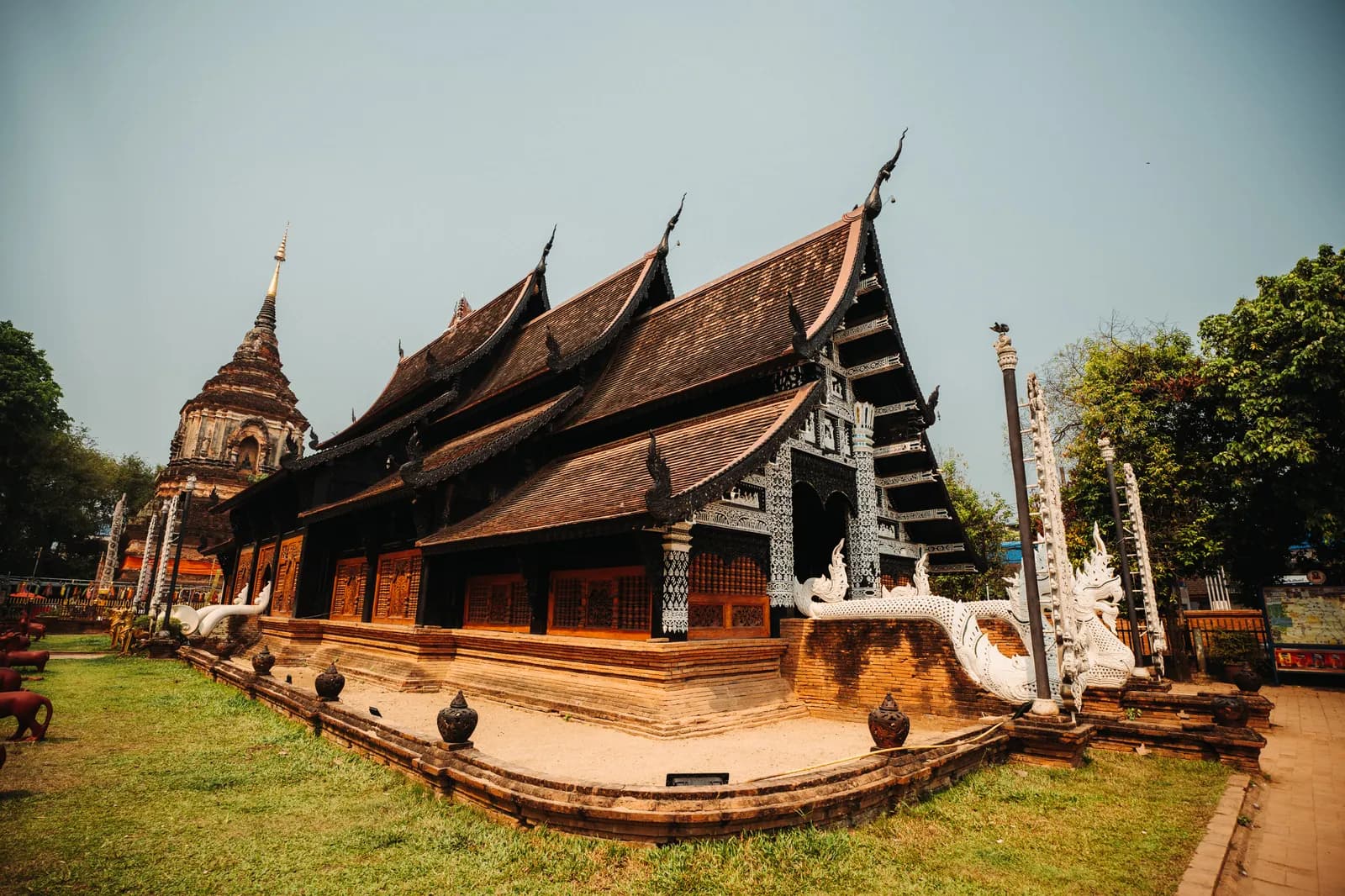
Just north of the moat, Wat Lok Moli is mentioned as early as 1367. Its great brick chedi, built in 1527 by King Ket, was never gilded or whitewashed: that is what makes it so beautiful, especially when hung with tung banners as it was on 1 April 2024. It holds the ashes of members of the Mangrai dynasty, including Queen Wisutthithewi. White elephants stand guard in front of the carved black teak viharn. Free.
My routes on foot and by Grab
A day in the old city
The old city is a square roughly 1.5km on each side. This loop of about 5km is done on foot, with breaks. Set off early: in the hot season it is over 35°C by late morning.
| Time | Stop | What to do there |
|---|---|---|
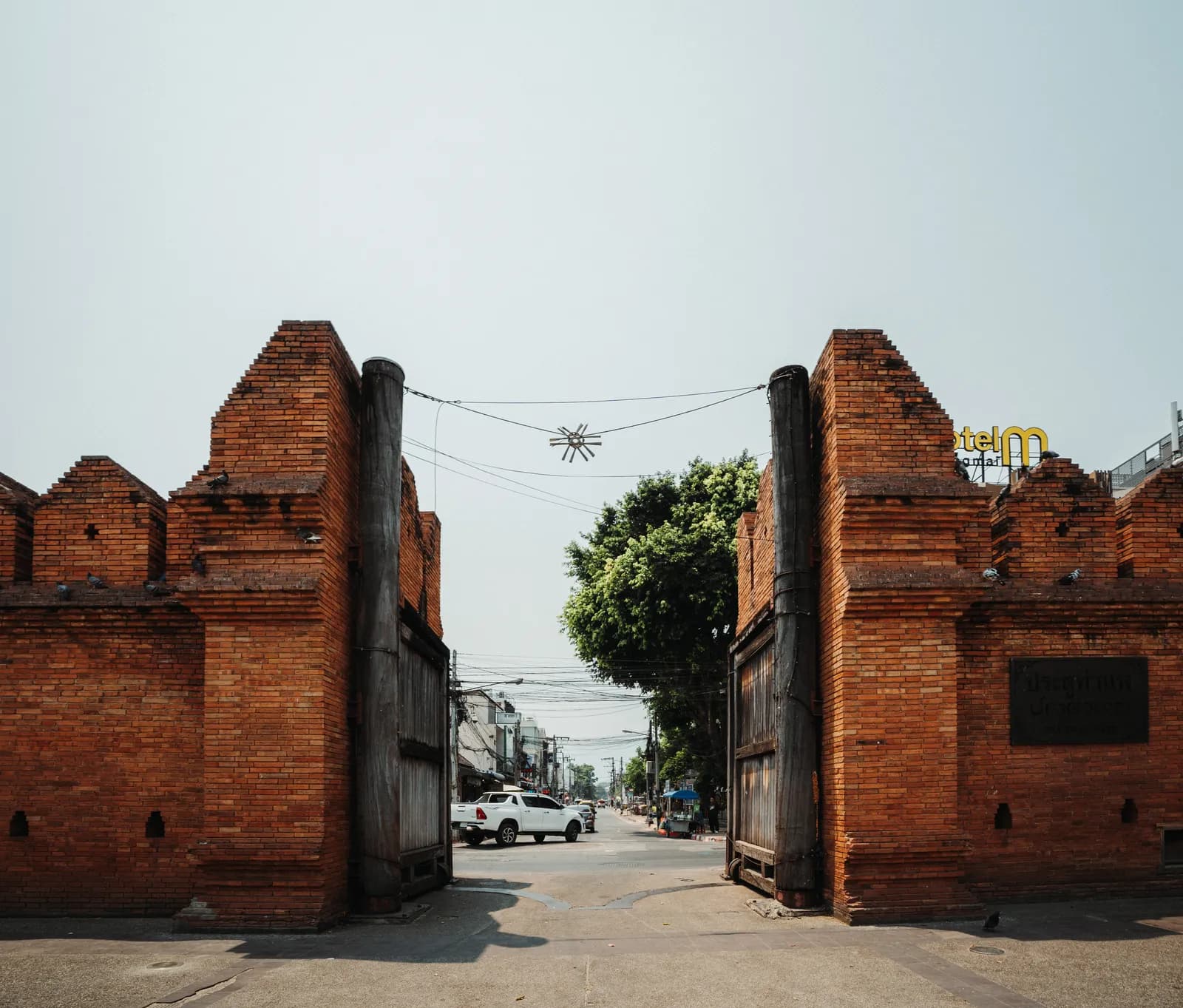
| 7.30am | Tha Phae Gate | The moat and brick walls, without the crowds |
| 8am | Wat Chiang Man | The elephant chedi, the library on stilts |
| 9am | Wat Lok Moli (outside the moat, to the north) | The bare chedi; optional if you like walking |
| 10.15am | Wat Phan Tao | The teak viharn, before the Chedi Luang crowds |
| 10.45am | Wat Chedi Luang | The great chedi, the city pillar, a monk chat |
| 12pm | Lunch break | Ratchamanka Road or around Phra Singh |
| 2pm | Wat Muen Tum | The wall of lanterns and the Buddha head |
| 2.45pm | Wat Chet Lin and Wat Phuak Hong | The bamboo bridge, the round chedi, Nong Buak Haad park |
| 4pm | Wat Phra Singh | The Viharn Lai Kham and the golden chedi in warm light |
| 5.30pm | Wat Sri Suphan (south, via Chiang Mai Gate) | The silver ubosot at sunset, then the Wualai market on Saturday evenings |
On Sundays, finish at the Sunday Walking Street, the night market along Ratchadamnoen Road between Tha Phae Gate and Wat Phra Singh. On 31 March 2024 the street was packed from nightfall, and temple courtyards were serving as food courts.
A half-day beyond the walls
Allow four hours including travel. The easiest way is to hop between them by Grab or Bolt, each ride usually costing around a hundred baht or less over these distances.
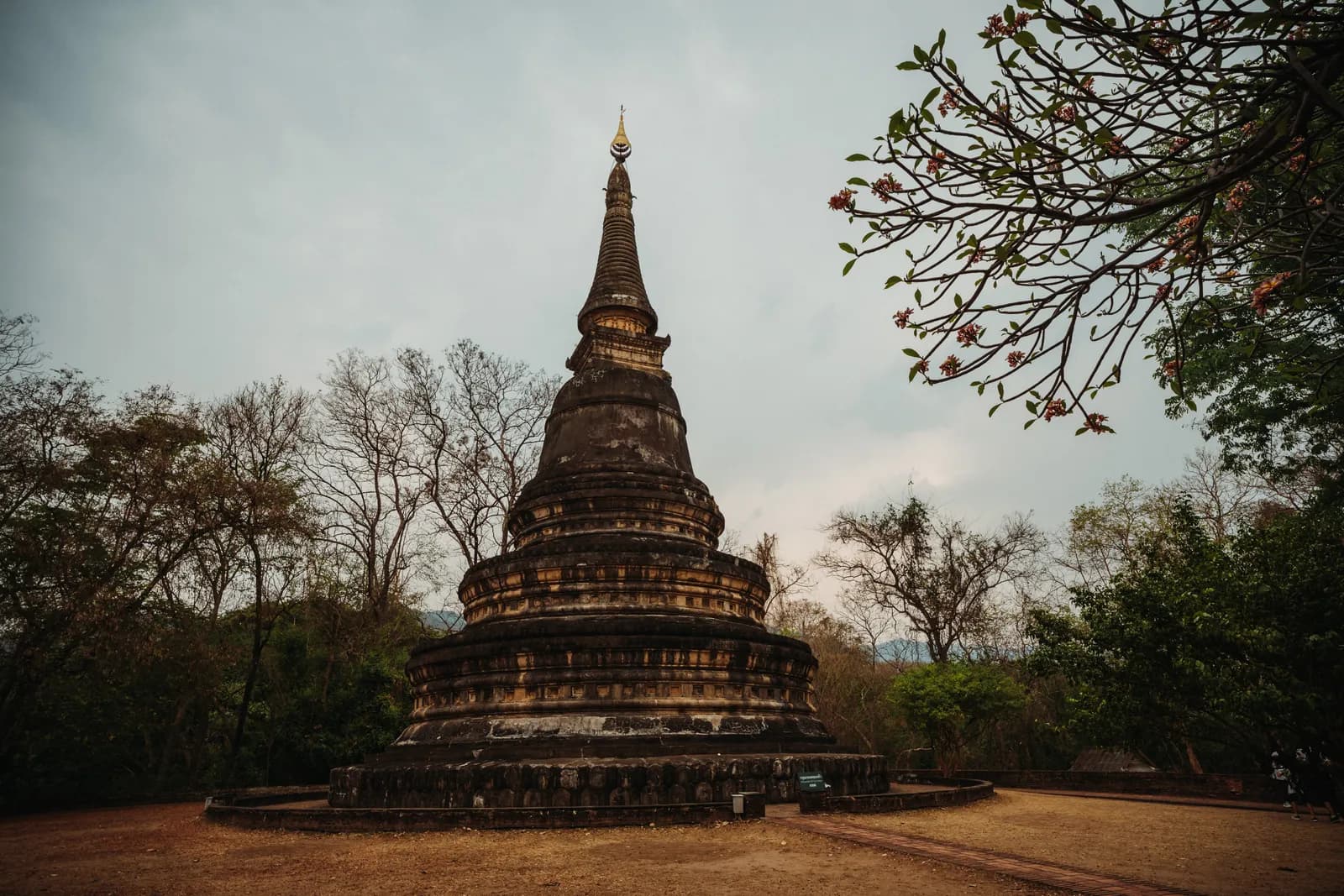
- 01Wat Suan Dok (about 30 min), 1.5km from Suan Dok Gate.
- 02Wat Umong (1 to 1.5 hrs), about 3km to the south-west, in the forest.
- 03A break at Chom Café, close by, or back towards Nimman.
- 04Wat Chet Yot (45 min), to the north, about ten minutes' drive from Nimman, for the late-afternoon light.
If you want the Wat Suan Dok monk chat, reverse the order: Chet Yot and Umong in the afternoon, Suan Dok at 5pm. Doi Suthep needs another half-day: the mountain drive alone takes 30 to 45 minutes.
Dress code and etiquette
These are active places of worship, where monks live. The rules are simple.
- Shoulders and knees covered, for men and women alike. No vest tops or short shorts. A scarf and light trousers in your bag solve the problem; some temples lend sarongs against a deposit.
- Shoes off before every viharn, ubosot or museum.
- Never point your feet at a Buddha or a monk: sit with your legs folded to the side.
- No contact between a woman and a monk: a woman does not touch a monk or hand him anything directly.
- Respect the statues: do not climb on them.
- Restricted areas: the ubosot at Wat Sri Suphan and the city pillar enclosure at Chedi Luang are closed to women.
Monk chats: talking with the monks
Free of charge, monk chats are one of the most rewarding experiences in Chiang Mai. Monks and novices, often students, sit at tables and chat in English with visitors: life in the monastery, meditation, Theravada Buddhism, but also football or their studies.
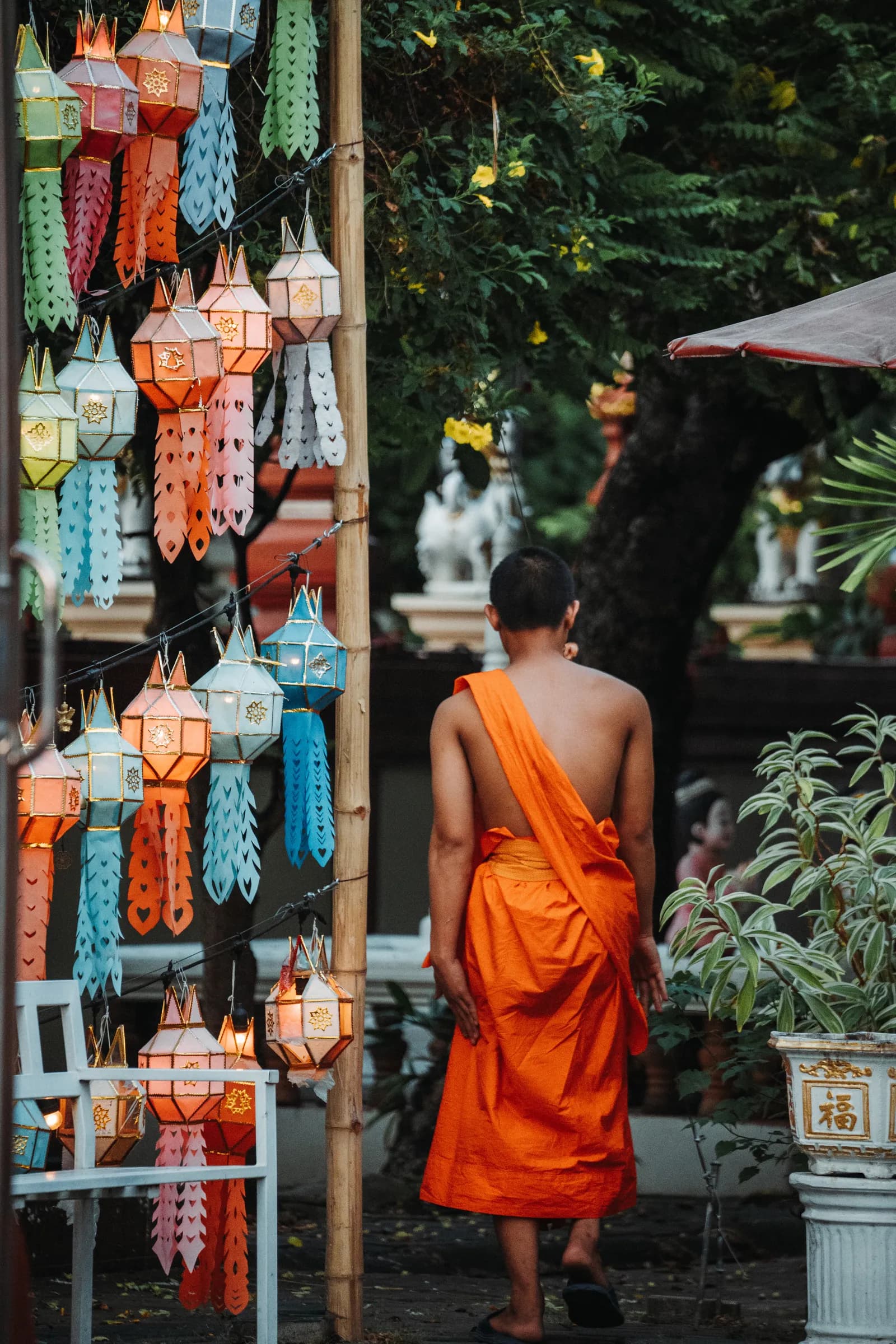
- Wat Chedi Luang: monk chat tables are set up in the grounds, on the north side of the chedi, during the day on most days.
- Wat Suan Dok: the programme run by Mahachulalongkorn Buddhist University, which has its campus in the temple, takes place in the late afternoon, usually from 5pm to 7pm on weekdays.
- Wat Sri Suphan: conversation sessions and introductions to meditation are offered on some evenings, usually from 5.30pm.
Times vary with exams and retreats: ask on the spot the day before.
Frequently asked questions
The vast majority are free, with a donation in the box always welcome. A few very popular temples charge foreigners: about 50 baht at Wat Chedi Luang and Wat Sri Suphan, 40 baht at Wat Phra Singh, 30 baht at Wat Phra That Doi Suthep. Fees change regularly, so carry small change.
One day on foot is enough for the big old-city temples (Chedi Luang, Phan Tao, Phra Singh, Chiang Man). Add half a day for Wat Suan Dok, Wat Umong and Wat Chet Yot, and another half-day for Doi Suthep. Three days lets you see everything without rushing.
Women can visit the whole of Wat Sri Suphan except the inside of the silver ubosot, which is reserved for men. They can see it from outside and through the open door. The entrance fee is the same for everyone.
Cover your shoulders and knees, men and women alike, and avoid see-through clothing. Take your shoes off before entering each hall. Some temples lend or rent sarongs, but it is easier to carry a scarf or light trousers in your bag.
At Wat Chedi Luang, monk chat tables are set up in the grounds during the day. At Wat Suan Dok, the Buddhist university's programme runs in the late afternoon, usually from 5pm to 7pm on weekdays. It is free, and questions about monastic life are welcome.
For sheer presence, Wat Chedi Luang and its ruined brick chedi, six centuries old. For decoration, the Lai Kham chapel at Wat Phra Singh and the silver ubosot of Wat Sri Suphan. For atmosphere, Wat Umong and its tunnels in the forest.
Yes, it is the most sacred temple in the north, about 15km from the old city and over 1,000m up. Entry costs 30 baht for foreigners. Climb the 306-step staircase or take the funicular, and avoid smoky days in March and April, when the view disappears.
My verdict
If you only have one day, do Wat Chedi Luang, Wat Phan Tao and Wat Phra Singh, then Wat Sri Suphan at sunset. Ruin, teak, gold and silver: all of Chiang Mai is there. If you have two days, add Wat Umong: it is the most unexpected of them all, because the mood changes completely, with forest, tunnels and silence.
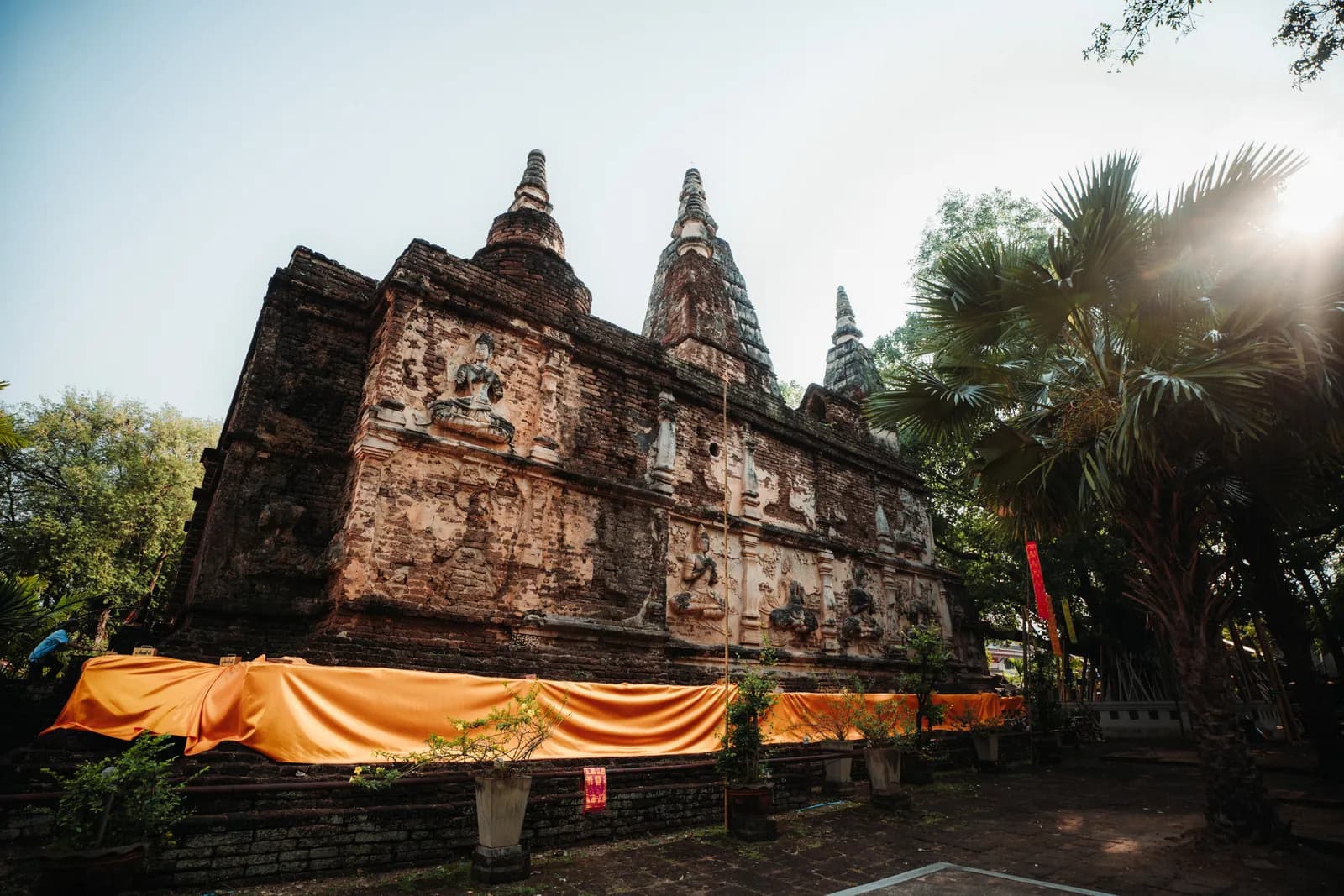
What disappoints a little is the cumulative effect. After the fifth gilded viharn with nagas, you stop telling them apart, and the big old-city temples are swamped by tour groups between 10am and 3pm, especially in high season. Hence my advice: fewer temples, but at the right time. In April 2024, Wat Suan Dok had its main chedi under scaffolding, beneath a milky, smoky sky: I would go mainly for the monk chat and the white chedis.
It is a visit for history lovers, walkers and photographers (my shots are taken on the Sony A7 III). Less so for families with young children in April: between 35 and 40°C, with the smoke, the days are exhausting.
What I liked:
- Wat Umong, its tunnels and its forest, twenty minutes from the centre.
- The east face of Wat Chedi Luang and its nagas, seen through the bougainvillea.
- The silver ubosot of Wat Sri Suphan at sunset.
- The calm of Wat Chet Lin and Wat Chet Yot, where I met almost no one.
What I liked less:
- The midday crowds at Chedi Luang and Phra Singh.
- The April smoke, which washes out every photo and makes walking hard work.
- The ban on women in the silver ubosot, at the same price as men.
Practical information
When to go: from November to February, the cool season, when the air is clean. In March and April, the heat and the smoke from crop burning make the days hard going; my photos from April 2024 show it, and I describe it in my three-month Thailand itinerary.
Getting around: the old city is walkable. For the west and Doi Suthep, the Grab and Bolt apps work well, and red songthaews (shared taxis) go everywhere, with the fare agreed before you get in. A SIM card or eSIM is almost essential for booking rides; see my guide to travel eSIMs.
Saily eSIM
Stay connected with the best secure eSIM
With Saily, the secure eSIM with superpowers, say goodbye to roaming abroad! -5% with code AMEBOHEME.

| Item | Budget per person |
|---|---|
| Wat Chedi Luang | About 50 baht |
| Wat Phra Singh | 40 baht |
| Wat Sri Suphan | 50 baht |
| Wat Phra That Doi Suthep | 30 baht (+ optional funicular) |
| Donations at free temples | 20 baht per temple, as you wish |
| Grab for the half-day in the west | About 200 to 400 baht |
| Total for two days of temples | About 300 to 600 baht excluding meals |
Where to eat: in the old city, Huen Phen, at 112 Ratchamanka Road between Wat Chedi Luang and Wat Phra Singh, has long served northern Thai food (sai ua sausage, nam phrik ong, hang lay curry). Near Wat Umong, Chom Café, on Somphot Chiang Mai 700 Pi Road, is a garden café with waterfalls and misters, open from lunchtime into the evening (check hours before you go). On Sunday evenings, the Sunday Walking Street is a fine substitute for a restaurant.
Where to stay: to visit the temples on foot, stay in the old city. The south-west, around Wat Chet Lin and Nong Buak Haad park, is the quietest corner; the east, towards Tha Phae Gate, is the handiest for markets and restaurants. Nimman, to the west, suits you if you favour the temples beyond the walls.
Further reading
If you are heading south, compare with Wat Chalong, Phuket's most revered temple, very different in style. Coming soon on the blog: a day trip to Doi Inthanon, the complete Chiang Mai guide and the White Temple in Chiang Rai.
Find all my articles on Thailand to plan the rest of your trip.
Sources and fact-checkingInformation checked on 9 October 2026 · 18 sources consulted
- Wikipedia: Wat Chedi Luang (history, 1545 earthquake, Emerald Buddha, city pillar)
- Wikipedia: Wat Phra Singh (founded 1345, Phra Buddha Sihing, Viharn Lai Kham)
- Wikipedia: Wat Chiang Man (1297, elephant chedi, 1581 inscription)
- Wikipedia: Wat Suan Dok (1370, royal chedis, MCU university)
- Wikipedia: Wat Umong (1297, Kue Na's tunnels, 1949 revival)
- Wikipedia: Wat Chet Yot (1455, Buddhist council of 1477)
- Wikipedia: Wat Sri Suphan (silver ubosot, closed to women)
- Wikipedia: Wat Phan Tao (former royal teak residence)
- Wikipedia: Wat Lok Moli (chedi of 1527)
- Wikipedia: Wat Phuak Hong (round chedi of 1517)
- Love Thailand: Wat Chetlin (coronation, pond, opening hours)
- Chiang Mai Citylife: Doi Suthep-Pui entrance fees from October 2025
- Beautiful Chiang Mai: Wat Phra Singh, fee and hours (June 2026)
- Beautiful Chiang Mai: Wat Chedi Luang, monk chat and city pillar (June 2026)
- Beautiful Chiang Mai: Wat Sri Suphan, fee and rules (June 2026)
- Beautiful Chiang Mai: Wat Umong, opening hours (June 2026)
- Beautiful Chiang Mai: Wat Suan Dok, monk chat (June 2026)
- Nomads Travel Guide: Wat Chedi Luang, 2026 fee
Âme Bohème exists thanks to you
Some links in this article are affiliate links. This means that if you book or purchase a product through these links, we receive a small commission, at no extra cost to you. It's thanks to this support that we can continue creating free, quality content.
You can also buy us a coffee, or follow us on Instagram and Facebook.