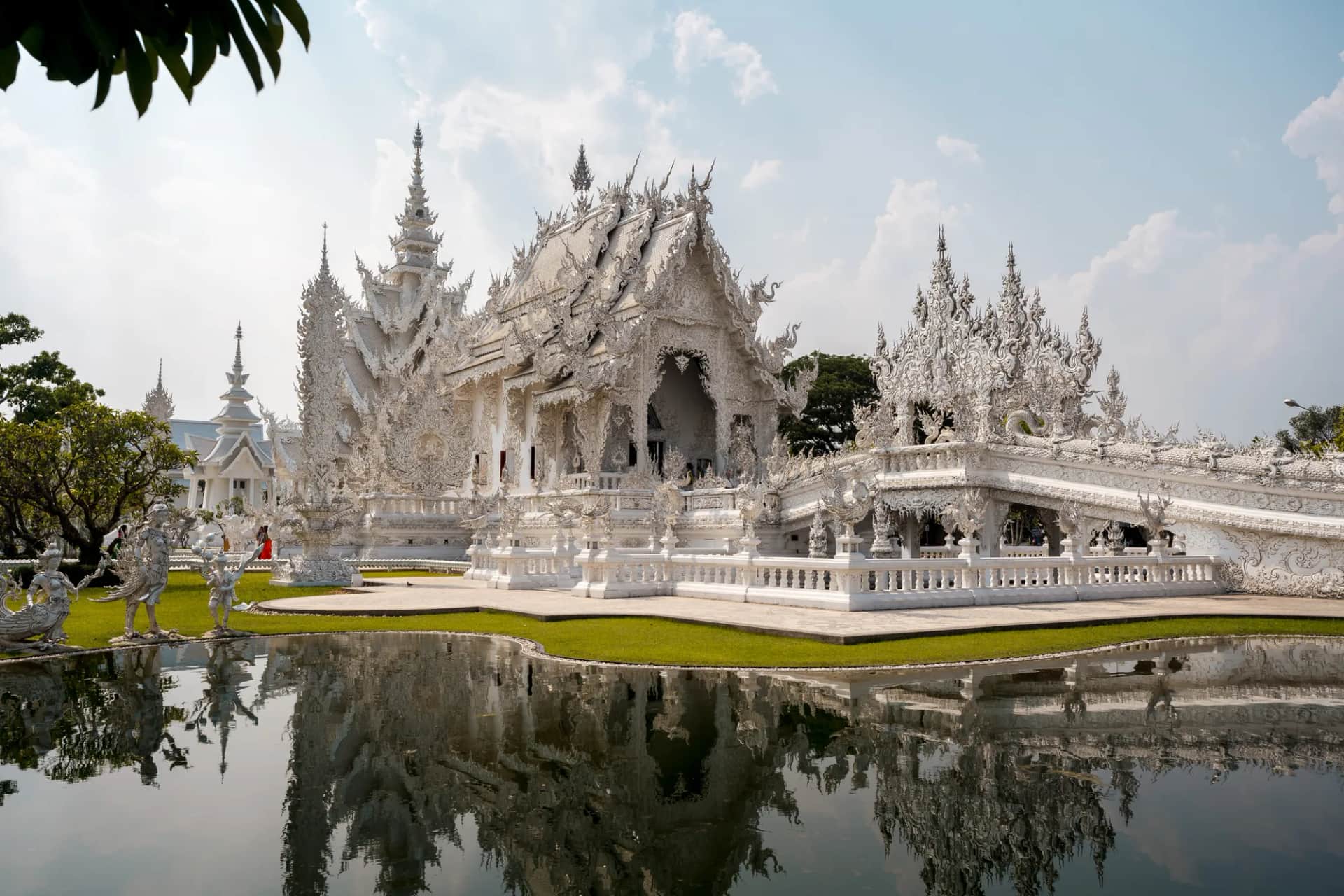

On 20 April 2024, around midday, the sun was beating down so hard on Wat Rong Khun that the white facades were almost blinding. My photos show a dense crowd at the entrance to the ubosot and a tour coach parked just behind the hands of hell. It was my first stop in Chiang Rai, and I covered the whole site: the bridge, the ubosot, the golden pavilion, the artificial caves, the galleries and the famous golden building.
The White Temple is not an ancient temple. It is one man's construction site: the painter Chalermchai Kositpipat has been rebuilding it since 1997 and calls it his life's work. People come as much for a work of contemporary art as for a place of worship, with its symbols, its provocations (Neo from The Matrix painted in the sanctuary) and its rules. This guide brings everything up to date as of October 2026: the new price, the Cave of Art now included, the best time to go, getting there from Chiang Rai or Chiang Mai, and two days to see the rest.
Chalermchai Kositpipat and the temple's history
Chalermchai Kositpipat was born in 1955 in Mueang district, Chiang Rai. A graduate of Silpakorn University, he made his name with Buddhist paintings, including the murals of the Thai temple Wat Buddhapadipa in London, and was named a National Artist of Thailand in 2011. In the late 1990s, he decided to rebuild the old temple of his home village, which was then in poor condition.
Work began in 1997 and has never stopped. Chalermchai funds it himself, with more than 40 million baht invested according to Wikipedia, and for a long time he capped donations at 10,000 baht per person so that no patron could influence his project. The full plan includes nine buildings (ubosot, meditation halls, galleries, monks' quarters), and the artist does not expect to see the end: completion is forecast around 2070, carried on by his students. He summed it up in an oft-quoted line: only death can stop his dream, but not his project.
On 5 May 2014, a magnitude 6.3 earthquake struck neighbouring Mae Lao district, less than 30 km from Chiang Rai. The temple was closed, the ubosot's spire fell, pillars cracked and murals were damaged. Early reports even mentioned demolition, but engineers concluded that the structure was sound, and restoration began quickly. Ten years later, nothing in my April 2024 photos betrays that damage.
One last thing to understand before going in: the white represents the purity of the Buddha, and the thousands of mirror fragments set into the stucco invite introspection, since everyone sees themselves reflected. The whole site is designed as a journey from hell to enlightenment.
The bridge of the cycle of rebirth and the hands of hell
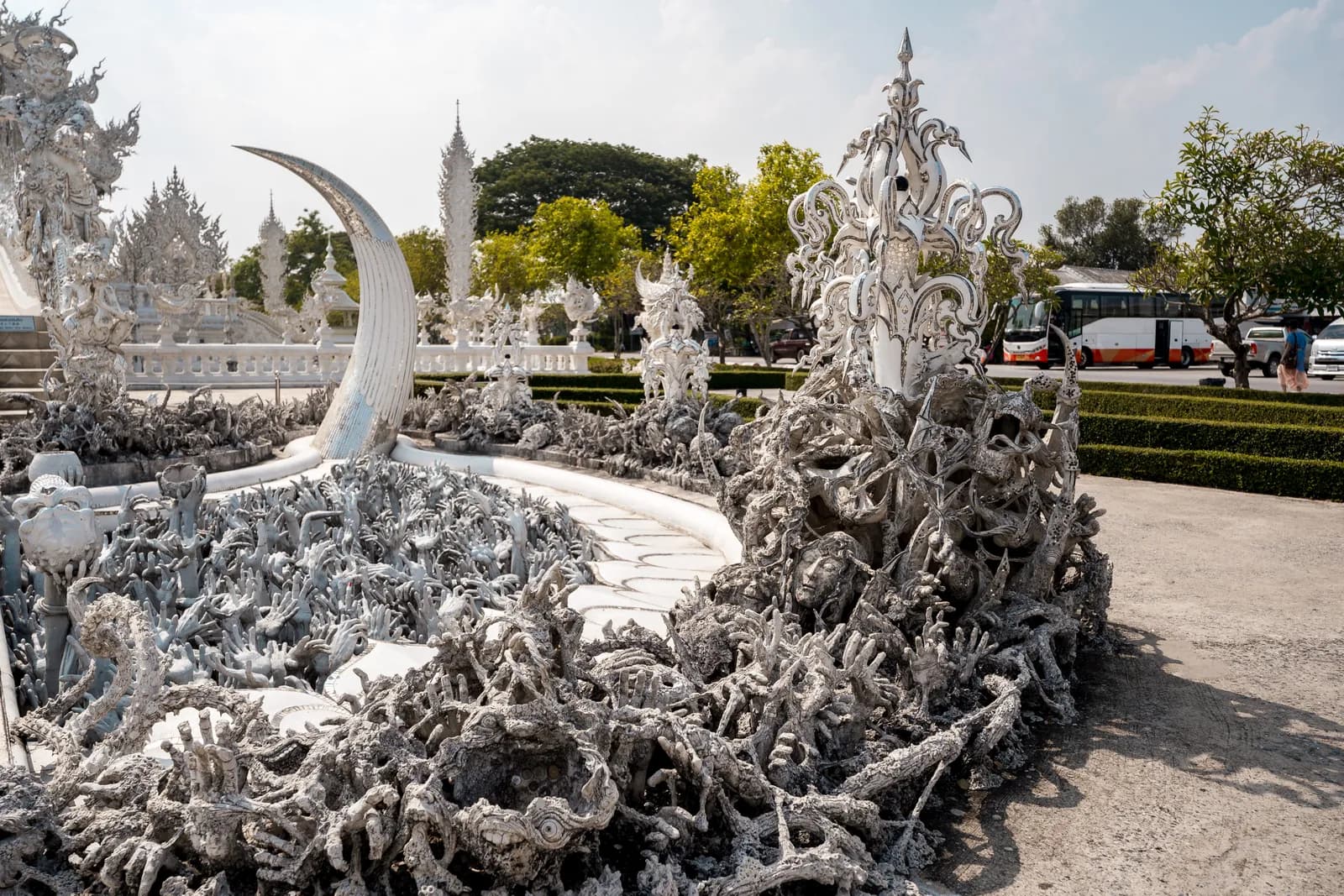
To reach the ubosot, you take a narrow walkway across a semicircular pool. On either side, hundreds of grey stucco hands rise from the ground and reach out towards you. They represent unrestrained desire and souls trapped in hell. Two large white crescent-shaped tusks frame the path, and among the mass you can pick out skulls, demon heads and a few horror film characters.
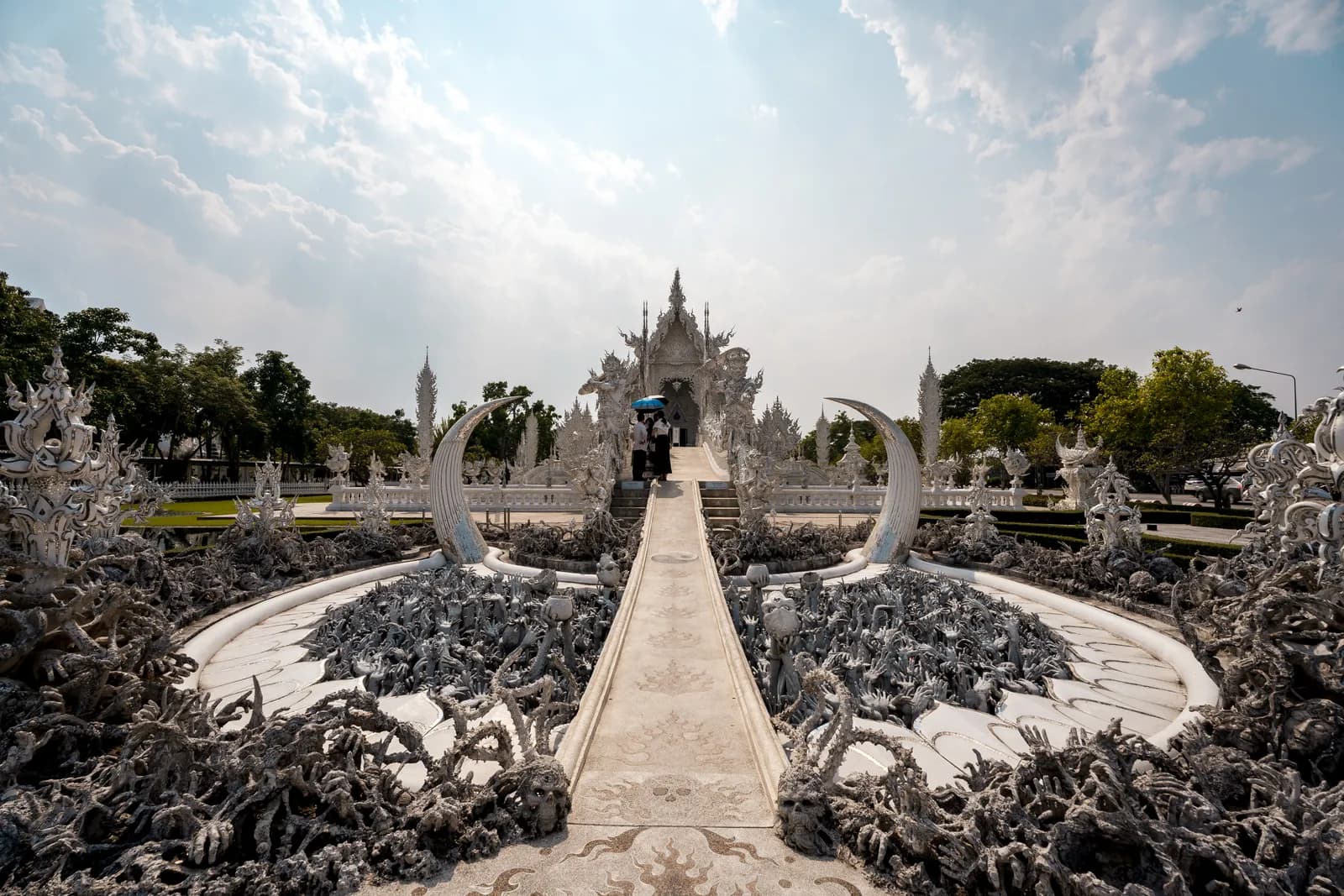
This is known as the bridge of the cycle of rebirth: crossing it symbolically means leaving temptation and suffering behind to reach the "gate of heaven". The gate is guarded by two figures, Death and Rahu, the deity who decides the fate of the dead. Behind them sit meditating Buddhas, just in front of the sanctuary entrance.
In practice, the bridge is crossed in one direction only (no turning back, in keeping with the symbolism) and you are not allowed to linger. At peak times, the queue shuffles along. Take your photos of the bridge from the edge of the pool before stepping on: that's where the perspective is best, as in my shot taken straight down the axis.
The ubosot, outside and in
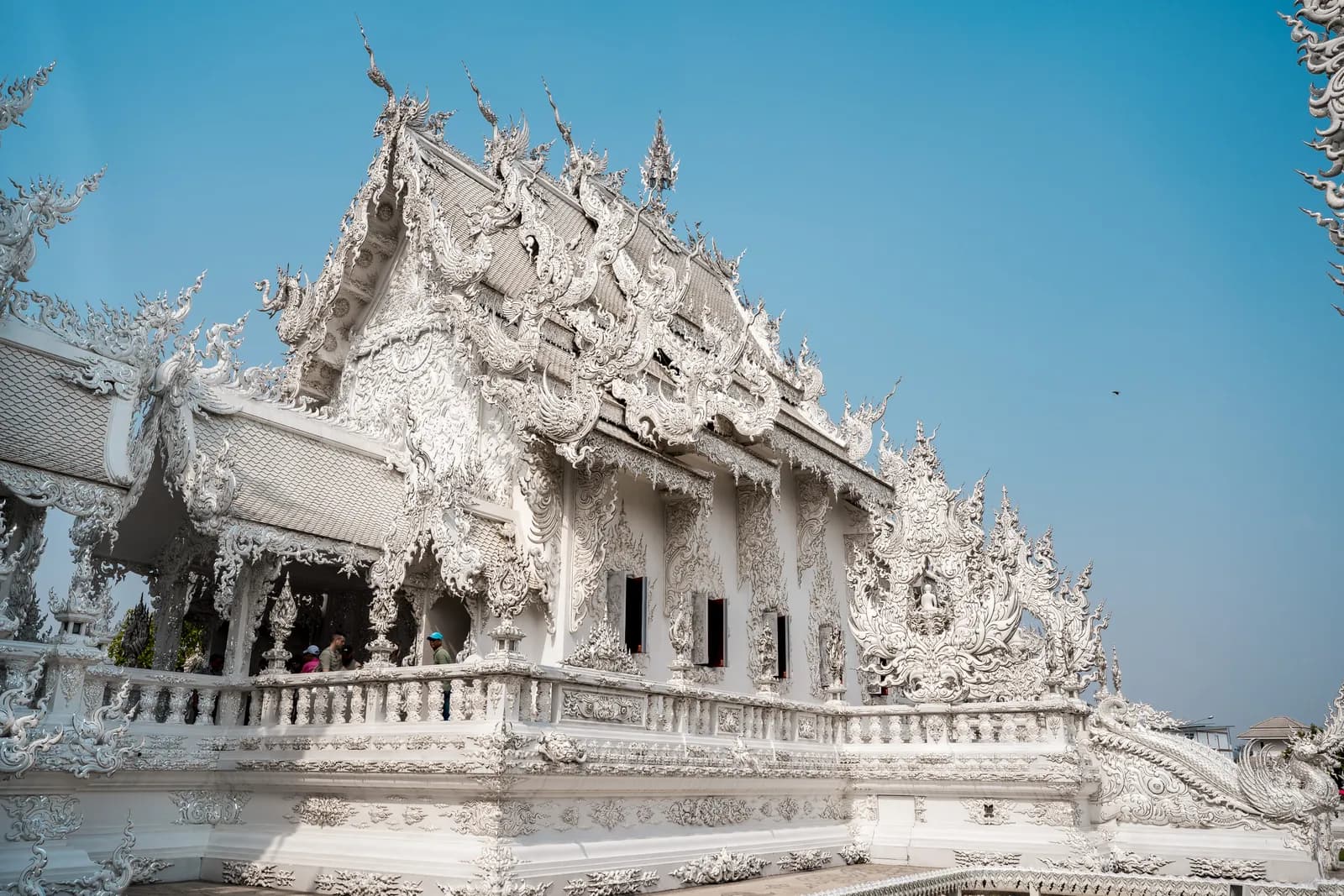
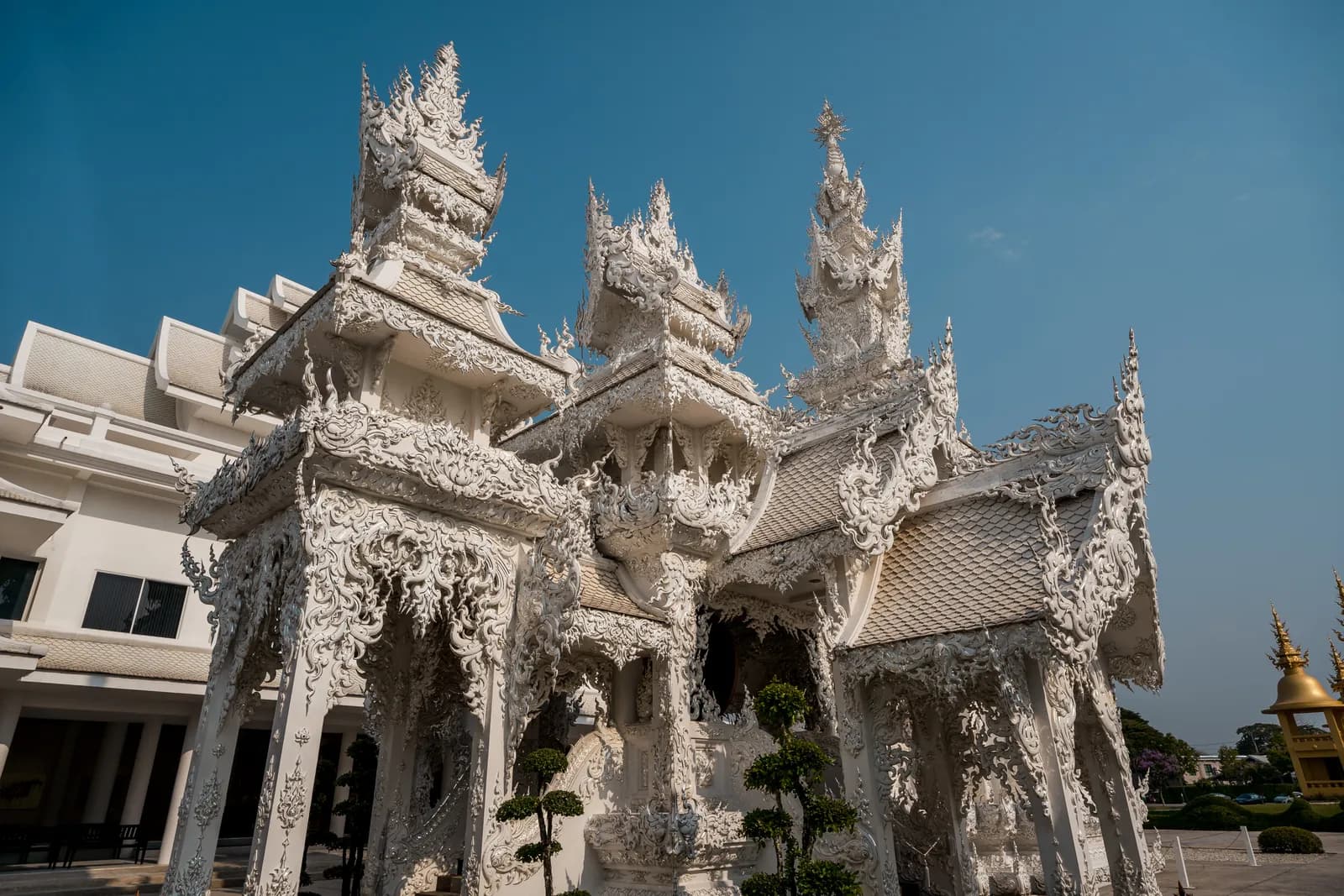
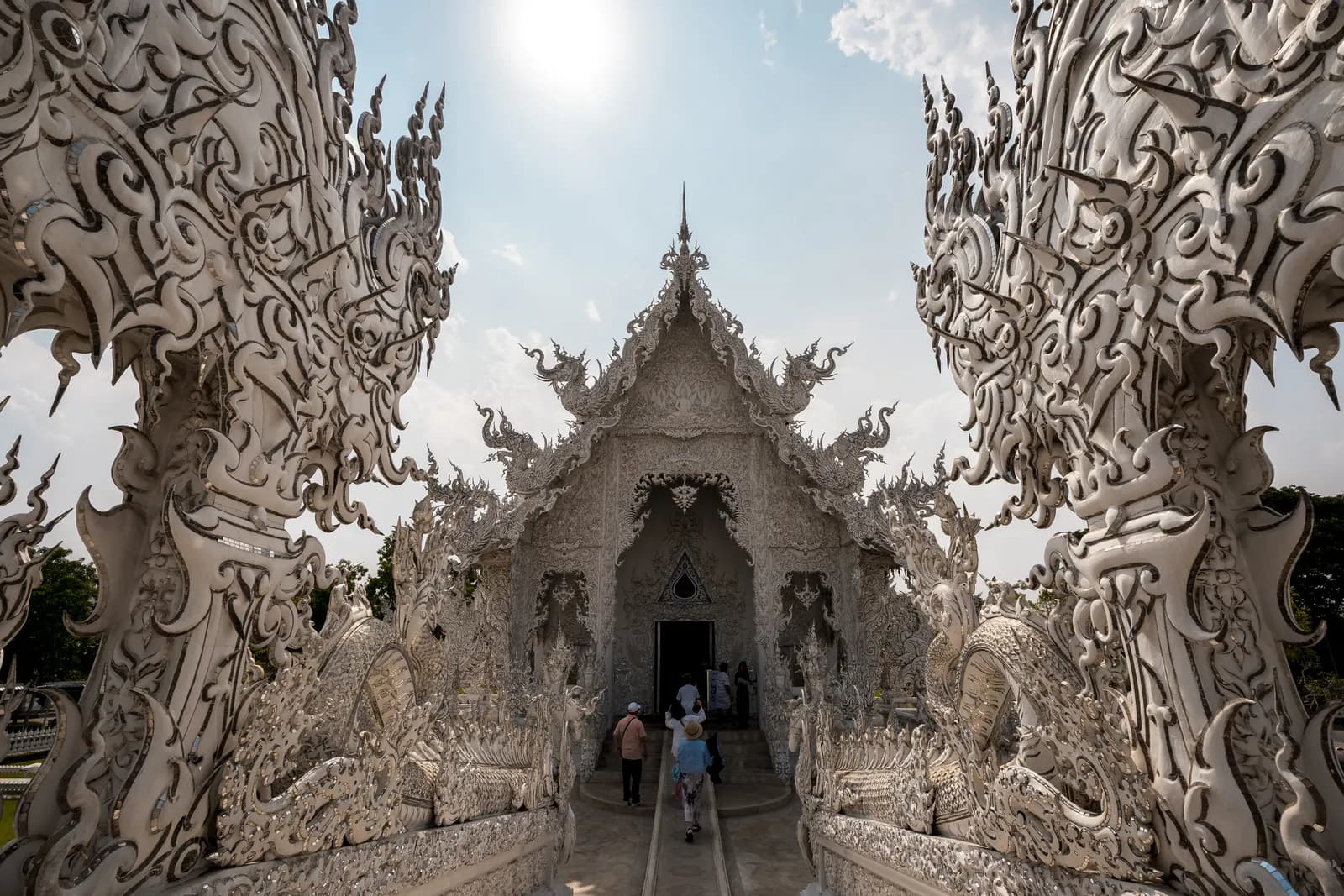
The ubosot (ordination hall) is the heart of the site. From outside, it is a riot of detail: three tiers of stacked roofs, nagas (mythical serpents) winding along the balustrades, gables carved like lace and thousands of mirror fragments that sparkle as soon as the sun moves. My best views of the building were taken from a low angle with a wide lens, with blue sky behind the gables: up close, you can appreciate the delicacy of the stucco work, which leaves no surface plain.
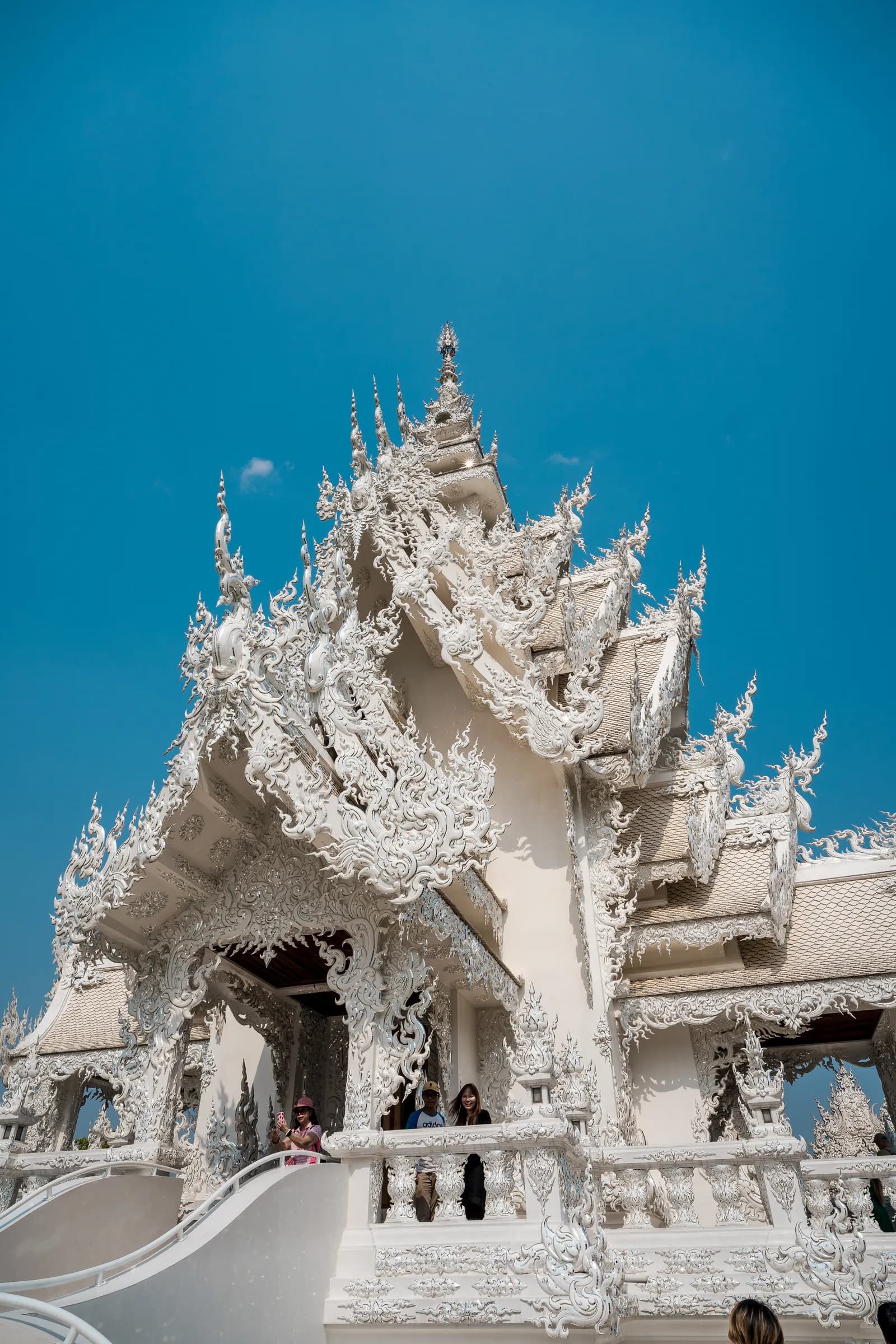
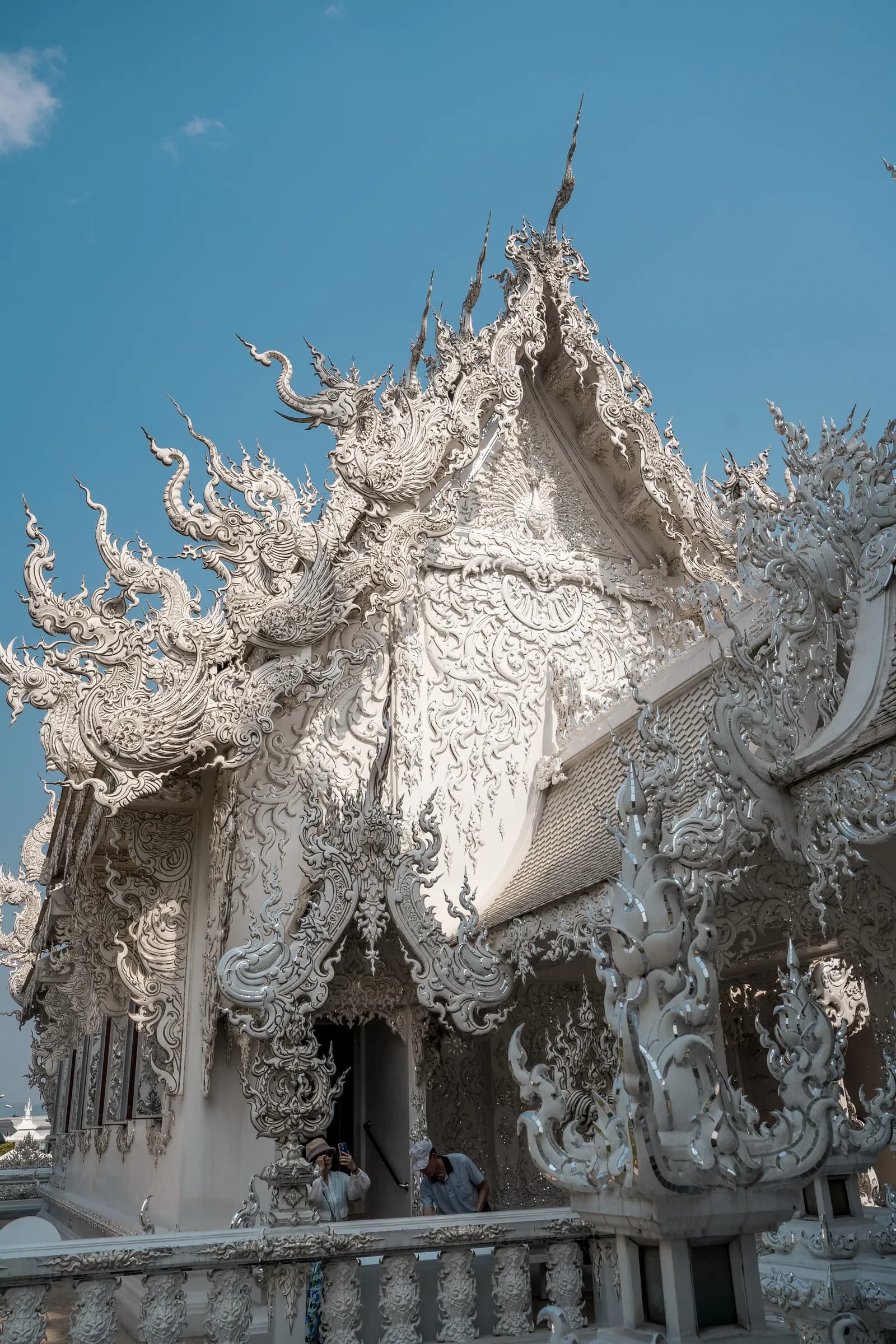
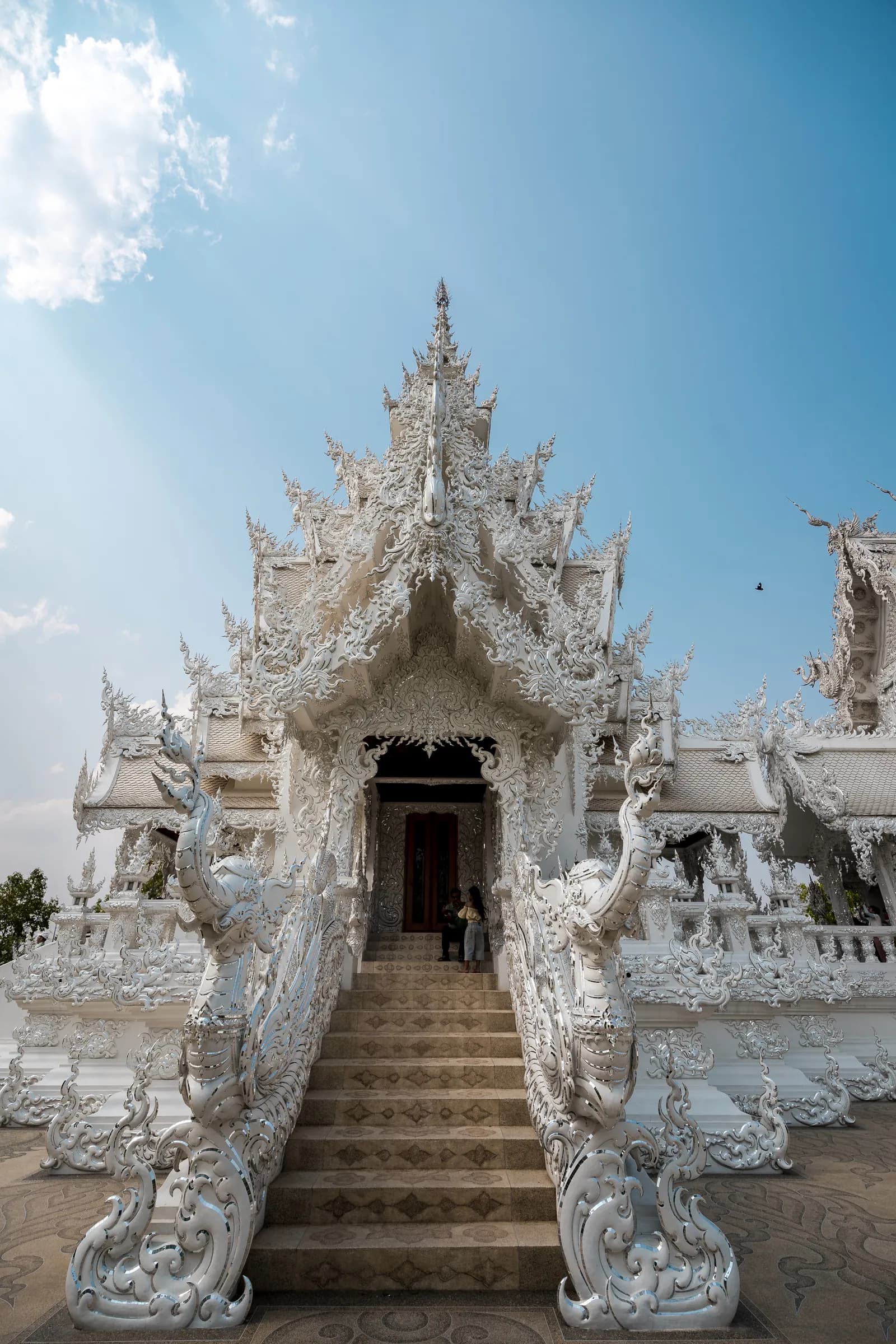
Photos : Pierre Bouyer
The interior murals
The interior surprises every visitor. On the walls, orange flames and demon faces surround figures from Western pop culture: Neo from The Matrix, Michael Jackson, Freddy Krueger, a Terminator, Superman, Spider-Man, Harry Potter, Kung Fu Panda, Hello Kitty, and even a plane hitting the Twin Towers on 11 September, watched by an Angry Bird. The artist's message is clear: modern violence, greed and hedonism lead humanity away from enlightenment.
Photos and videos are strictly forbidden inside, and guards enforce the rule. You take your shoes off at the entrance (a plastic bag is sometimes provided to carry them), speak quietly and never point your feet at the Buddha. If you'd like a record of the murals, the on-site shop sells prints.
The rest of the site, beyond the ubosot
Many visitors head back to the car park straight after the ubosot. That's a shame: the secondary buildings are sometimes more photogenic than the temple, with far fewer people. Allow at least 45 minutes for this part.
The golden building, or Thailand's finest toilets
In the middle of a neatly clipped garden stands a fully gilded building, as ornate as the temple. These are the toilets. The joke is not entirely a joke: in Chalermchai's symbolism, gold represents the body and earthly desires (money, material things), as opposed to the white of the mind. Putting gold in a toilet block says what he thinks of attachment to wealth.
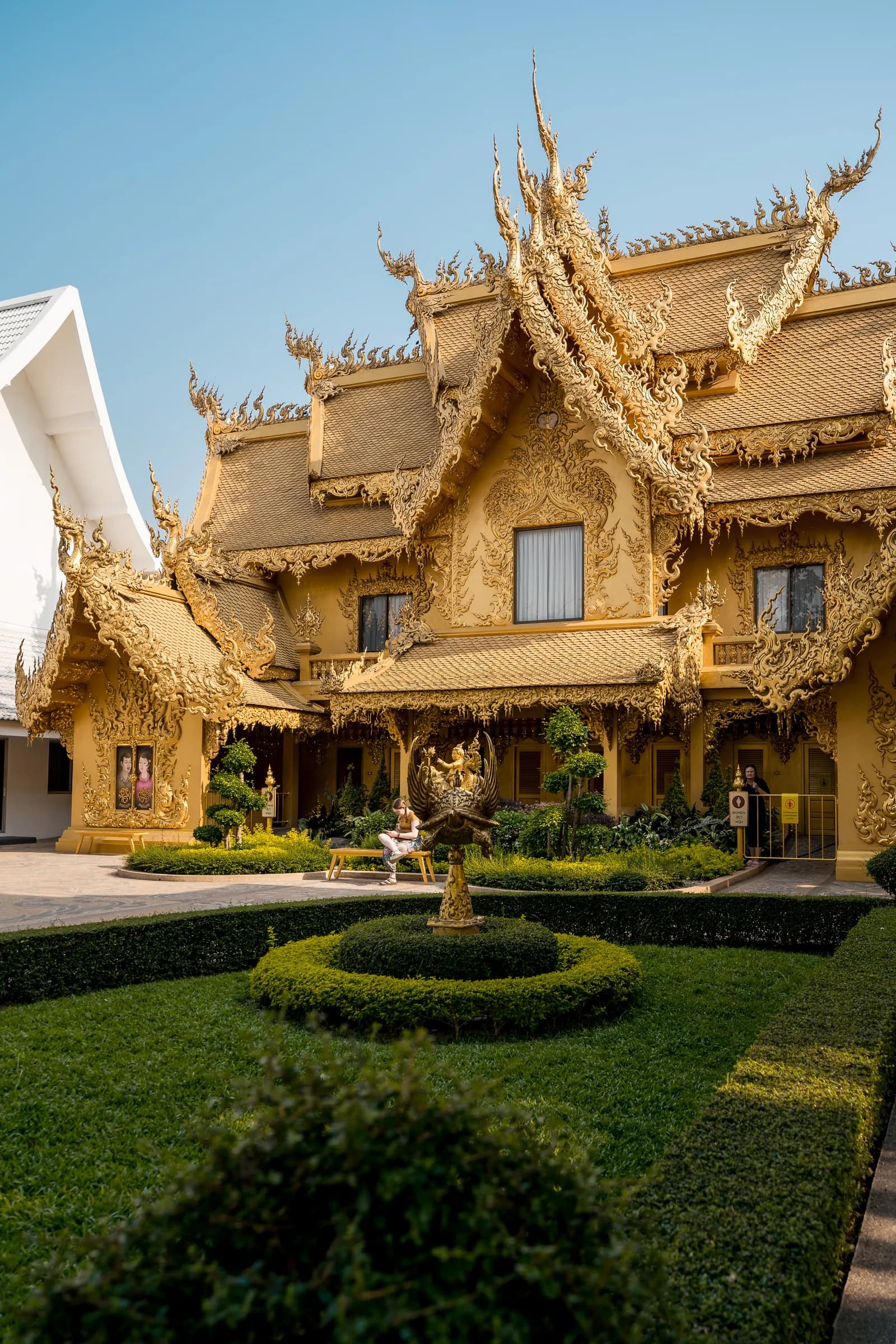
The golden pavilion on the pond
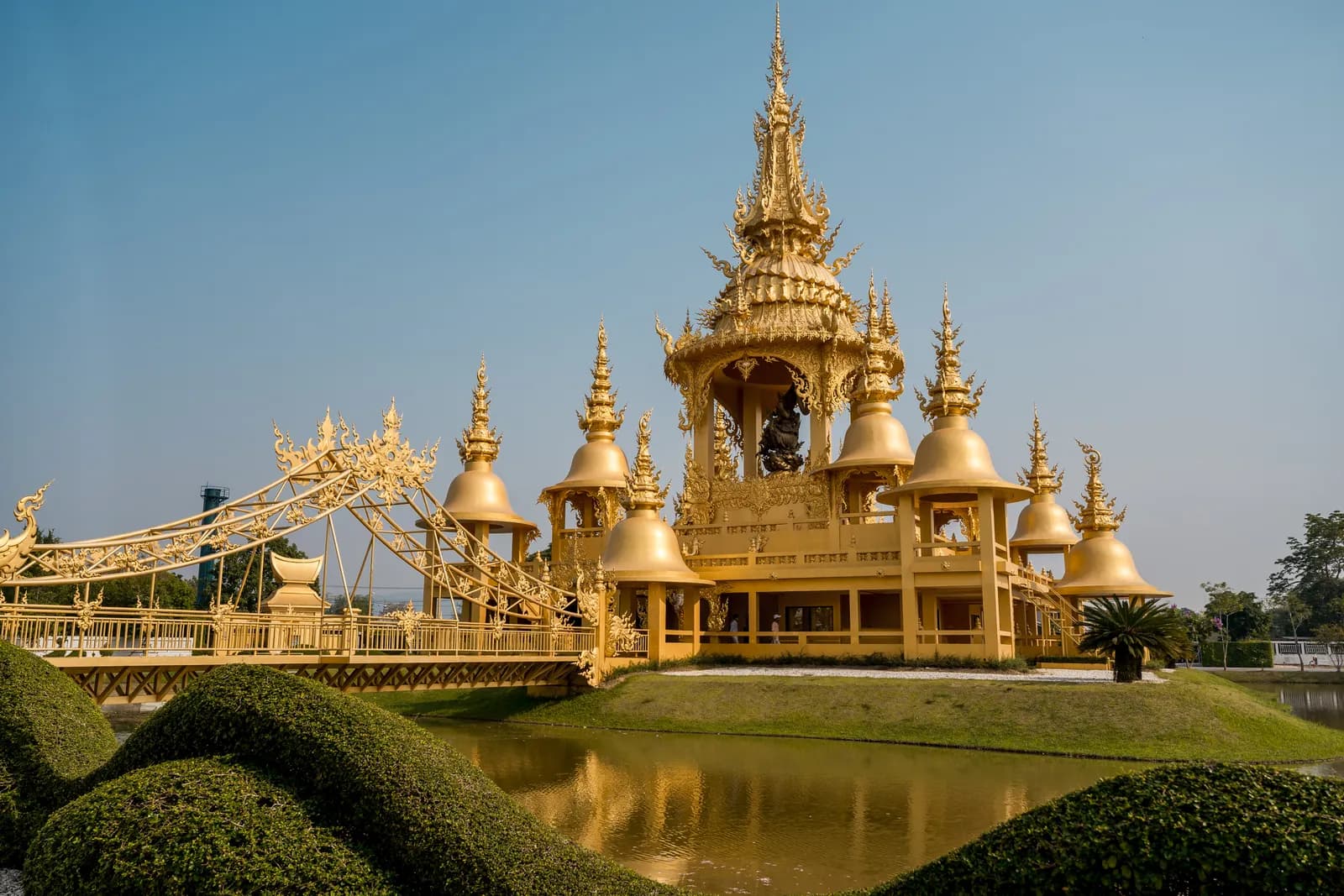
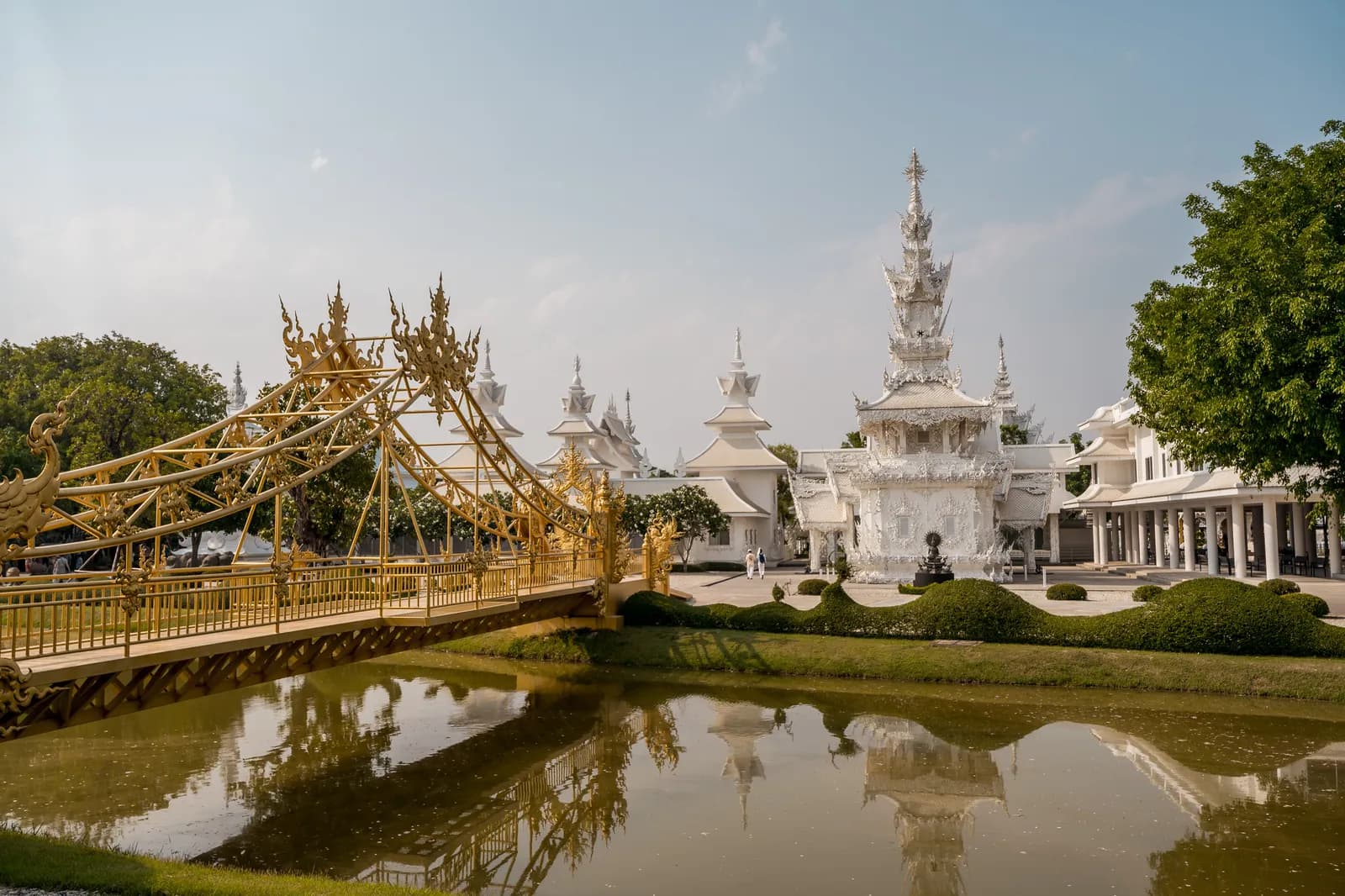
Further on, a golden pavilion bristling with spires and bells is reflected in a pond. You reach it via a golden footbridge with flame-shaped railings. According to the guides I consulted, this pavilion is dedicated to Ganesha, the elephant-headed deity Thais pray to for success. With the gold reflected in the green water, it is one of the finest viewpoints on the site.
Photos : Pierre Bouyer
The galleries and the artist's gallery
Along the path bordering the site stand white buildings with carved facades and trees whose trunks bear stucco faces. Here you'll find the gallery devoted to Chalermchai Kositpipat, displaying his Buddhist paintings. It deserves twenty minutes: you understand that the artist is first and foremost a painter, and that the temple extends his canvases into three dimensions.
The Cave of Art, included since 2026
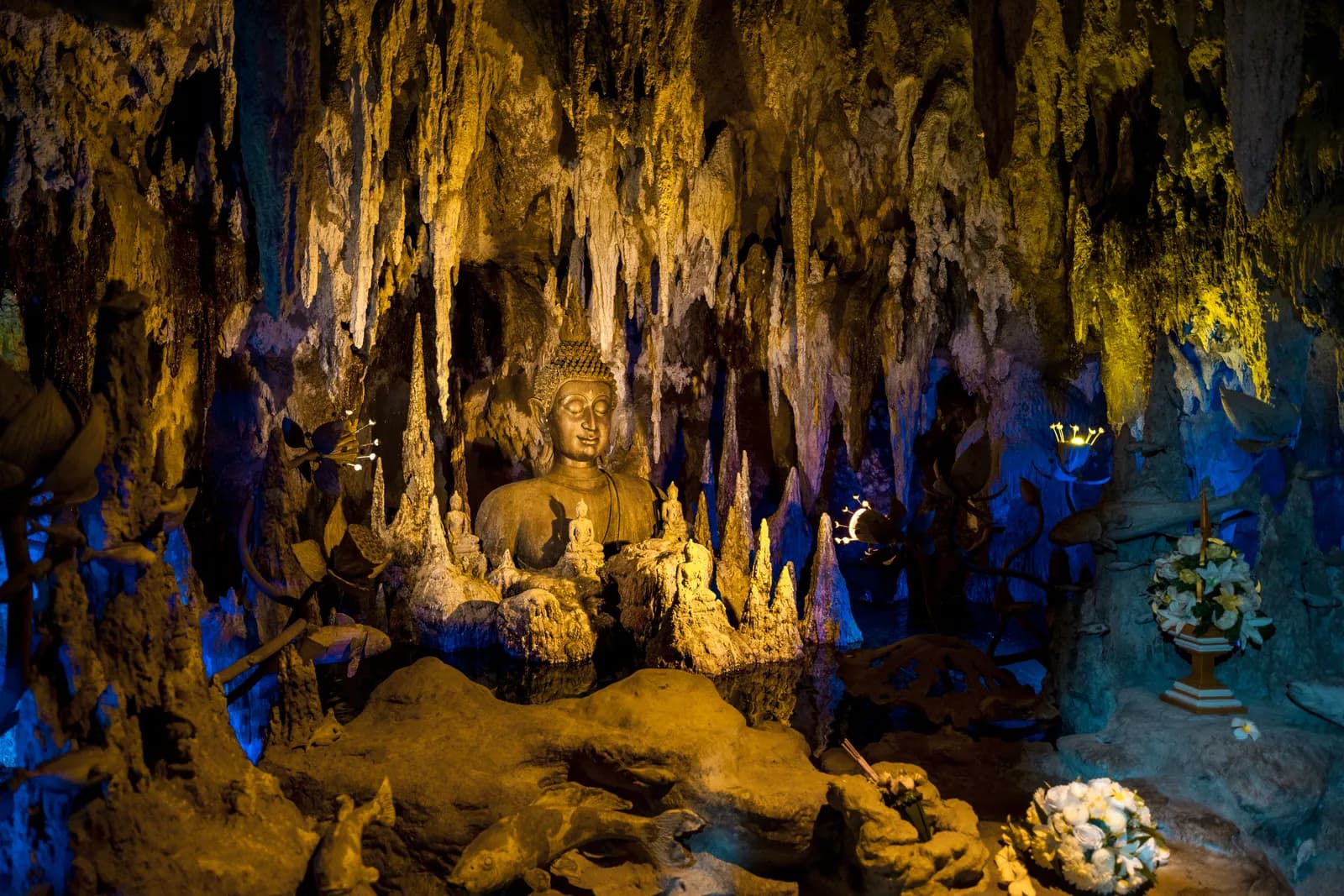
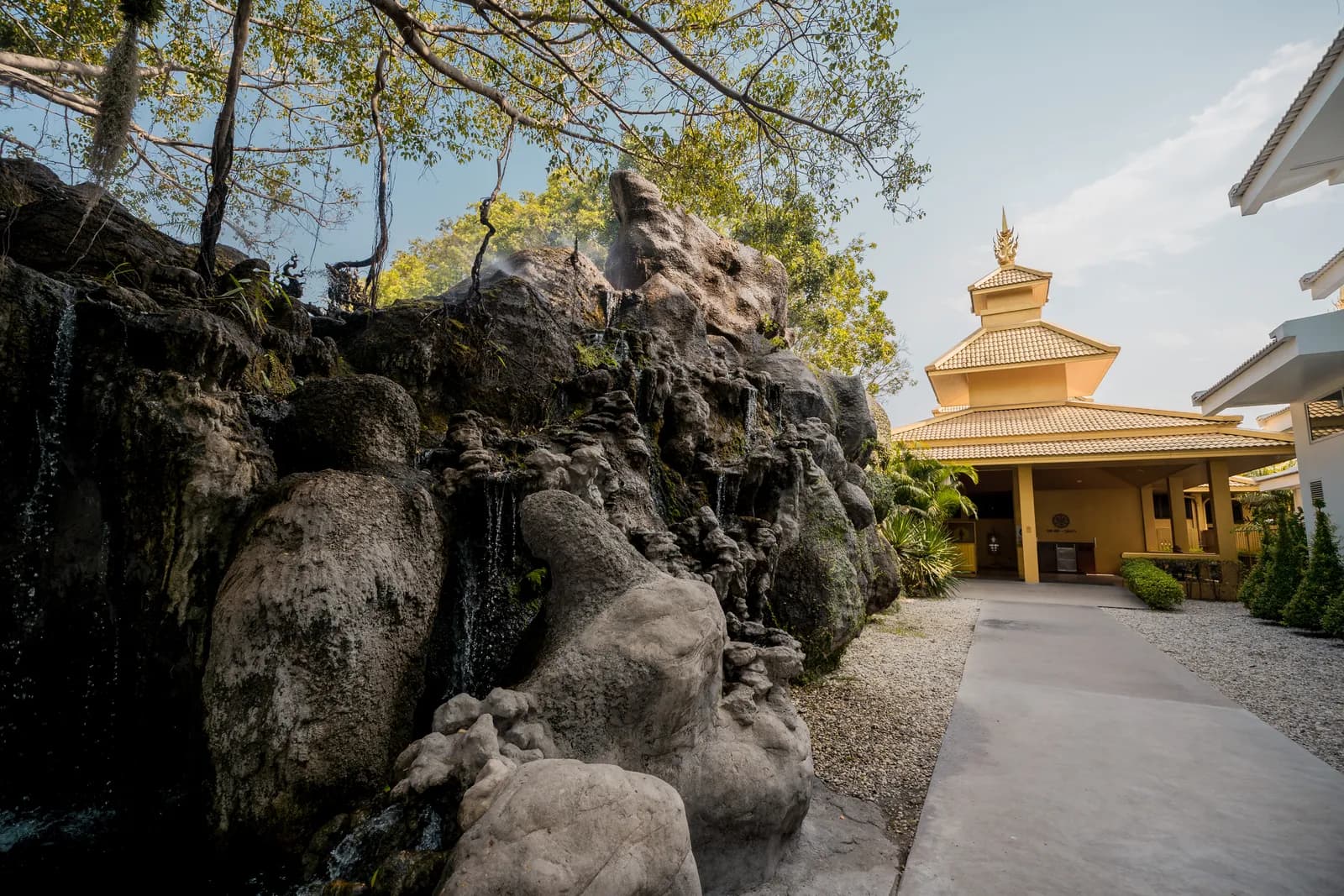
The Cave of Art is the latest addition to open on the site, near the back entrance and the car park. It is an artificial cave with narrow passages that took the artist and his team more than six years to complete. The route leads symbolically from hell to heaven: first statues of demons and hands emerging from the walls, then chambers bathed in blue and green light, and finally a sanctuary where a Buddha sits among stalactites and stalagmites.
Photos : Pierre Bouyer
Until 2025, the Cave of Art required a separate 50-baht ticket. Since 1 January 2026, it has been included in the 200-baht ticket, which softens the price rise a little. In April 2024, I photographed the artificial rocks, the waterfalls around the entrance and the inside of a cave lit in yellow and blue, with a Buddha among the formations. Allow 15 to 20 minutes, and skip it if you're claustrophobic: some passages are low and narrow.
Best time and crowds
The White Temple fills up on a very predictable schedule. Day trips leaving Chiang Mai around 7am arrive after 3 hours on the road: coaches follow one another from 10am to 2pm, just when the light is harshest. In my midday photos, the crowd is packed in front of the ubosot entrance.
- 8am to 9.30am: the best slot. Few people, soft low light that brings out the relief of the stucco, and crisp reflections in the pool if the wind hasn't picked up yet.
- 10am to 2pm: the worst time. Crowds on the bridge, a queue at the ubosot entrance, and heat reflected off the white (over 35°C in April).
- After 3.30pm: the crowds thin and the golden light returns, but the ubosot may close before the site does. A good option if you're staying in Chiang Rai.
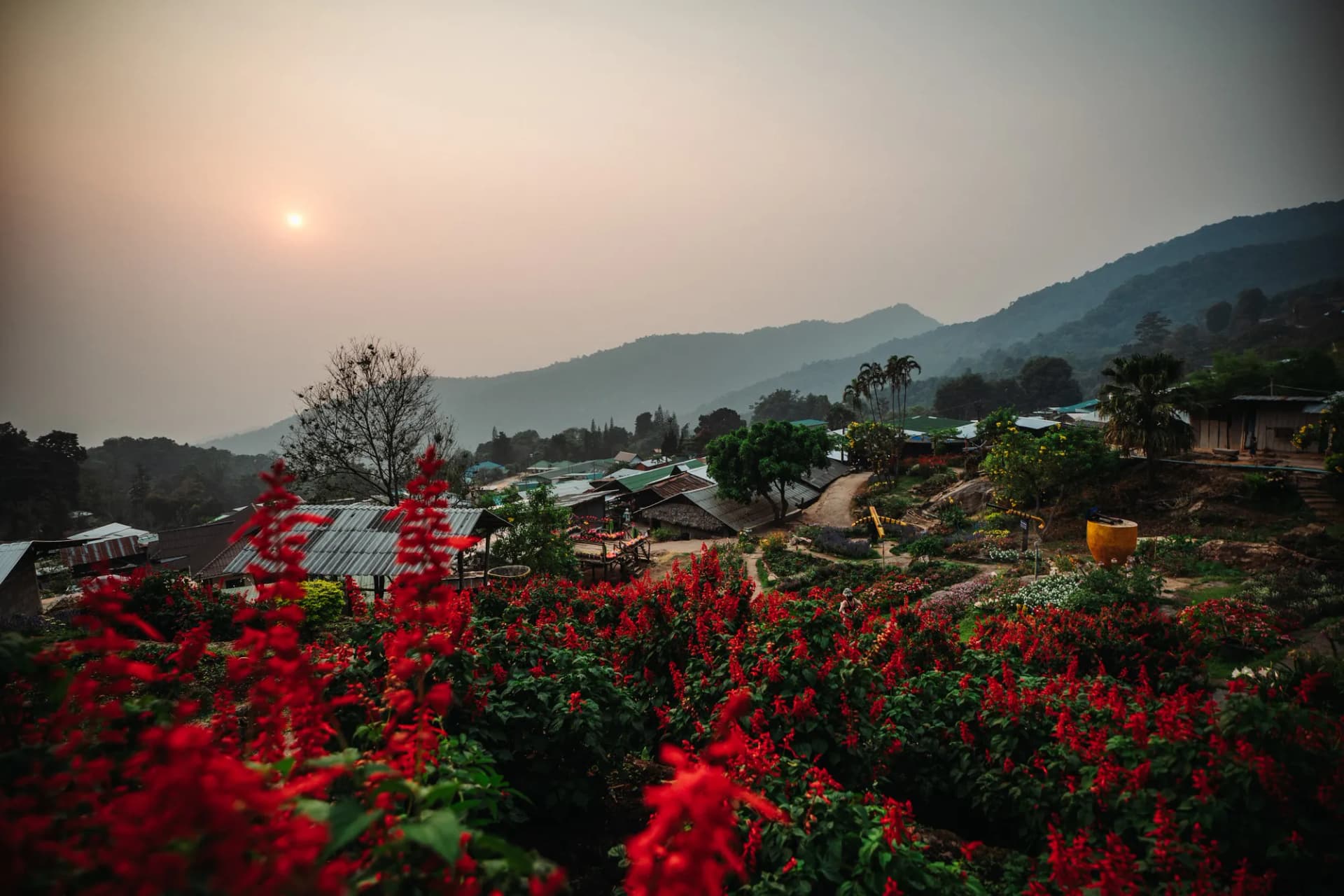
If possible, avoid weekends and Thai public holidays, when local visitors add to the foreign crowds. As for the season, November to February brings clear skies and cool mornings. From February to April, smoke from crop burning veils the sky: on the day of my visit, the sun was no more than a pale disc in the afternoon, as I explain in my article on the burning season in the north.
Dress code, rules and pitfalls
Wat Rong Khun is still a working temple, and staff enforce the dress code at the entrance.
- Clothing: shoulders covered, no vest tops or backless tops; legs covered at least to the knees, no short shorts or short skirts. Since 2026, a sarong is lent free of charge to visitors who don't comply, but a light shirt and loose trousers are more comfortable at 35°C.
- Shoes: off before entering the ubosot. Slip-on sandals save time in the queue.
- Photos: allowed everywhere except inside the ubosot. Leave the drone at home.
- Behaviour: don't sit on the balustrades, don't touch the sculptures (the stucco and mirrors are fragile), and don't stop on the bridge.
The most common pitfalls: arriving at 11am and spending the visit in the crowds; paying top price for a tuk-tuk without agreeing the return trip, when free vehicles become scarce in the late afternoon; leaving without cash, as the ticket office only takes cash according to several recent guides; and leaving without seeing the golden pavilion or the Cave of Art, even though they are included in the ticket.
Prices, opening hours and budget
The 2026 increase got people talking: the ticket doubled, from 100 to 200 baht, to fund the upkeep of a very demanding site (specialist cleaning, restoration of the stucco and mirrors, gardens). The Cave of Art and the sarong loan were added to the ticket in return.
| Item | Price in October 2026 | Good to know |
|---|---|---|
| White Temple entry (foreigner) | 200 baht | Since 01/01/2026, 100 baht in 2024; cash |
| Entry (Thai nationals, over-70s, children under 120 cm) | Free | ID may be requested |
| Cave of Art | Included | 50 baht extra until 2025 |
| Local bus from Chiang Rai Terminal 1 | 15 to 20 baht | About 30 minutes |
| Grab or taxi from the centre | 200 to 300 baht one way | About 20 minutes |
| Organised tour from Chiang Mai | 2,000 to 2,500 baht | 12 to 14 hours, often with the Blue Temple and Golden Triangle |
| Blue Temple | Free | Open 7am to 8pm |
| Guanyin lift (Wat Huay Pla Kang) | 40 baht | 7am to 6pm |
| Black House, Baan Dam | 80 baht | 9am to 5pm, closed 12pm to 1pm |
White Temple opening hours: daily from 8am to 5.30pm, with the ticket office closing around 5pm. For a full independent day in Chiang Rai (White Temple, Grab transport, a meal on site), budget around 600 to 800 baht per person.
Getting there from Chiang Rai
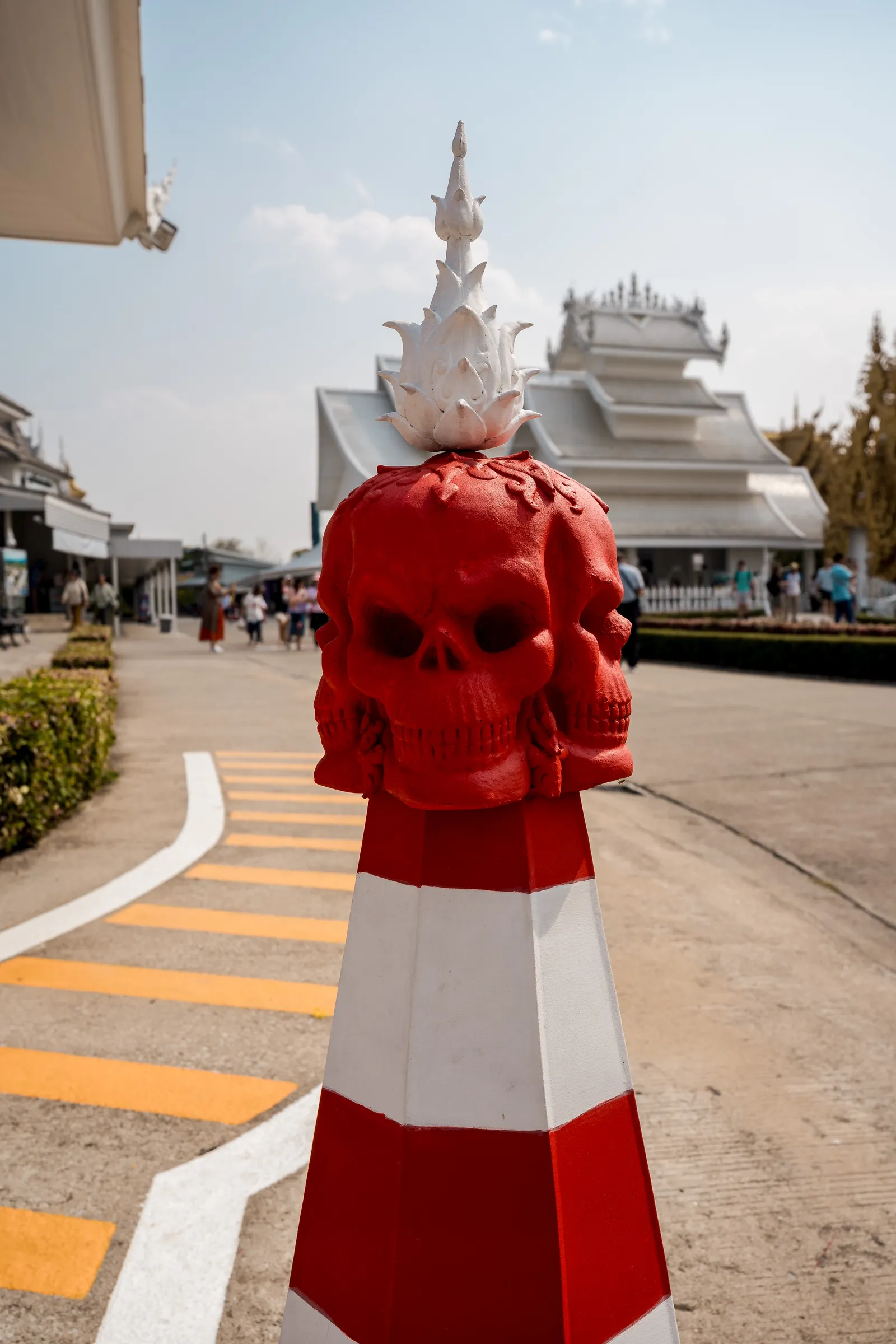
The temple is in Pa O Don Chai subdistrict, about 13 km south of central Chiang Rai, beside Highway 1 towards Chiang Mai. Coming from the car park, you pass red and white bollards topped with skulls: the tone is set before you even get in.
- Local bus: buses leave from Terminal 1, the old central terminal near the Night Bazaar, and drop you by the road opposite the temple. Expect 15 to 20 baht and around 30 minutes. The last ones run in the late afternoon.
- Grab, Bolt or taxi: the easiest option, 20 minutes for 200 to 300 baht one way. You'll need mobile data to book the return from the car park.
- Songthaew or private tuk-tuk: handy for linking several sites in a day. Agree the price and waiting time before setting off.
- Scooter: Highway 1 is wide but very busy. It's the most flexible way to combine the White Temple, Singha Park (about 6 km away) and Wat Huay Pla Kang, provided you hold a valid licence and are used to driving on the left.
BikesBooking
Scooter, motorbike, quad & buggy rental worldwide
Compare verified local rental companies and book a scooter, motorbike, quad or buggy at the best price. Instant confirmation, free cancellation.


From Chiang Mai: is the day trip worth it?
Chiang Rai is about 3 hours by road from Chiang Mai, and many agencies offer the round trip in a day, for around 2,000 to 2,500 baht per person: hotel pickup around 7am, a stop at the Mae Kachan hot springs, the White Temple, the Blue Temple, lunch, sometimes the Black House, then the Golden Triangle and its boat ride, and back around 8pm or 9pm.
My view is fairly clear-cut: it's doable, but it isn't the right way to see the White Temple. Here's why:
- Time on the road: about 6 hours in a minibus out of a 12 to 14-hour day. You spend more time sitting than looking at temples.
- Timing: tours reach the White Temple between 10am and 1pm, exactly when the crowds and the glare are at their worst. You'll never see the calm morning reflection.
- Time on site: often 45 minutes to an hour, not enough for the Cave of Art, the gallery and the golden pavilion.
- Price: for the same budget, a night in a decent Chiang Rai hotel and two Greenbus journeys (around 130 to 260 baht each depending on class) let you see everything at your own pace.
The day trip makes sense in one case: if you only have one day to spare and are set on the Golden Triangle. Otherwise, do as I did: two days on site, with a calm visit to the temple and evenings in town. If you're planning your stay in Chiang Mai, my guides to the most beautiful temples in Chiang Mai and a day at Doi Inthanon will help you weigh up the two regions.
Combining it with the rest of Chiang Rai
The area around Chiang Rai has a remarkable collection of contemporary sites, often linked to Chalermchai Kositpipat or his students. Here's what I saw in two days, and what I missed.
The Blue Temple, Wat Rong Suea Ten
North of the centre, near the Kok River, the Blue Temple was designed by Phuttha Kabkaew, a student of Chalermchai, and opened to the public in 2016. Entry is free (open 7am to 8pm). On the morning of 21 April 2024, the sky was clear and the blues intense: a blue and gold facade guarded by nagas, a blue and gold chedi, a blue elephant and a misted garden full of sculptures. Inside, a large white Buddha sits in a nave painted entirely in midnight blue. Unlike the White Temple, photos are tolerated here, quietly. Allow 30 to 45 minutes; it was already busy, but nothing like Wat Rong Khun.
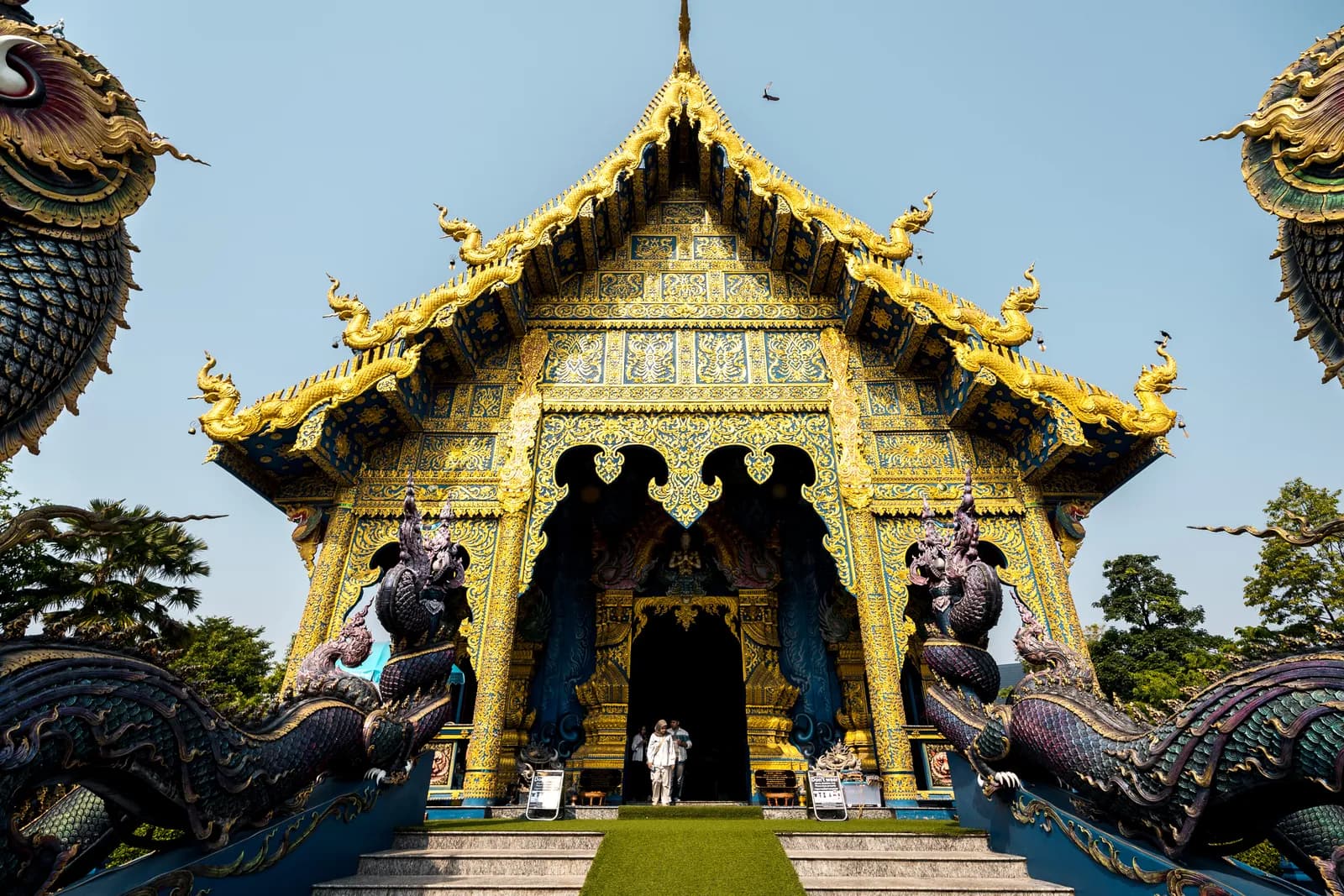
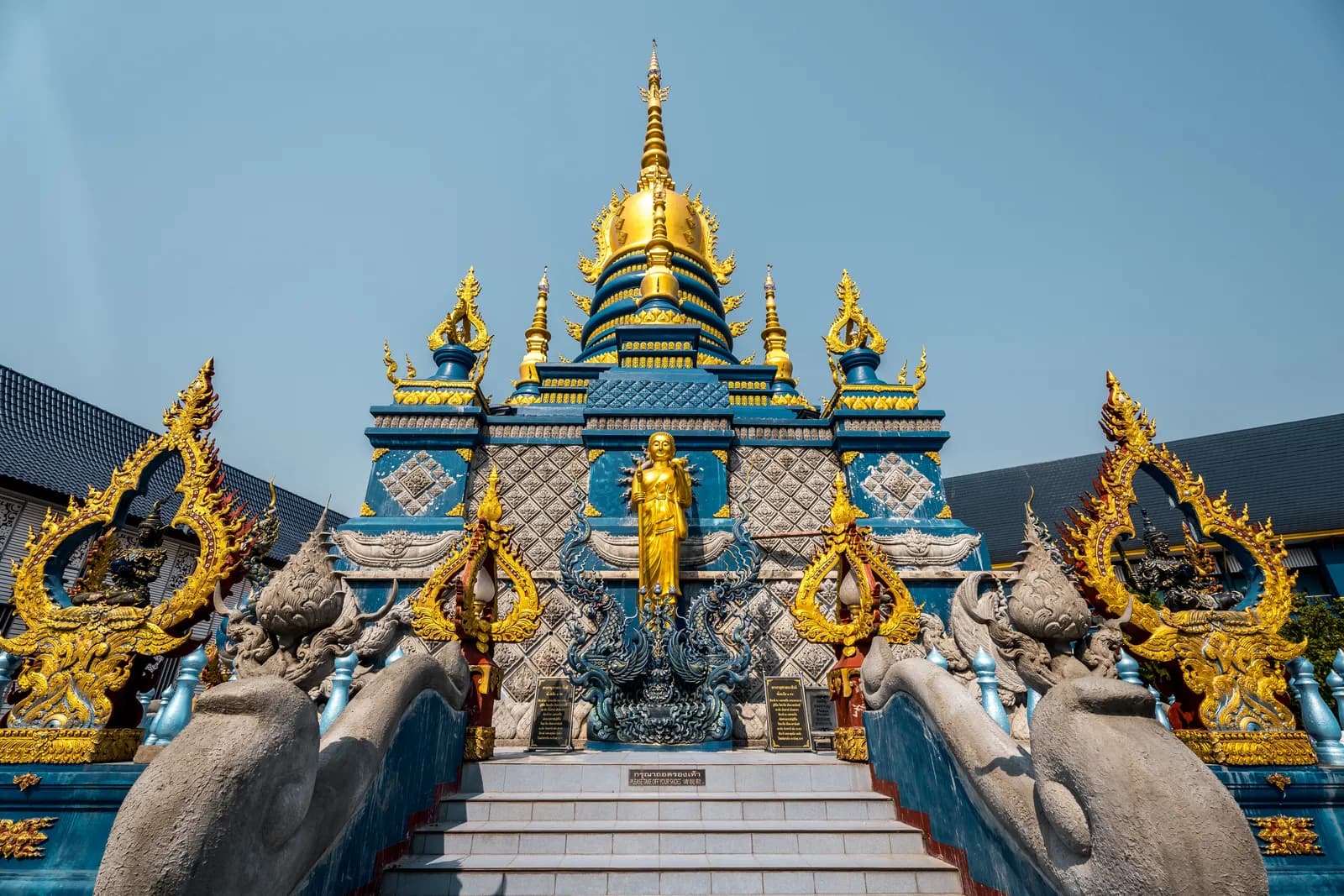
Photos : Pierre Bouyer
Wat Huay Pla Kang, the giant Guanyin
West of town, on a hill, a white statue of Guanyin (Kuan Im, the bodhisattva of compassion), about 69 m tall, overlooks the plain. The staircase leading up to it is flanked by white dragons, and a lift (40 baht, 7am to 6pm) climbs inside the statue to portholes looking out over the whole valley. Next to it, a nine-tiered Chinese pagoda, guarded by two multicoloured dragons, houses prayer halls.
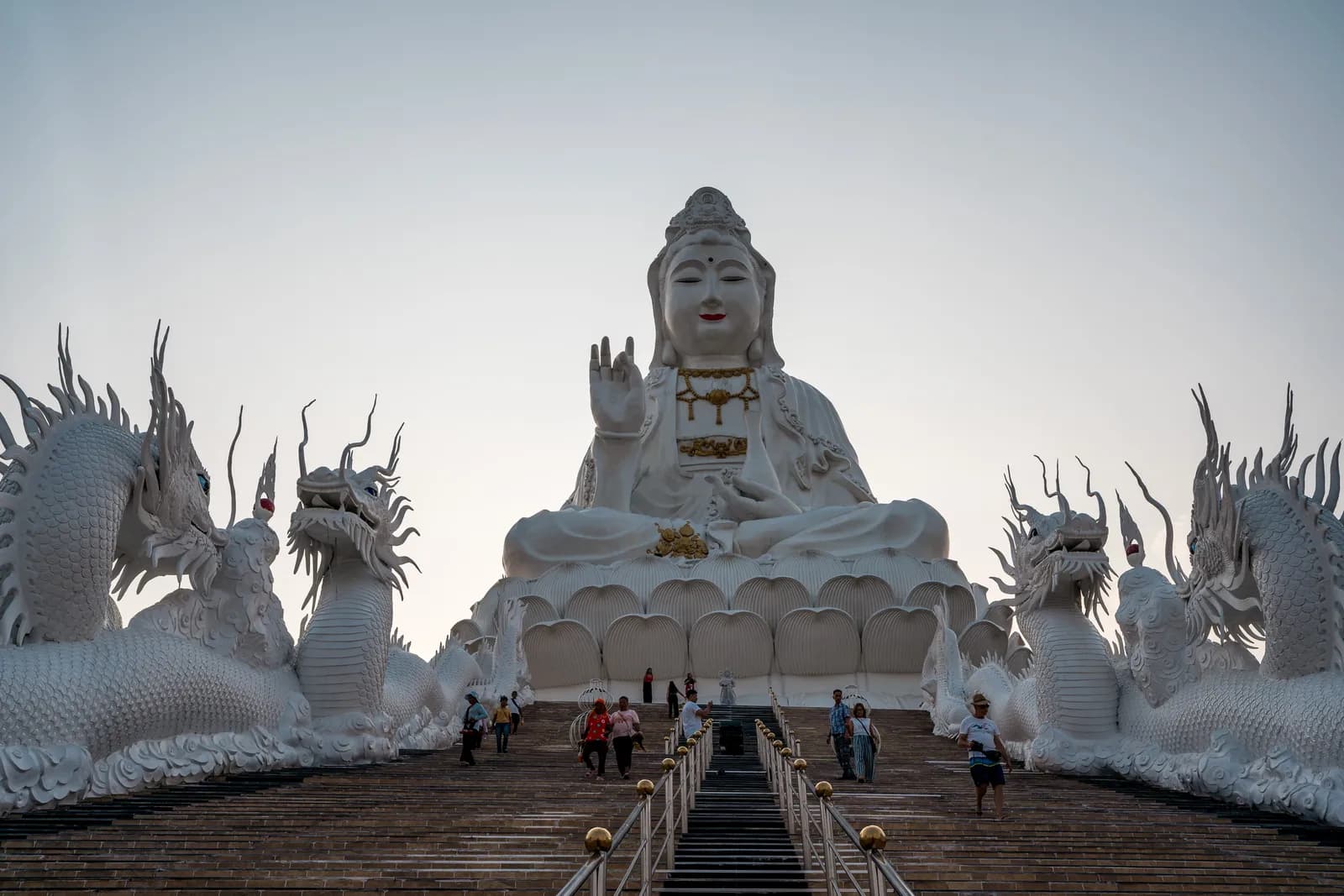
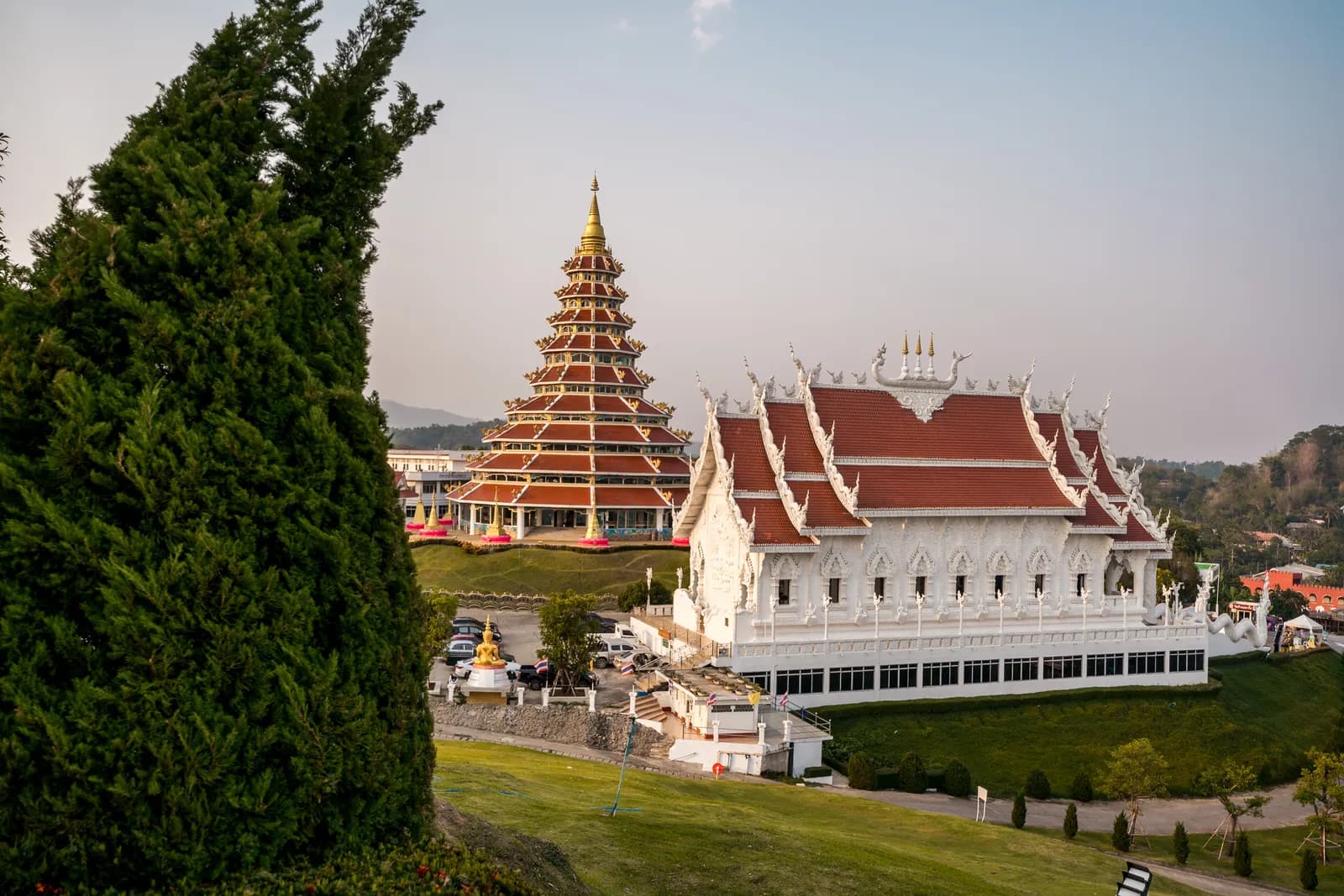
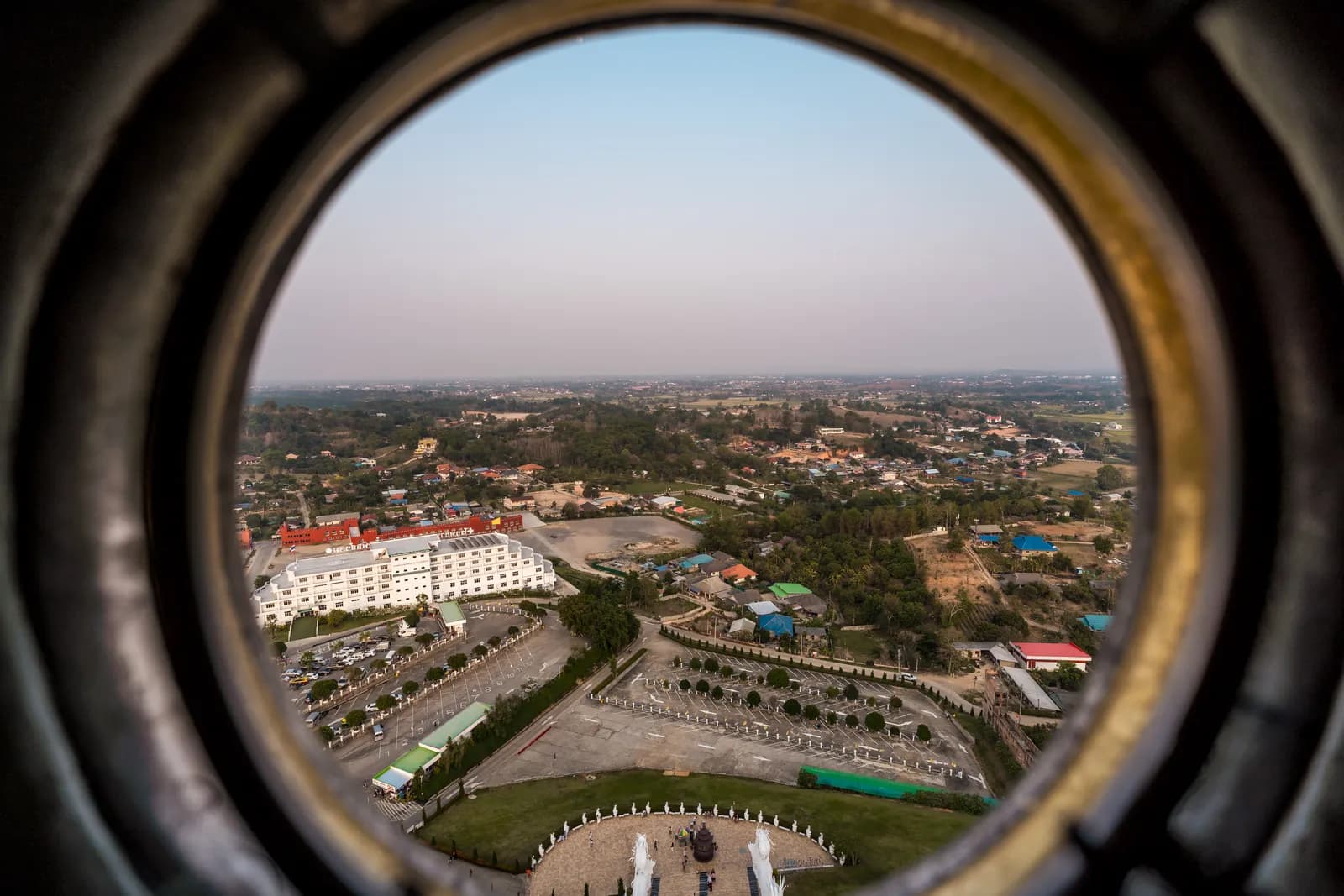
Photos : Pierre Bouyer
I went on 20 April in the late afternoon, after the White Temple, and that's the time I recommend: pink sunset light on the statue, the plain fading into haze, and a site that stays open until 9pm. Entry to the temple is free. Covered clothing is required to enter the statue.
The Black House, Baan Dam
I didn't photograph it, but it is the perfect counterpoint to the White Temple. Baan Dam is the work of another National Artist, Thawan Duchanee (who died in 2014), who spent nearly forty years building a complex of more than 40 black teak houses, 13 km north of town. Animal skins, skulls, horns and carved furniture create a dark and unsettling world. Entry costs 80 baht, 9am to 5pm with a break from 12pm to 1pm.
Singha Park
About 6 km from the White Temple, Singha Park is a huge farming estate of nearly 13 km² owned by the Singha brewery: tea plantations, lakes, cycle paths, an observation tower and an enclosure with giraffes and zebras. Entry is free (9am to 6pm); the sightseeing tram costs 150 baht, and you can rent bikes or e-bikes. I stopped by on the 20th in the late afternoon, when the big golden statue of the Singha lion stood out against a pale, smoke-hazed sun, then again on the 21st for the tea plantations. A good green break between two temples.
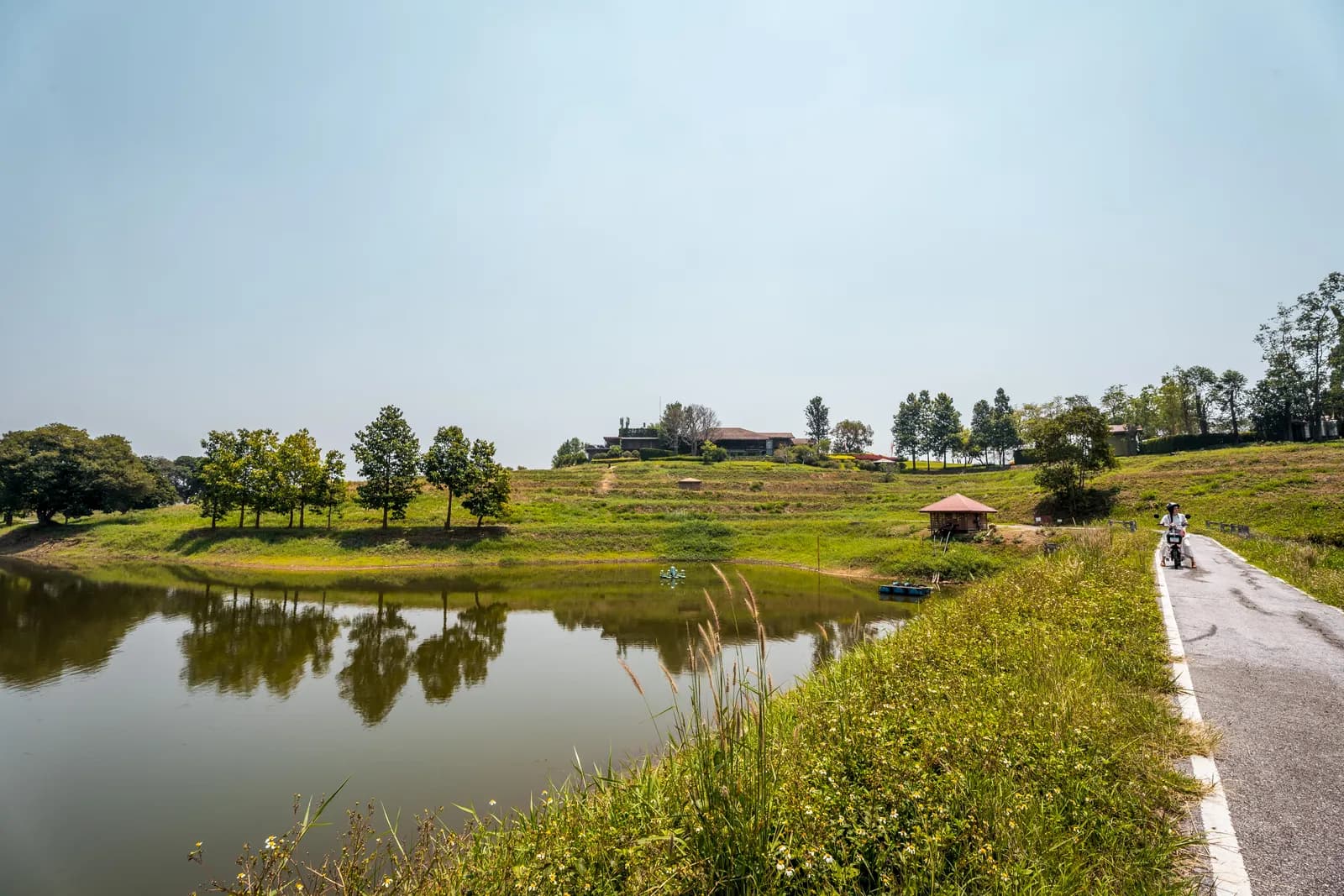
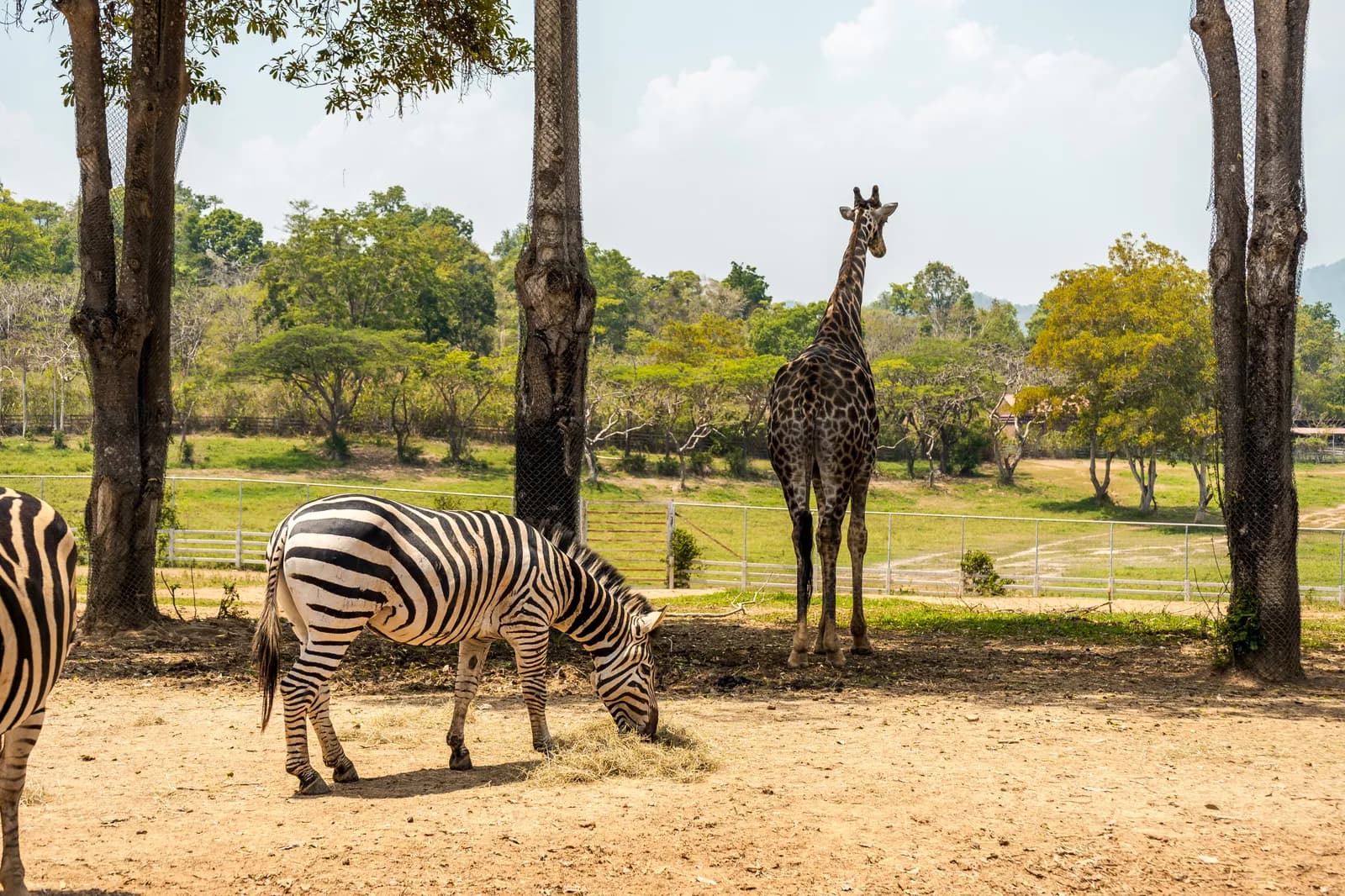
Photos : Pierre Bouyer
The night markets
The Night Bazaar, near Terminal 1, opens every evening from 6pm to midnight, with craft stalls and a large open-air food area facing a stage. On Saturdays, Thanalai Road becomes pedestrianised for the Saturday Walking Street (roughly 4pm to 11pm, busiest between 6pm and 8pm), and on Sundays it's the turn of San Khong Noi Road. On the evening of 20 April, I photographed fruit stalls still lit by the sunset, then streets lined with clothing stalls and a food court full of white tables.
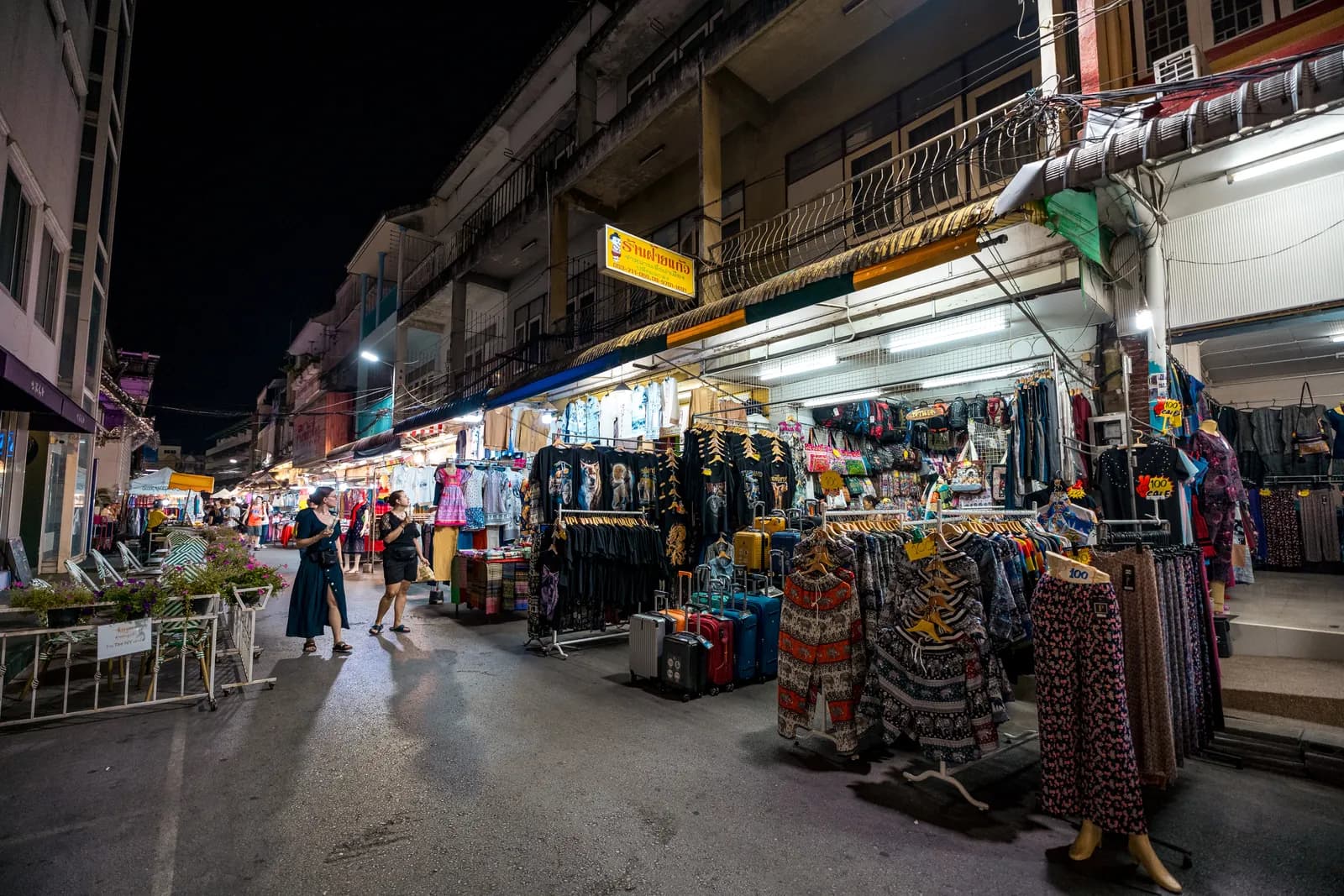
The golden clock tower
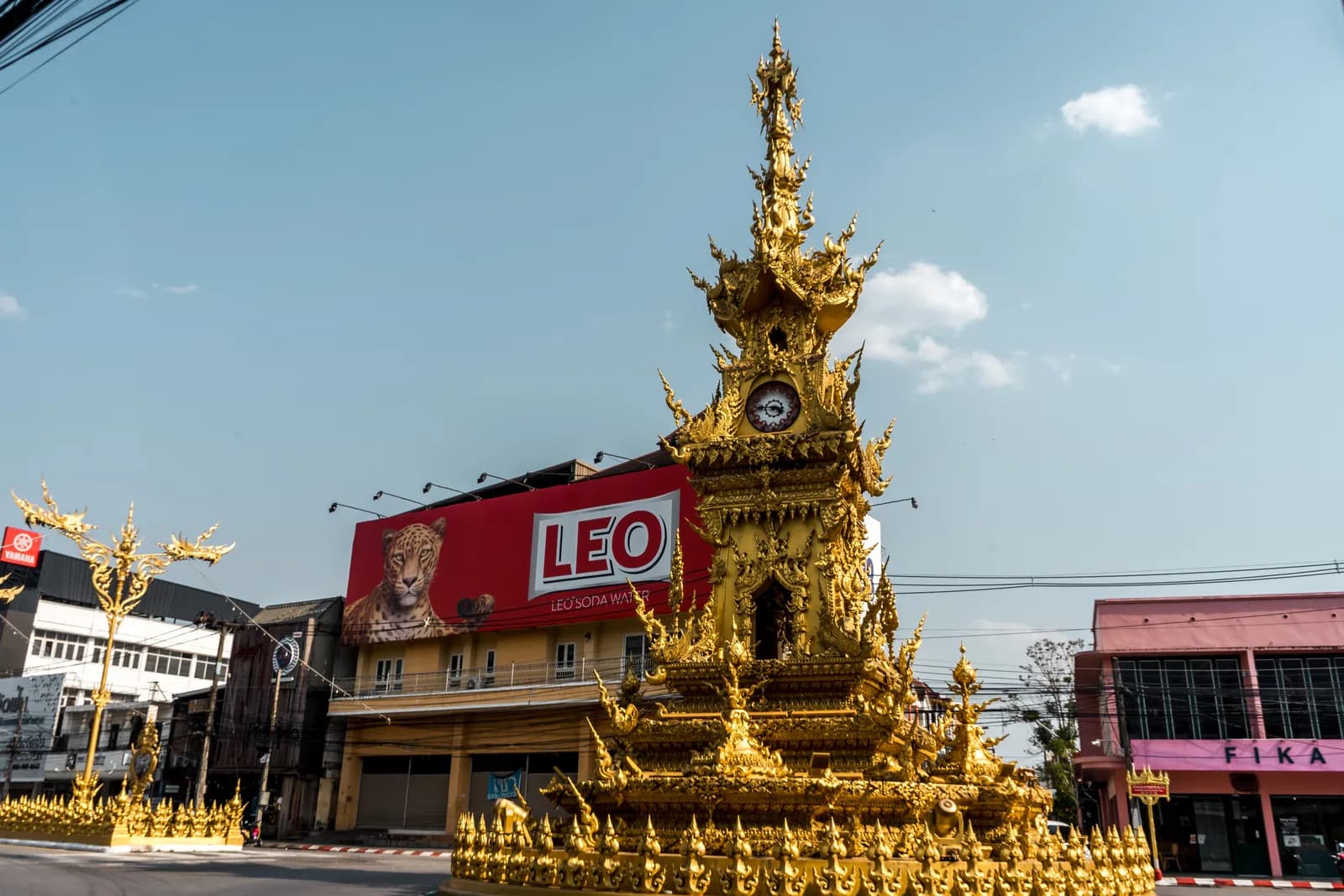
Right in the centre, on a roundabout, the clock tower is also by Chalermchai Kositpipat. Unveiled in 2008 in honour of King Bhumibol, it echoes the flames and lacework of the White Temple, but all in gold. Several guides mention a short music and light show every evening at 7pm, 8pm and 9pm: I photographed it by day and didn't see the show, so check the times locally. The central temples, such as Wat Phra Kaew and Wat Phra Singh, are a few minutes' walk away.
My 2-day Chiang Rai itinerary
This is the order I'd follow today, taking crowds and light into account. It follows the stops of my visit on 20 and 21 April 2024, but puts the White Temple at opening time rather than midday.
| Time | Day 1 | Day 2 |
|---|---|---|
| 8am to 10.30am | White Temple at opening, ubosot then Cave of Art | Blue Temple while it's quiet (open from 7am) |
| 10.30am to 1pm | Golden building, golden pavilion, artist's gallery; lunch at the stalls by the entrance | Black House, Baan Dam (13 km north) |
| 1pm to 4pm | Singha Park: tea, lakes, giraffes, cycling | Central temples (Wat Phra Kaew, Wat Phra Singh) |
| 4pm to 7pm | Wat Huay Pla Kang and the Guanyin at sunset | Rest, then the clock tower at nightfall |
| Evening | Night Bazaar or Saturday Walking Street | Clock tower show, Sunday market if it's the right day |
For accommodation, the most convenient area is the town centre, between the clock tower and the Night Bazaar: everything is walkable in the evening, Terminal 1 is close by for the White Temple bus, and Grabs are plentiful. For food, the Night Bazaar food court and the weekend market stalls are more than enough; try khao soi, the northern curry noodle soup. If Chiang Rai is part of a longer trip, I've explained how I fitted it into my three-month Thailand itinerary.
Frequently asked questions
200 baht for foreign visitors since 1 January 2026, up from 100 baht. The ticket includes the Cave of Art and the loan of a sarong. Entry remains free for Thai nationals, over-70s and children under 120 cm.
The temple is open daily from 8am to 5.30pm, with last entry around 5pm. The ubosot, the main building, may close a little earlier, so don't leave the interior until last.
No. Photos and videos are banned inside the ubosot, and guards enforce the rule. They are allowed everywhere else on site, including on the bridge and around the golden building.
The temple is about 13 km south of the centre on Highway 1. A local bus leaves from Terminal 1 (the old central terminal) for around 20 baht, and a Grab or taxi usually costs 200 to 300 baht one way for a 20-minute ride.
It can be done, for around 2,000 to 2,500 baht per person, but the day lasts 12 to 14 hours including about 6 hours on the road, and you reach the temple at peak time. If you can, spend at least one night in Chiang Rai.
Shoulders must be covered and legs at least down to the knees: no vest tops, short shorts or short skirts. A sarong has been lent at the entrance since 2026, and you must take off your shoes to enter the ubosot.
Allow 1 to 1.5 hours for the temple and its surroundings, and up to 2 hours if you also visit the Cave of Art and the artist's gallery. Add travel time and perhaps a break at the stalls by the entrance.
The Blue Temple, Wat Rong Suea Ten (free), the giant Guanyin of Wat Huay Pla Kang, the Black House, Baan Dam (80 baht), Singha Park, the golden clock tower and the night markets. Two days are enough to see the highlights.
My verdict on the White Temple
The White Temple deserves its reputation, which is rare for such a heavily photographed site. What strikes you in person is the level of detail: there isn't a square metre of stucco left uncarved, and photos, even with a wide lens, only capture part of that density. The interior, with its pop murals, is baffling at first and then makes sense once you grasp the journey from hell to enlightenment. To me, it's less a temple than a total work of art, and that's how to approach it.
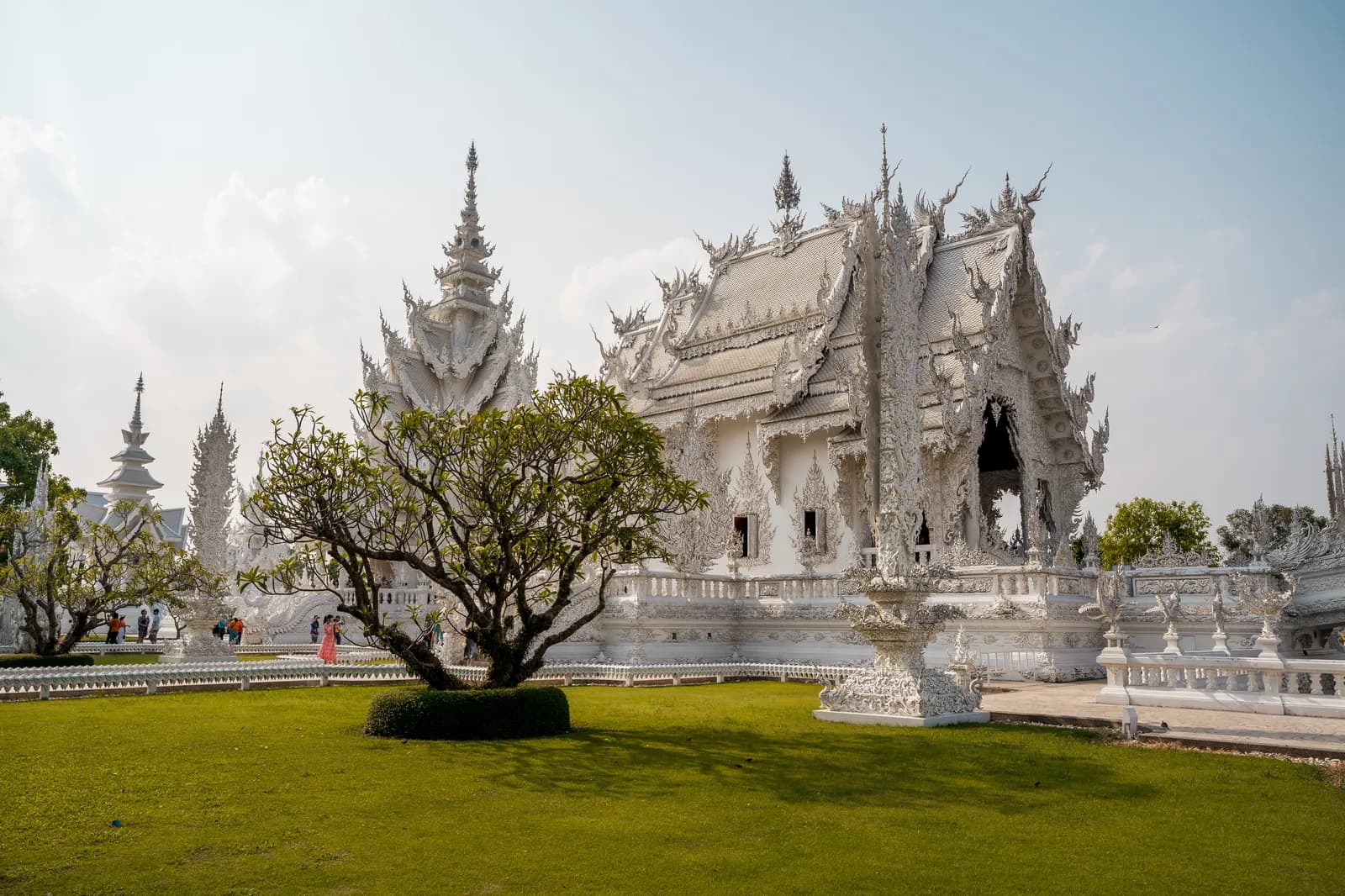
The disappointment is the experience at peak times: the bridge turned into a queue and the crowd in front of the ubosot. I visited at midday and regret it: the light was harsh and the white flattened. The 200-baht price remains reasonable for a site of this scale, especially with the Cave of Art included, but it makes the express day trip from Chiang Mai even less worthwhile.
What I liked:
- The delicacy of the stucco and mirrors, visible in every gable.
- The symbolic journey, from the bridge of hands to the ubosot.
- The golden building and the pavilion on the pond, much quieter.
- How close Singha Park and Huay Pla Kang are, easy to combine.
What I liked less:
- The crowds between 10am and 2pm, and not being able to linger on the bridge.
- The midday light, which flattens everything.
- The April heat, reflected off the white.
- The doubled ticket price, noticeable for a family.
It's for you if you love contemporary art, architecture and photography, and can spend at least one night in Chiang Rai. It's less so if you hate crowds and only have a day trip from Chiang Mai: in that case, the Blue Temple, free and calmer, gives a better experience for much less effort.
Going further
The White Temple takes two hours to visit, but it really comes into its own over two days in Chiang Rai, with the Blue Temple, the Guanyin of Huay Pla Kang and the evening markets. If you're heading back south afterwards, my guide to things to do in Chiang Mai will help you plan the next stage, and you'll find all my articles on the Thailand page.
Sources and fact-checkingInformation checked on 9 October 2026 · 15 sources consulted
- Chiang Rai Times: Wat Rong Khun doubles its fee (200 baht from 1 January 2026, Cave of Art and sarong included)
- Chiang Rai Times: White Temple entrance fee, hours and access
- Oh-Hoo: White Temple Chiang Rai, entrance fee, dress code and opening hours (2026)
- Wikipedia: Wat Rong Khun (history, 2014 earthquake, symbolism)
- Wikipedia: Chalermchai Kositpipat
- Slate / Atlas Obscura: the murals and the earthquake of 5 May 2014
- Two Passports Packed: The Cave of Art, Chiang Rai
- Two Passports Packed: White Temple Chiang Rai, complete guide
- Thai Holiday Guide: Wat Huai Pla Kang (Guanyin, 40-baht lift)
- Thai Holiday Guide: Ban Dam Museum (80 baht, 9am to 5pm)
- Thai Holiday Guide: Wat Rong Suea Ten, the Blue Temple
- Thai Holiday Guide: Singha Park Chiangrai
- Will Fly for Food: Chiang Rai clock tower and Night Bazaar
- Ticket2Attraction: Chiang Rai day tour from Chiang Mai (2,150 baht)
- 22places: White Temple Chiang Rai (local bus and taxi)
Âme Bohème exists thanks to you
Some links in this article are affiliate links. This means that if you book or purchase a product through these links, we receive a small commission, at no extra cost to you. It's thanks to this support that we can continue creating free, quality content.
You can also buy us a coffee, or follow us on Instagram and Facebook.