
On 28 April 2024, I spent a whole day on Rattanakosin Island, the historic heart of Bangkok: Saranrom Park in the morning, then Wat Phra Kaew and the Grand Palace, Wat Pho, Wat Arun across the river, and Chinatown after dark. More than 230 photos came out of it, nearly half of them inside the palace walls, under a sky full of cumulus and in the middle of a dense crowd.
The Grand Palace is not a single monument but a walled city of 218,400 square metres, enclosed by crenellated white walls. You go in for the Emerald Buddha, the most revered statue in the country, and come out with your head full of giant guardians, golden chedis held up by demons and a palace with a Victorian facade crowned by Thai roofs.
This guide covers everything you need for a visit in 2026: every building, the ticket, the dress code, the 'palace is closed' scam, the real closures and an hour-by-hour plan that includes Wat Pho and Wat Arun.
A little history: Rama I's royal city
Work began on 6 May 1782, on the orders of King Phutthayotfa Chulalok, Rama I, founder of the Chakri dynasty that still reigns today. He had just moved the capital from Thonburi, on the west bank of the Chao Phraya, to the more defensible east bank.
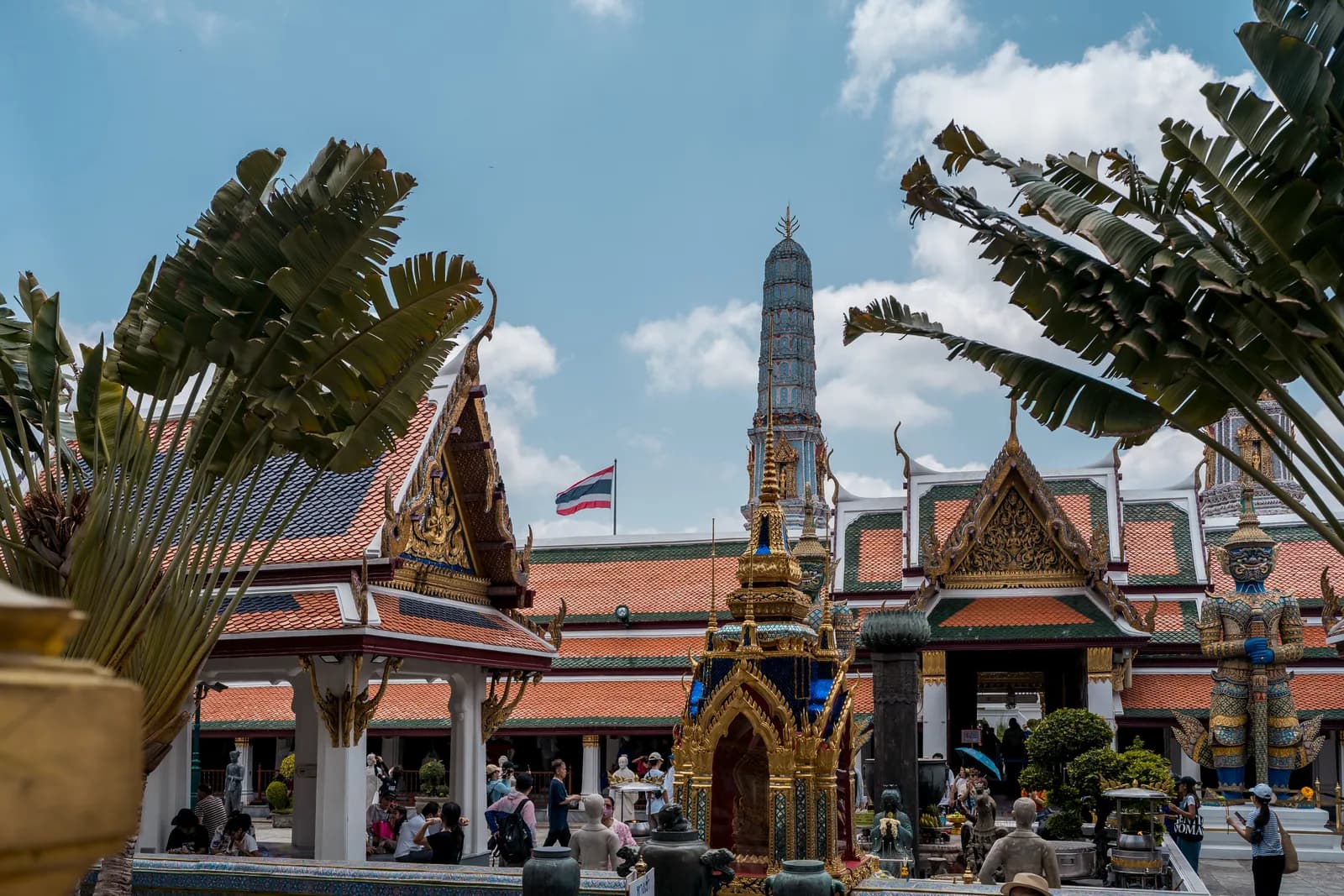
The complex is divided into several quarters: the royal temple of Wat Phra Kaew, the Outer Court (government offices), the Middle Court (throne halls and official residences) and the Inner Court, once reserved for the king, the queens and the ladies of the court. Kings lived here until the early 20th century. Rama IX lived at Chitralada Palace and the current monarch uses Dusit Palace, but the Grand Palace is still a working palace: it hosts major state ceremonies and still houses royal offices.
The Emerald Buddha and its three costumes
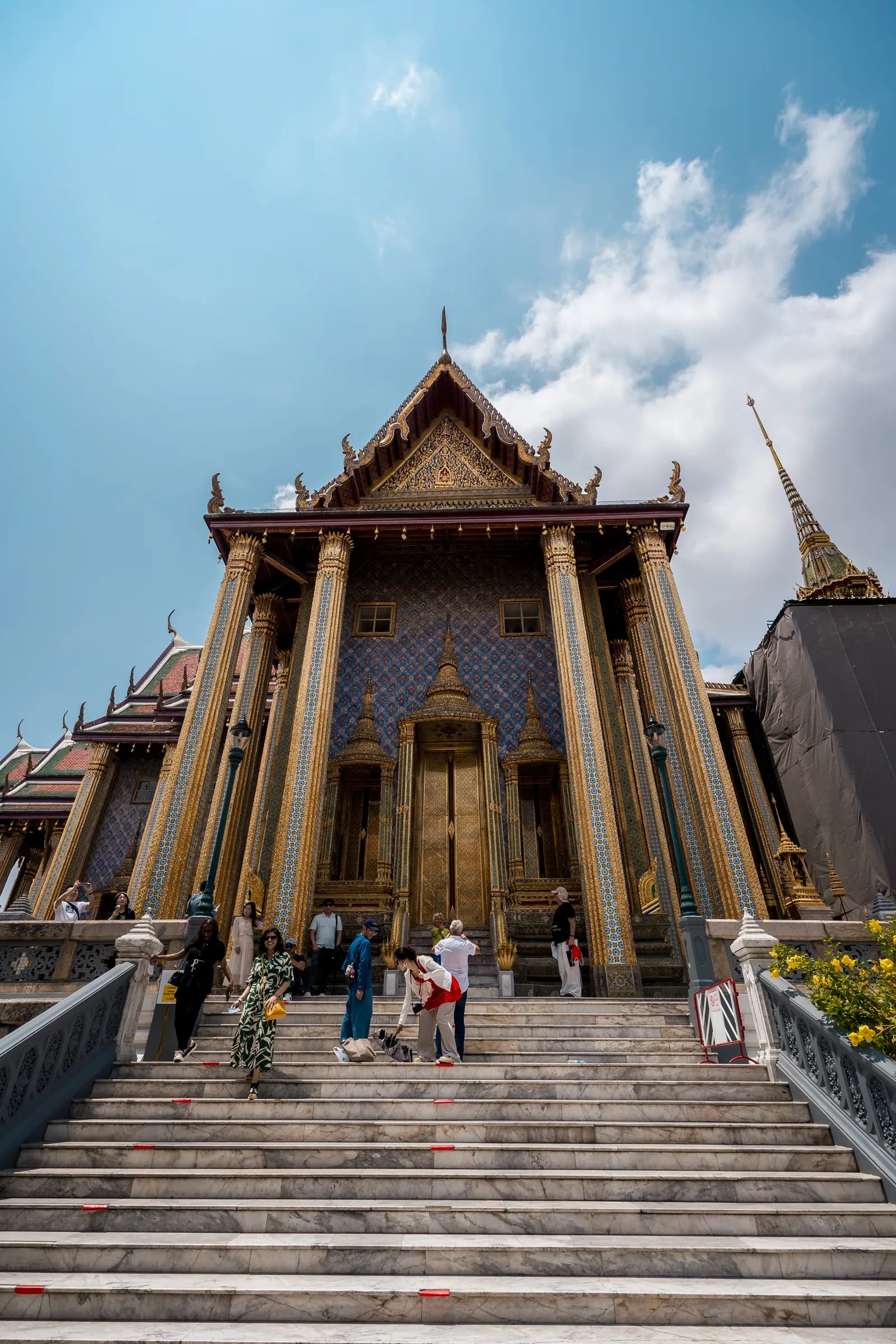
Wat Phra Kaew's official name is Wat Phra Si Rattana Satsadaram. It is the royal chapel, so no monks live here. Its main building, the ordination hall (ubosot), was begun in 1783, and the Emerald Buddha was installed there in 1785. Its walls stand on a base decorated with 112 golden garudas holding nagas, and its 48 columns are covered in glass mosaic.
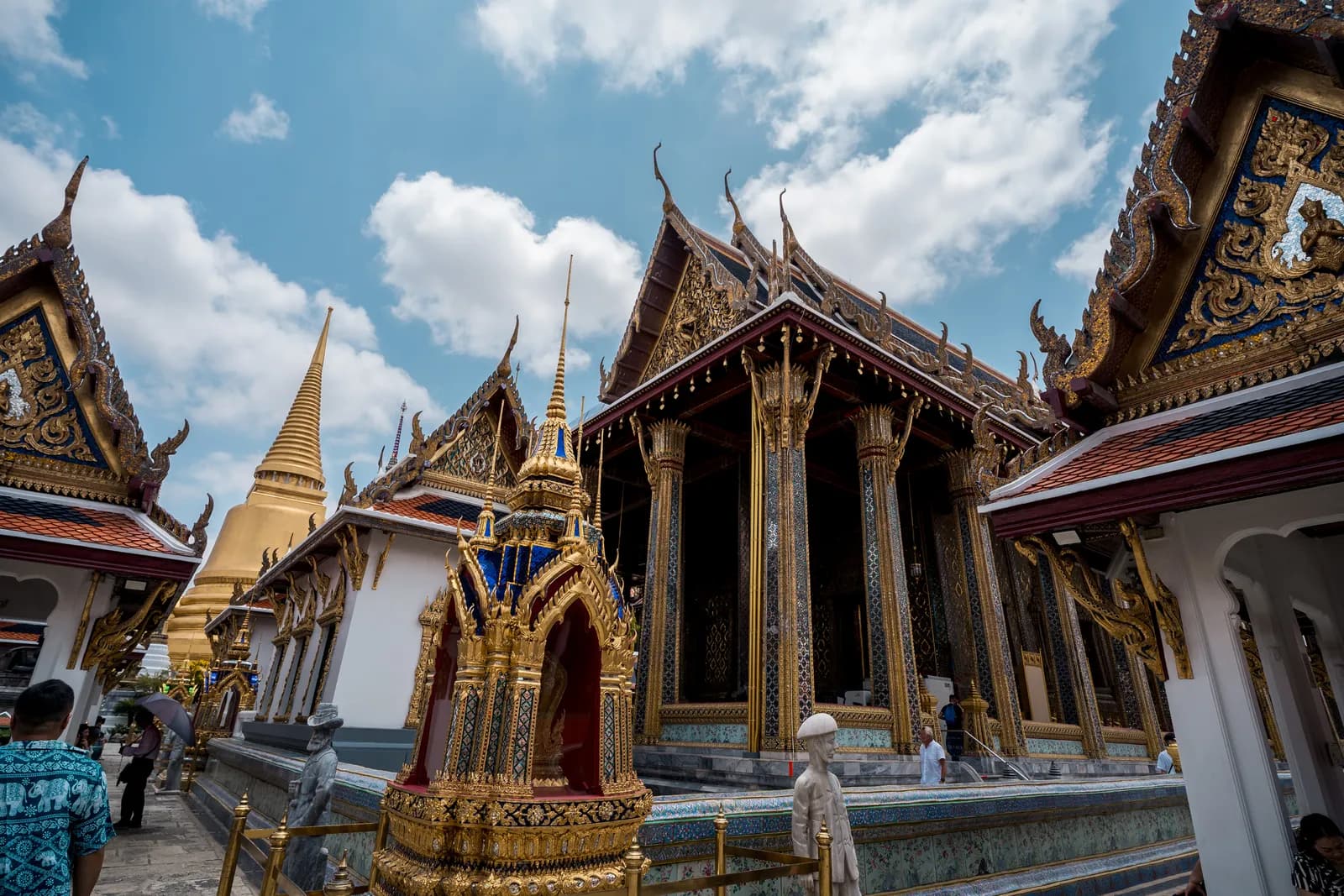
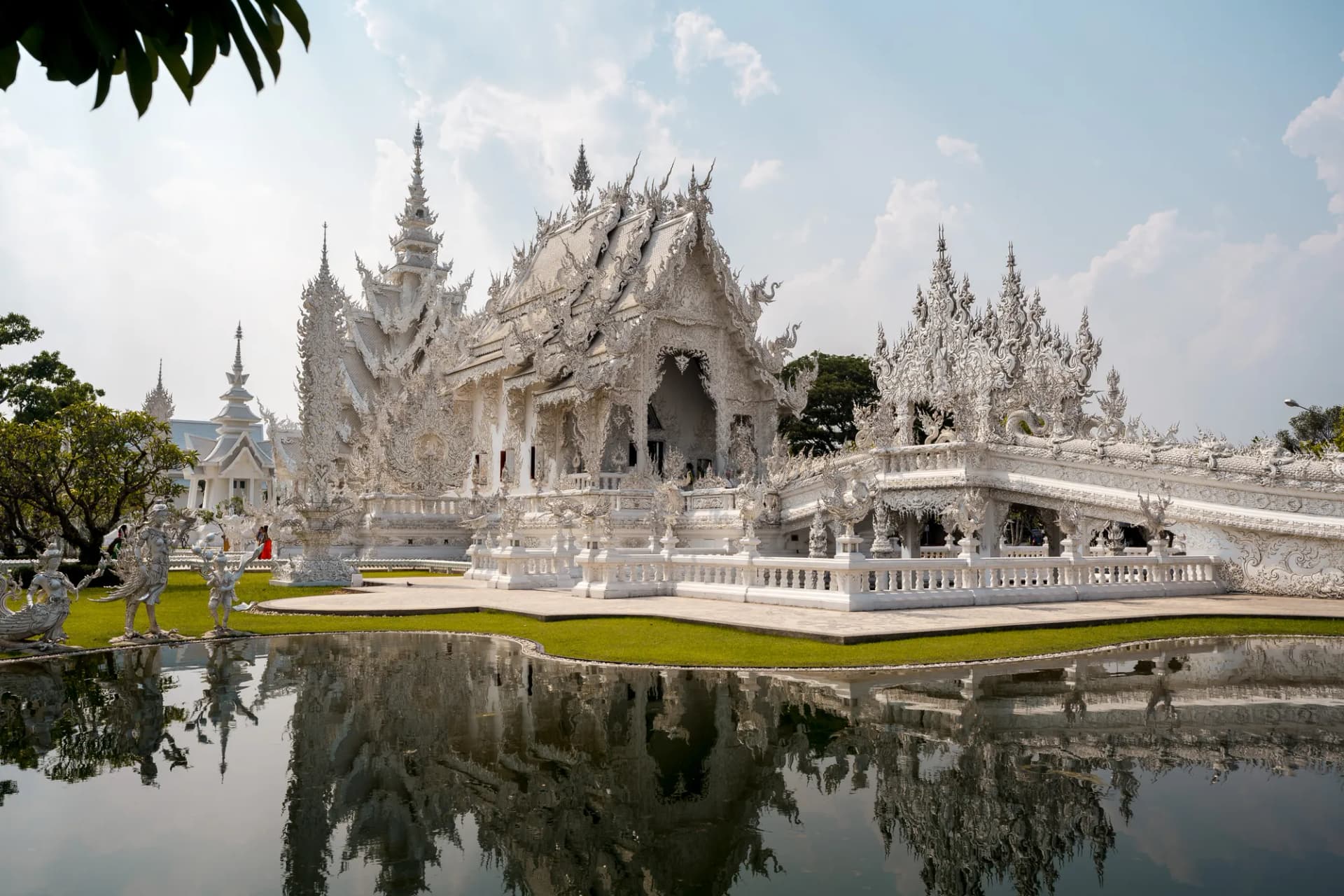
The statue itself is surprisingly small: 66cm tall, perched high on a gilded altar. It is not made of emerald but of green jasper or jade. Its story reads like a novel: discovered in 1434 in Chiang Rai, when lightning split a chedi and revealed a stucco-covered statue inside, it travelled to Lampang, Chiang Mai, Luang Prabang and Vientiane. General Chao Phraya Chakri, the future Rama I, brought it back from Laos in 1779. If you head north, the White Temple in Chiang Rai is a few kilometres from the town where it all began.
The Emerald Buddha wears three golden costumes, one per season: a crowned, jewelled outfit for the hot season, a monastic robe and sapphire-studded headdress for the rainy season, and a shawl of gold mesh for the cool season. The king or a member of the royal family changes them personally during a ceremony, three times a year, as the seasons turn in the lunar calendar (usually around March, July and November). On the day of the change, access to the ordination hall may be restricted.
Inside, you go barefoot, sit with your feet tucked behind you, never pointing at the altar, and photography is forbidden. The murals on the walls tell the life of the Buddha.
The Ramakien gallery and the giant guardians
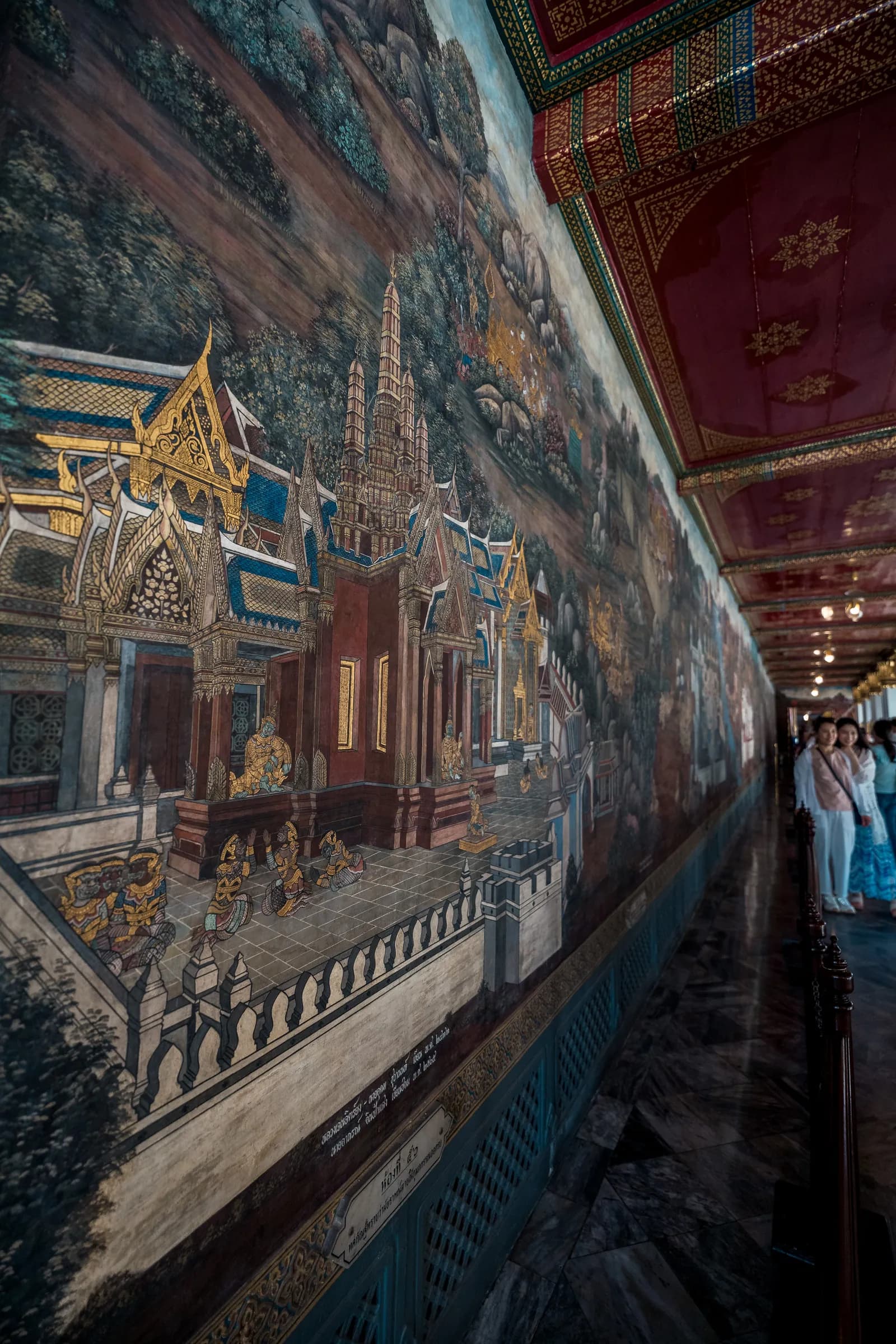
The whole temple is enclosed by a covered gallery whose walls are painted, end to end, with the Ramakien, the Thai version of the Indian Ramayana. The epic is divided into 178 scenes, each with a short summary in Thai. The first paintings date from Rama I, around 1797; Rama III had them erased and completely repainted, and they have been restored regularly ever since.
Photos : Pierre Bouyer
You follow Prince Rama, Hanuman's monkey army and the battles against the demon Thotsakan. In my photos, the gallery is long, dark and crowded: a steady stream of visitors moves along it, and the murals are best seen by standing close to the wall and looking down its length.
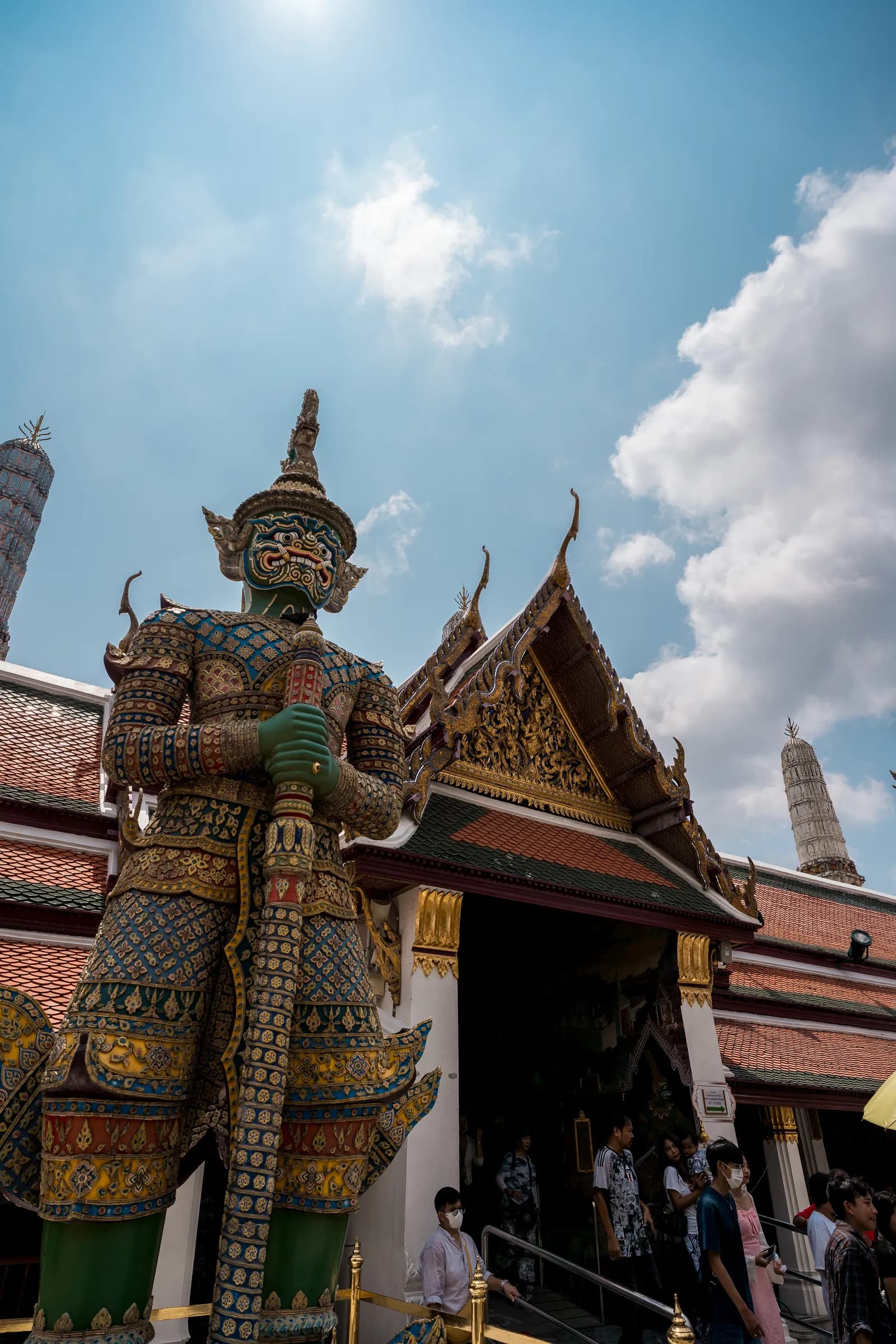
Twelve yakshas stand guard at the temple's six gates, giants about 5 metres tall leaning on clubs. They are characters from the Ramakien, each recognisable by colour and headdress: Thotsakan, green with stacked heads, Sahatsadecha, white, Suriyaphop, red.
The upper terrace, the heart of Wat Phra Kaew
North of the ordination hall, a large raised terrace lines up three monuments in completely different styles. It is the most photogenic part of the site and the one where you will spend the most time.
Phra Si Rattana Chedi, the golden chedi
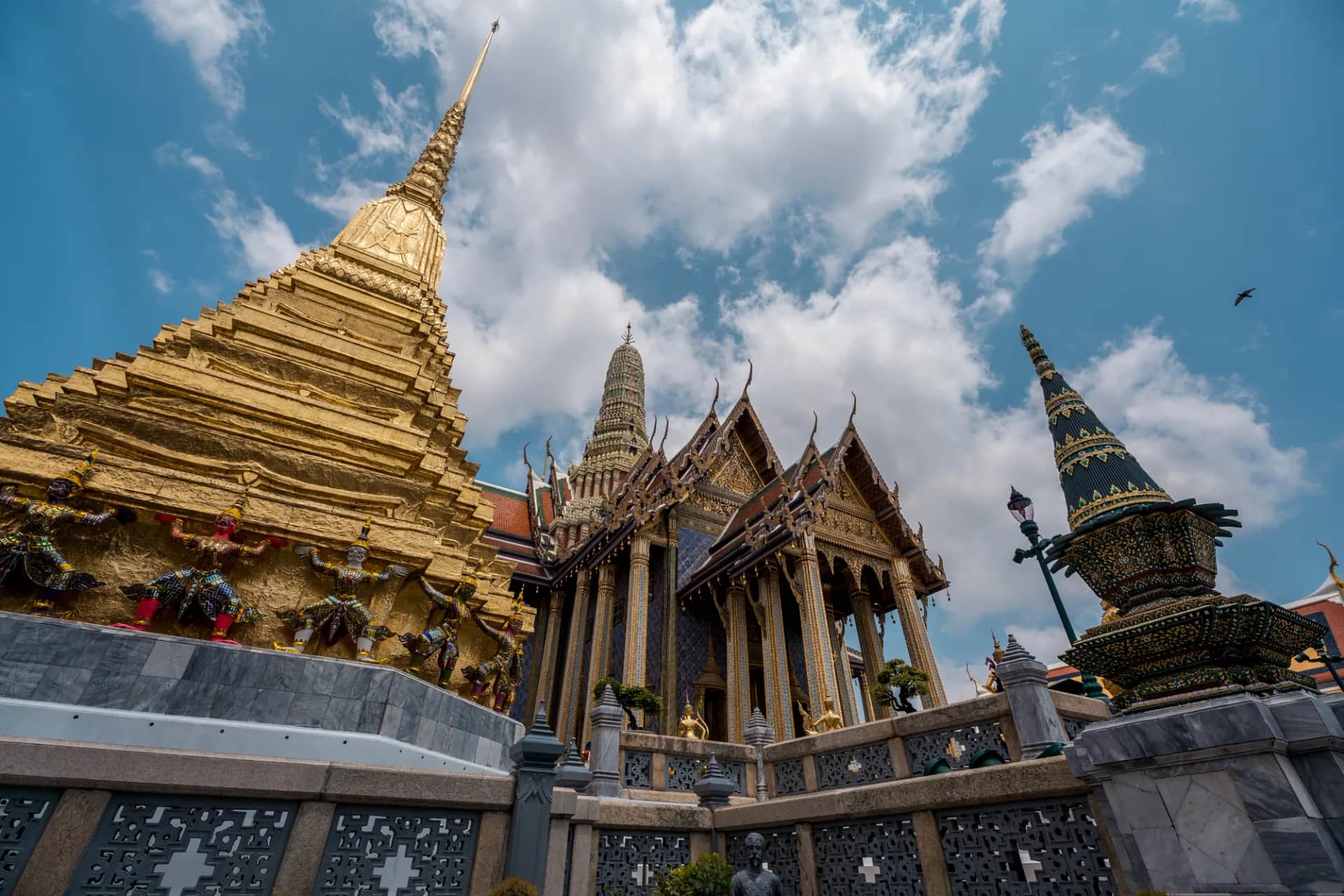
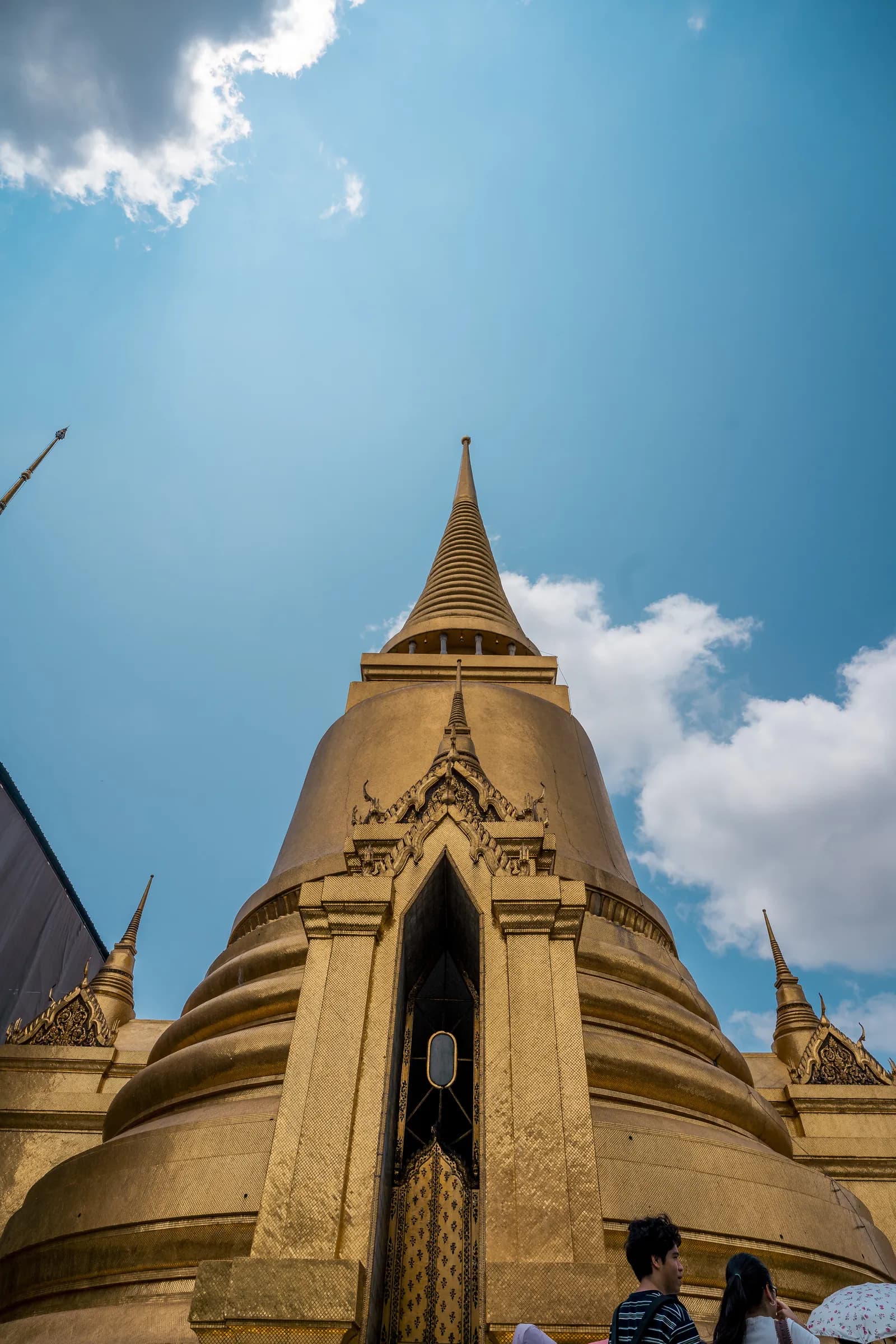
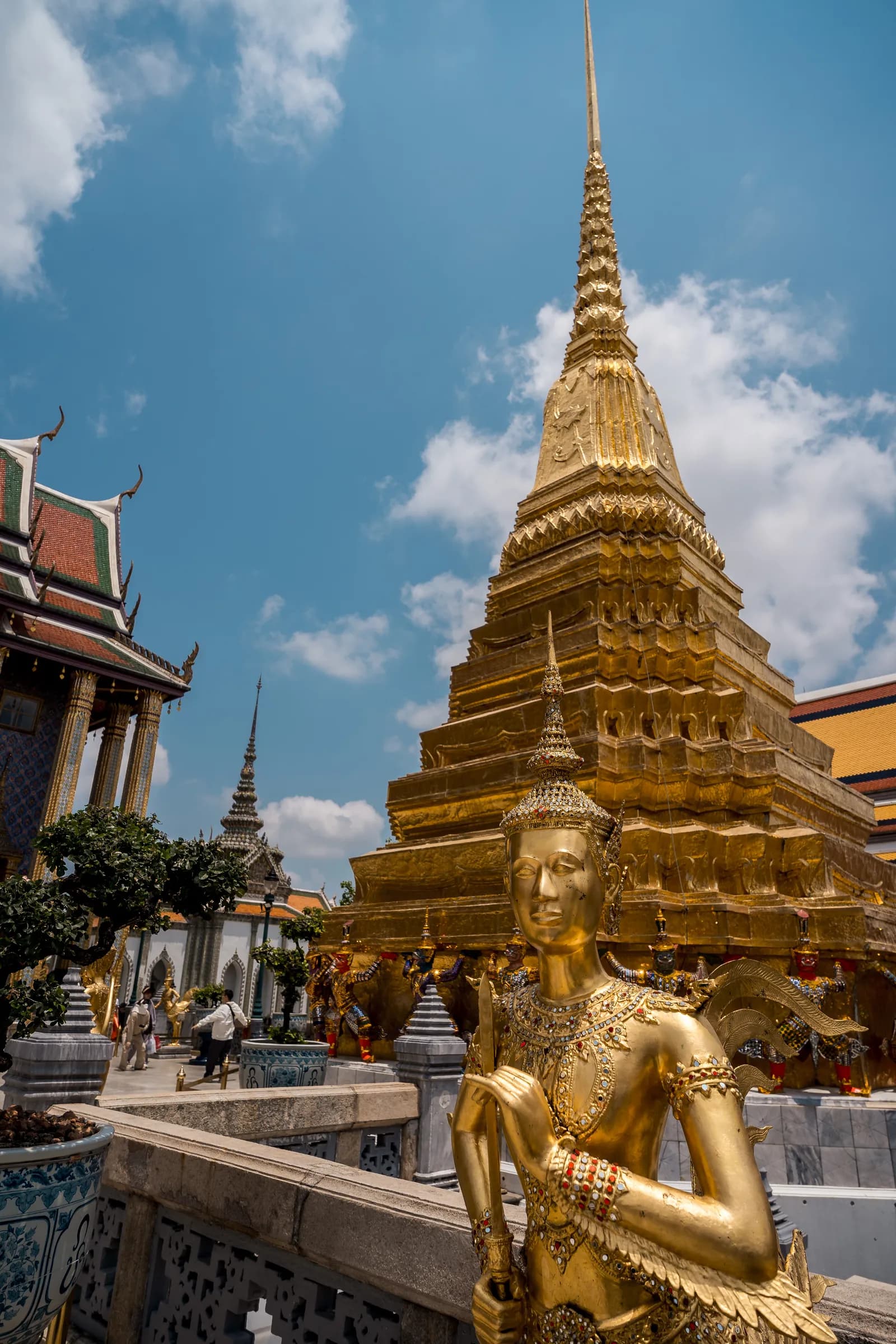
The large bell-shaped chedi, entirely gilded, was built in 1855 by Rama IV on the model of Sri Lankan stupas. It holds relics of the Buddha. Its golden tiles were imported from Italy under Rama V. On the day I visited, part of its base was covered in black sheeting for works, which shows up in several photos: restoration projects are frequent, and you will probably come across scaffolding somewhere.
Phra Mondop, the library
In the middle of the terrace, the Phra Mondop was built by Rama I to keep the sacred texts. It holds a mother-of-pearl inlaid cabinet containing the Tripitaka, the Buddhist canon. The interior is closed to the public: you admire the decorated columns, the doors and the tiered spire.
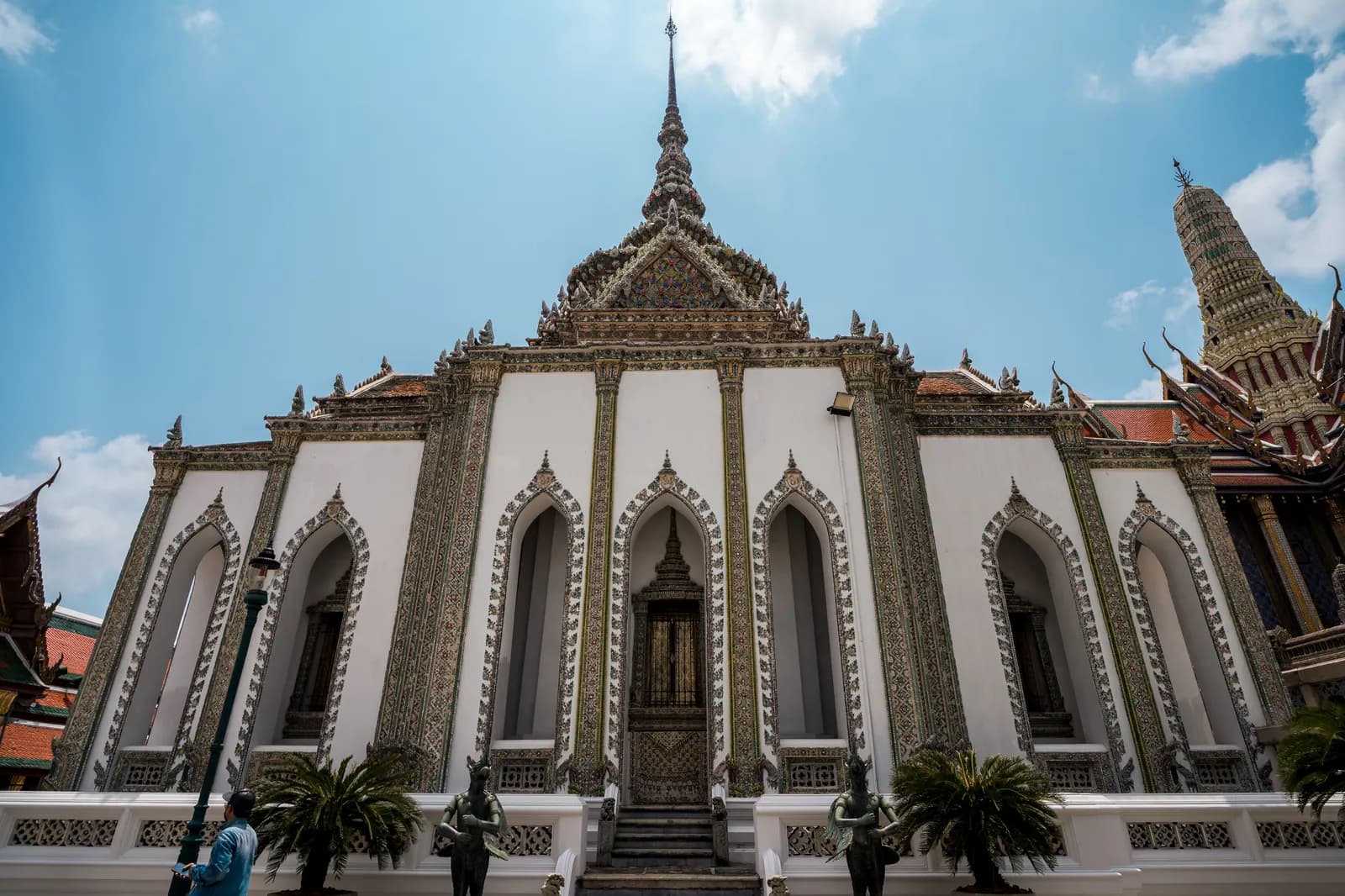
Prasat Phra Thep Bidon, the royal pantheon
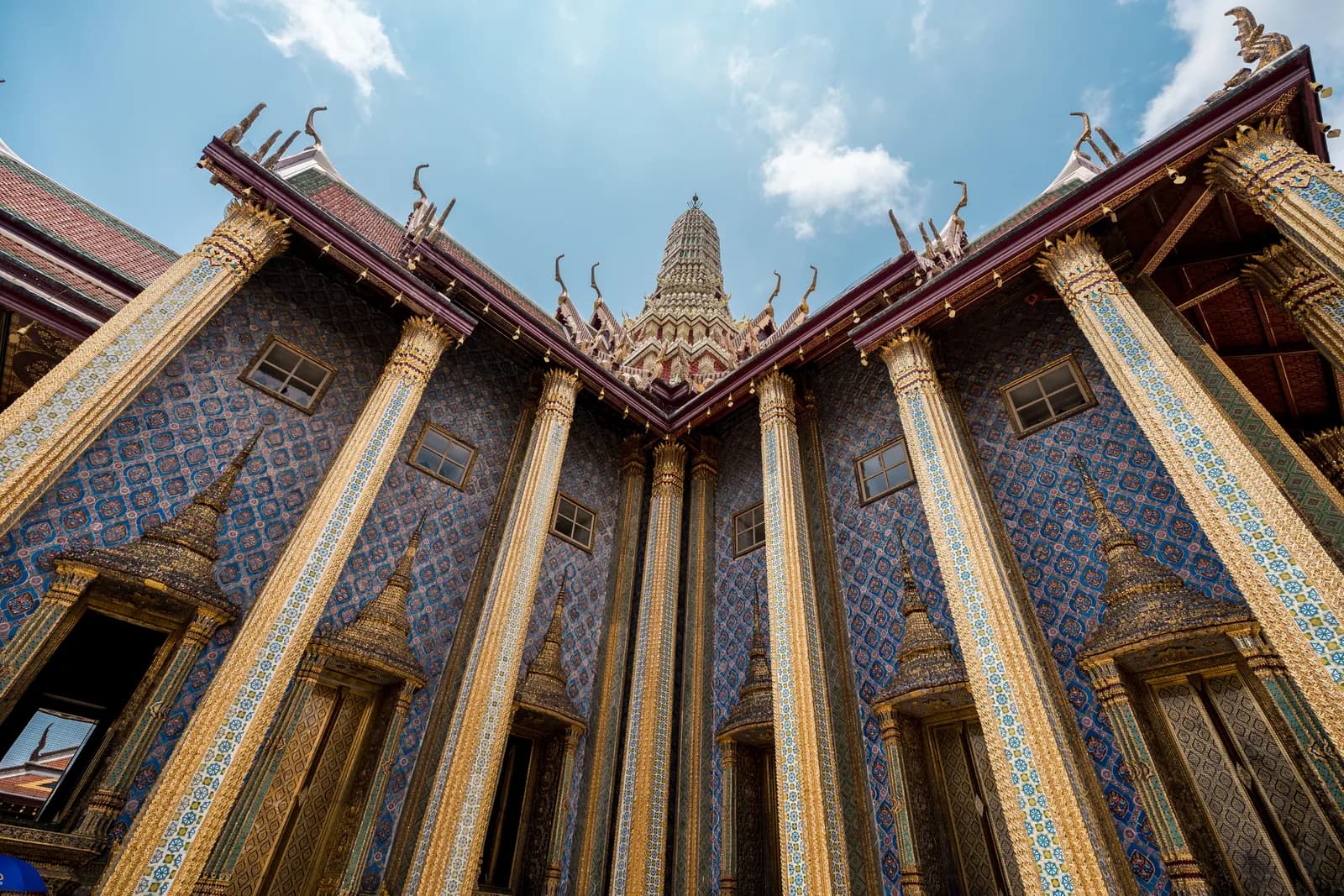
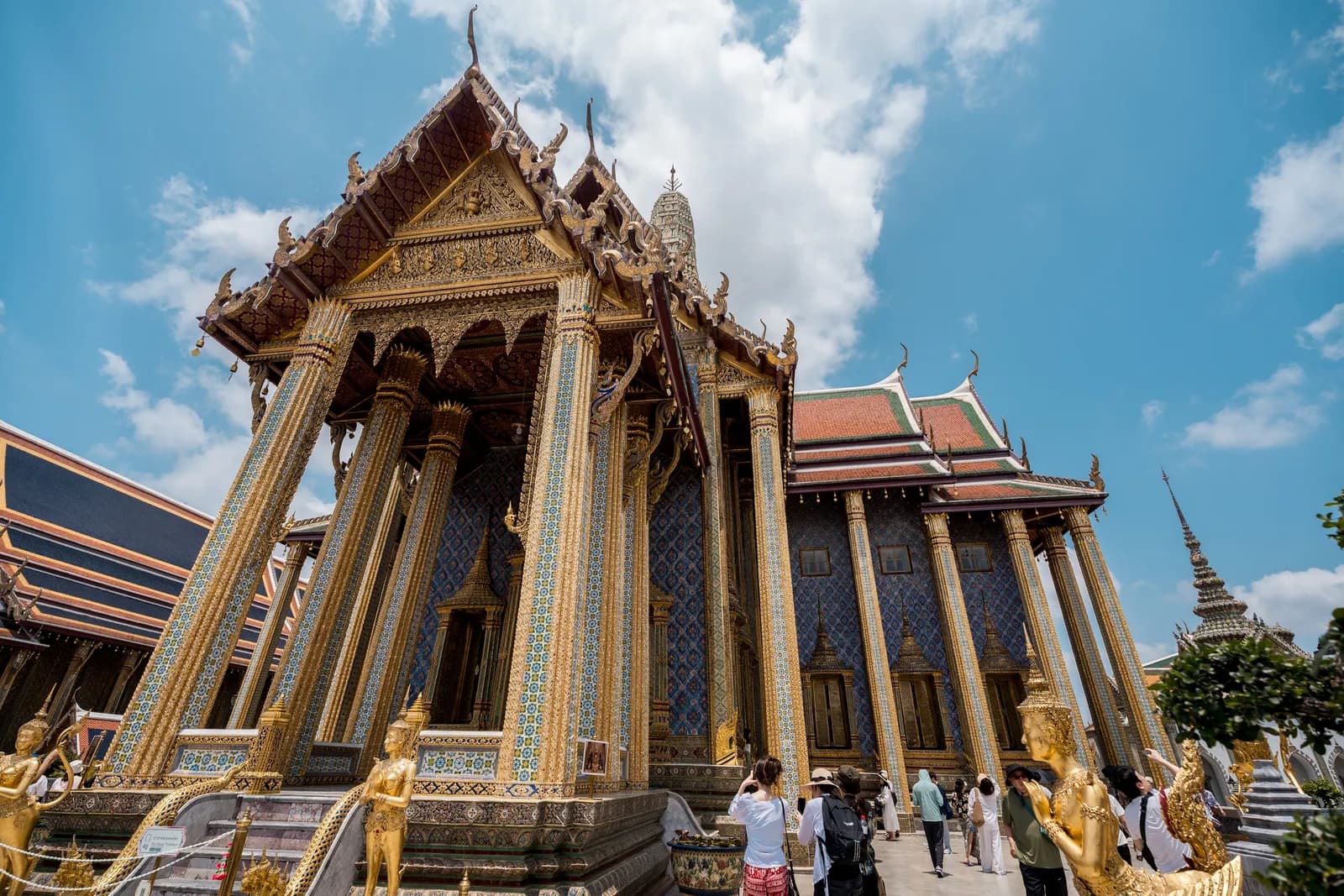
To the east, Prasat Phra Thep Bidon is the cross-shaped building topped by a prang, covered in blue mosaics and gilded columns. Completed under Rama VI, it holds life-size statues of the kings of the Chakri dynasty. It only opens to the public once a year, on 6 April, the day the dynasty was founded. The rest of the year, walk around the outside: the corners, where the columns meet under the roofs, are the most striking.
The model of Angkor
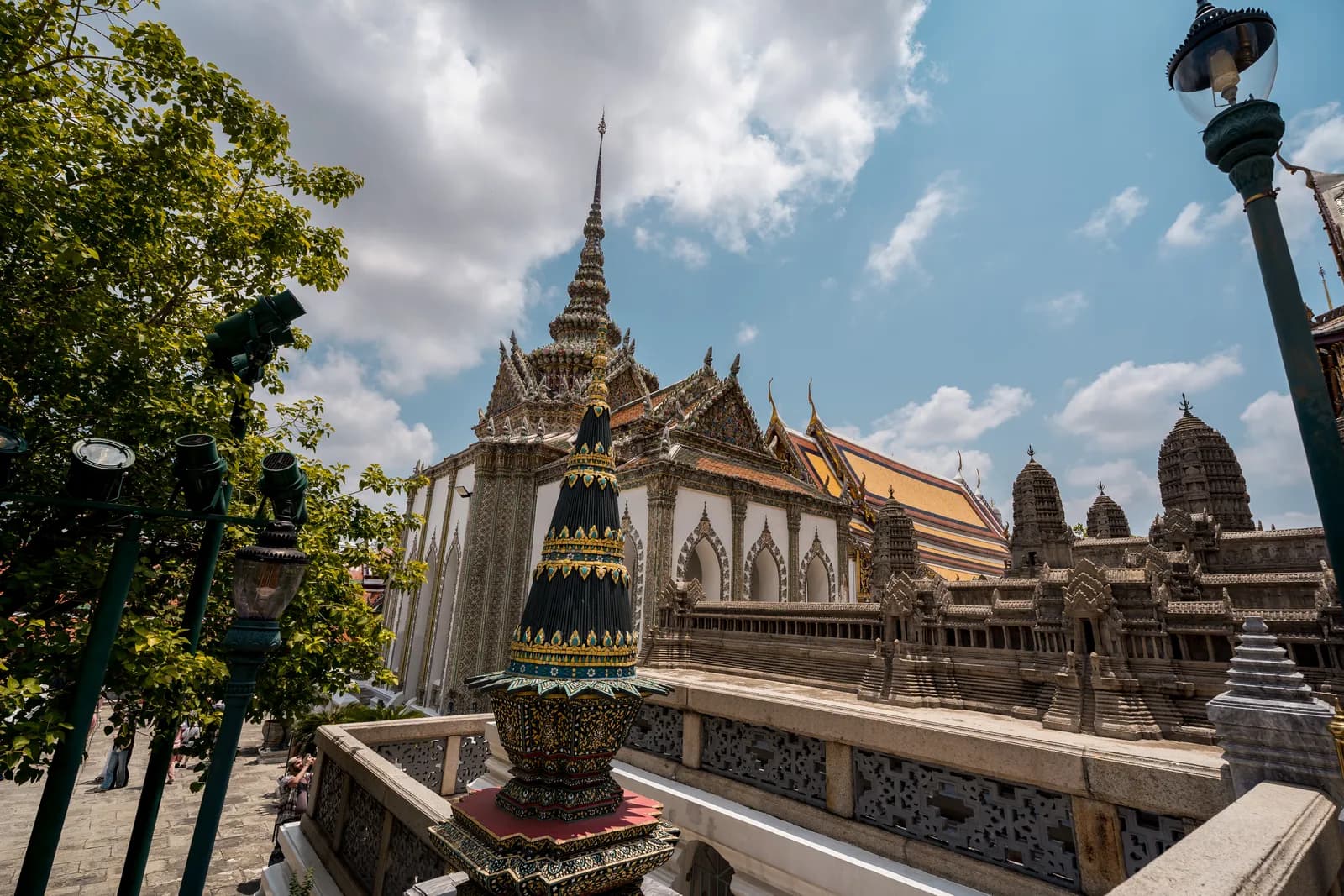
Just north of the Phra Mondop, a stone model reproduces Angkor Wat in detail. It was commissioned by Rama IV.
The golden chedis and the kinnari
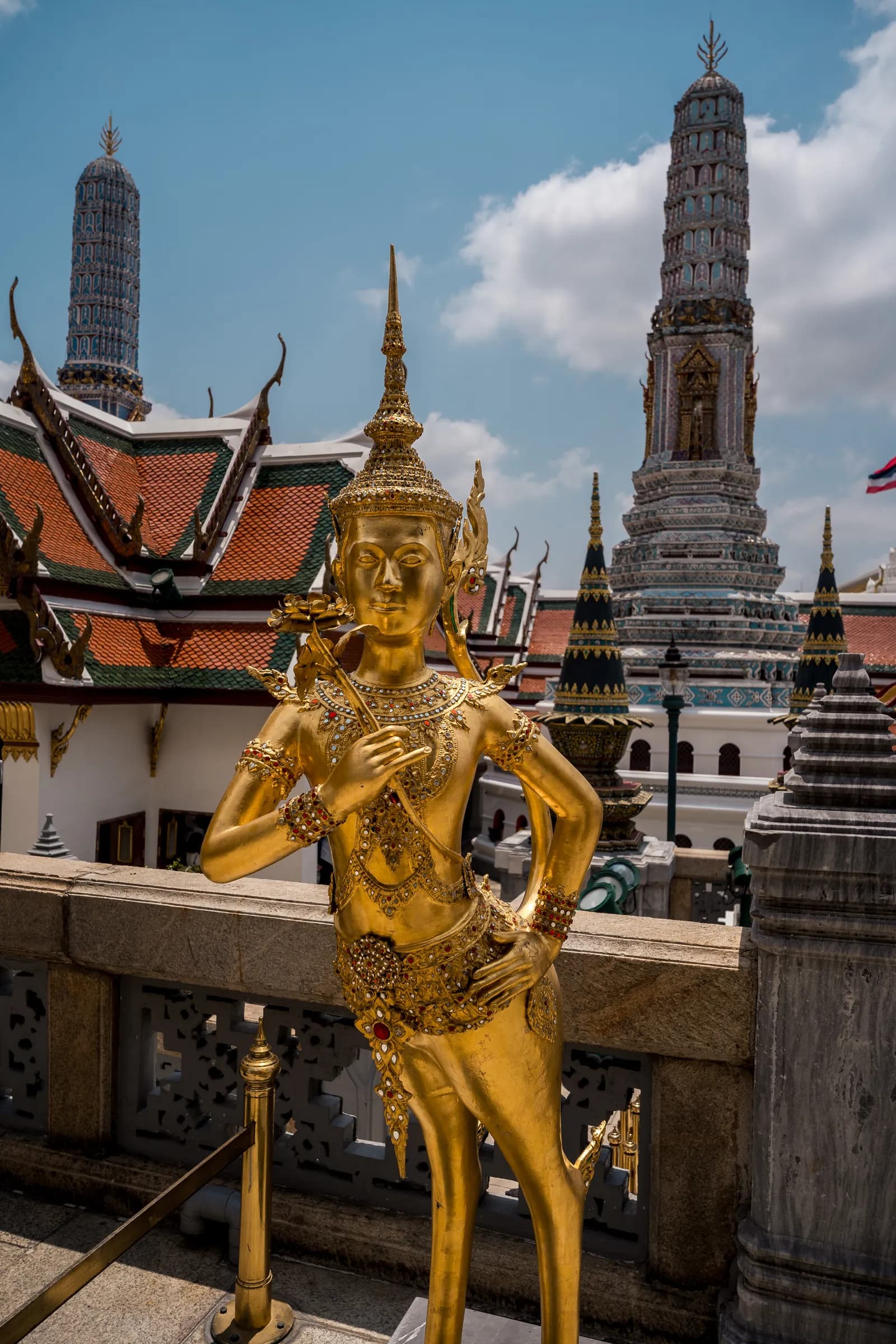
In front of Prasat Phra Thep Bidon, two 16-metre golden chedis were built by Rama I in memory of his parents. Rama V added a ring of demons and monkeys that seem to carry the whole monument on their shoulders. All around the terrace stand kinnari, half-woman, half-bird figures in gilded bronze, graceful and smiling. They are among the best photos of my day.
Photos : Pierre Bouyer
The eight prangs, the bell tower and the salas
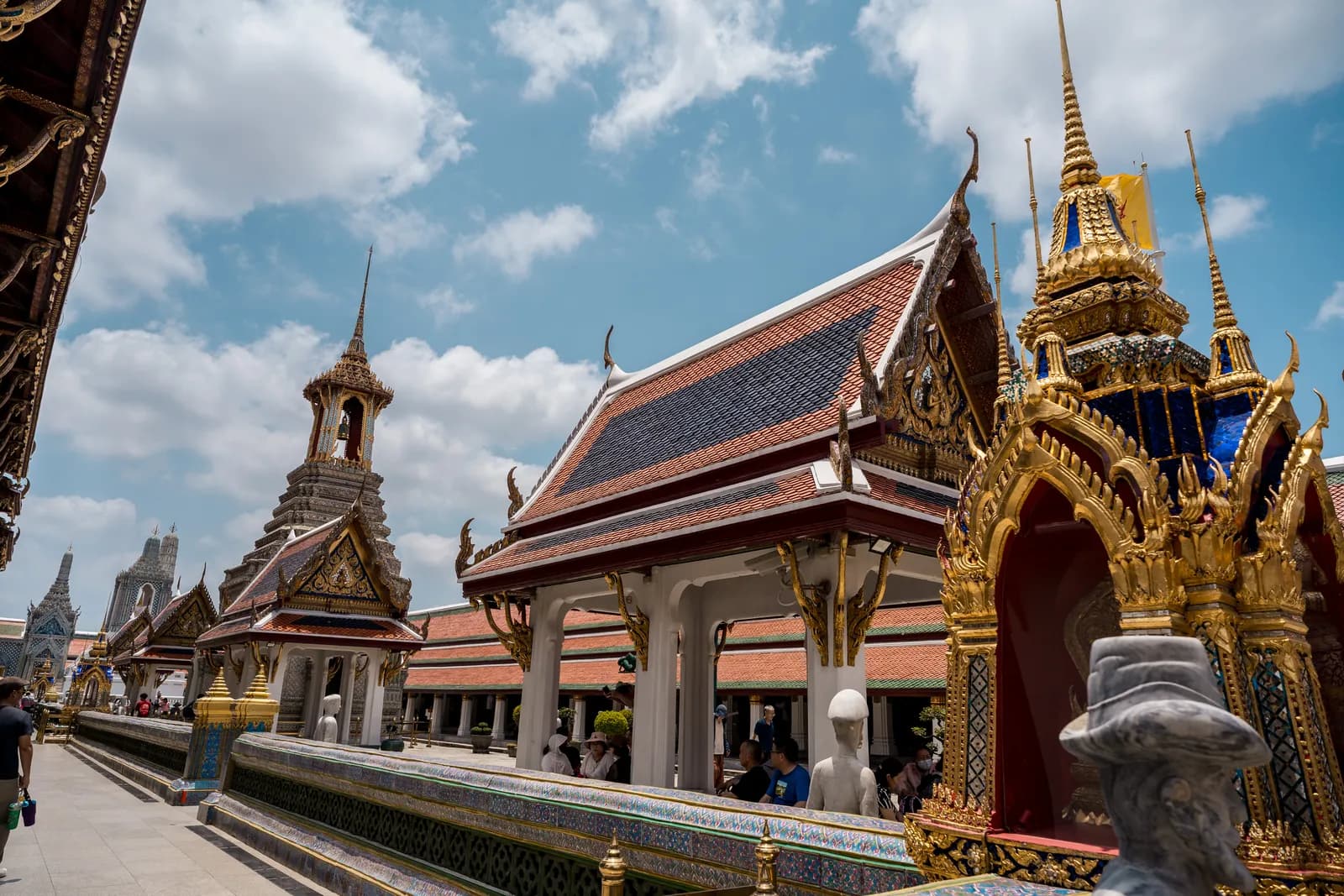
Along the east side stand eight porcelain-covered prangs, the Phra Asada Maha Chedi, built by Rama I and decorated under Rama III. The octagonal bell tower (Ho Rakhang) was completely rebuilt under Rama IV. Around the ordination hall, small open pavilions, the salas, provide a little shade, and small gilded shrines mark the temple's sacred boundary stones. Look out too for the bronze statue of the hermit Jivaka, the legendary father of traditional Thai medicine.
The palace side: the throne halls
Leaving Wat Phra Kaew, you pass into the courtyards of the palace itself. Here you mostly see facades and gardens: the throne halls are still ceremonial spaces.
Chakri Maha Prasat
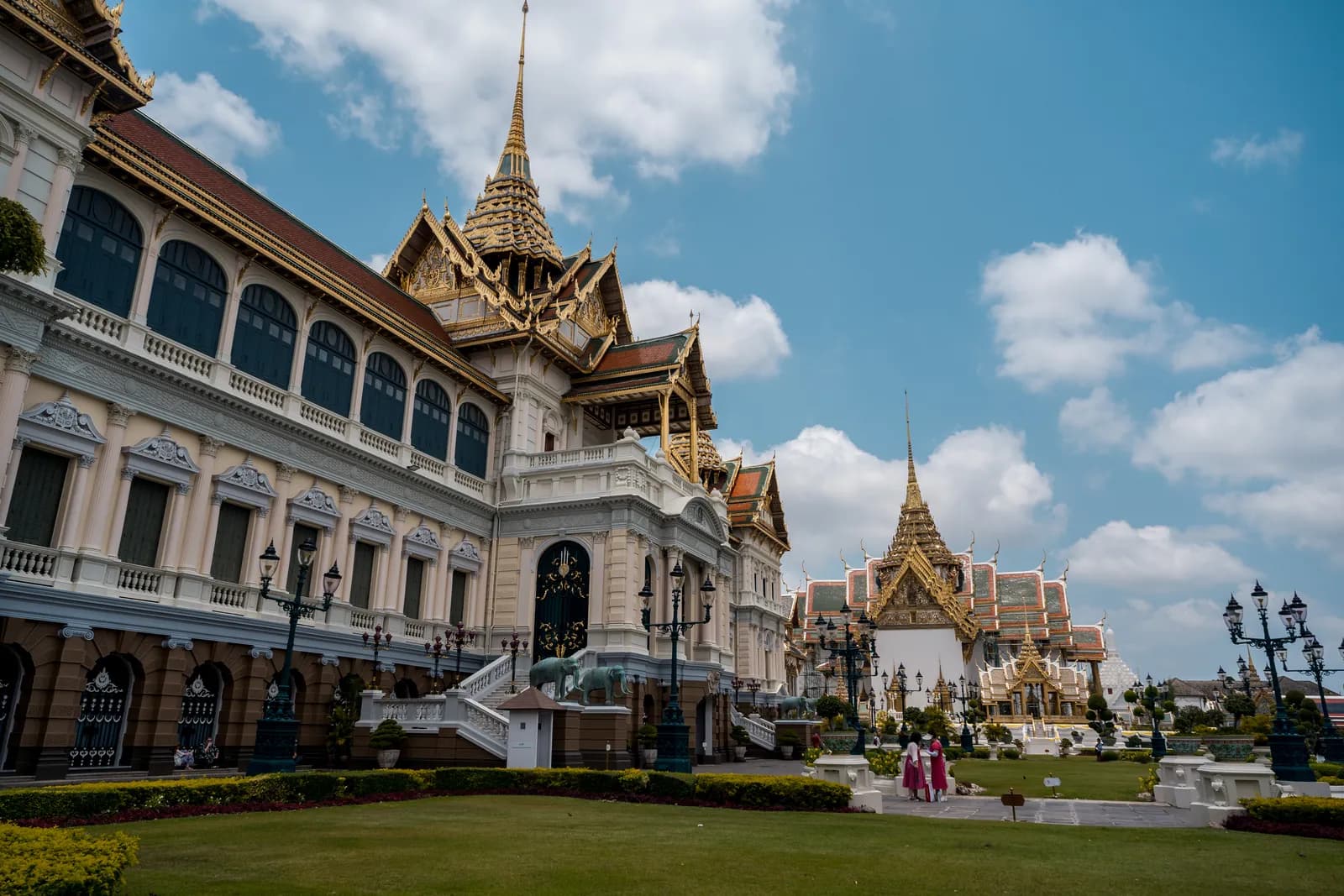
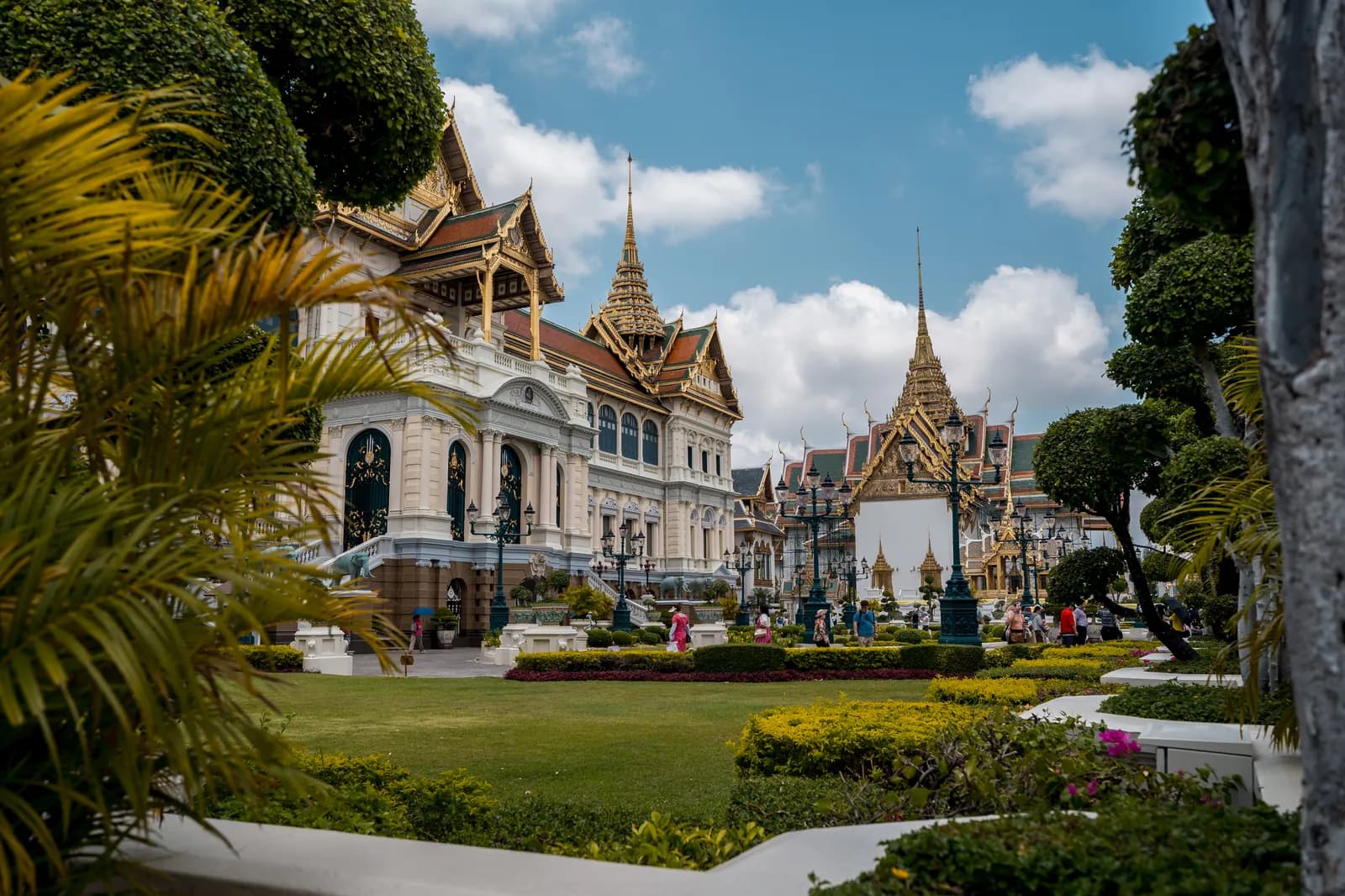
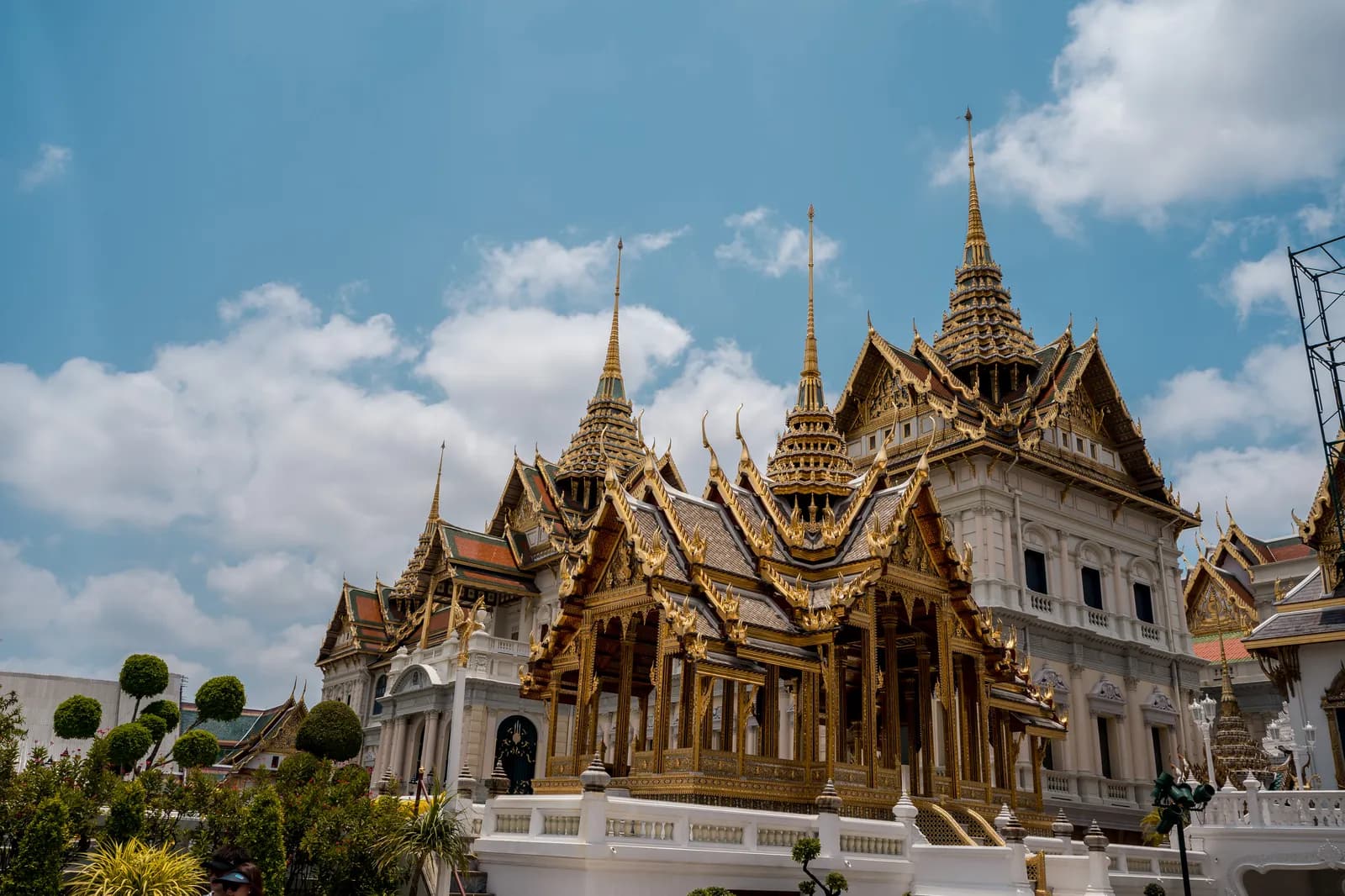
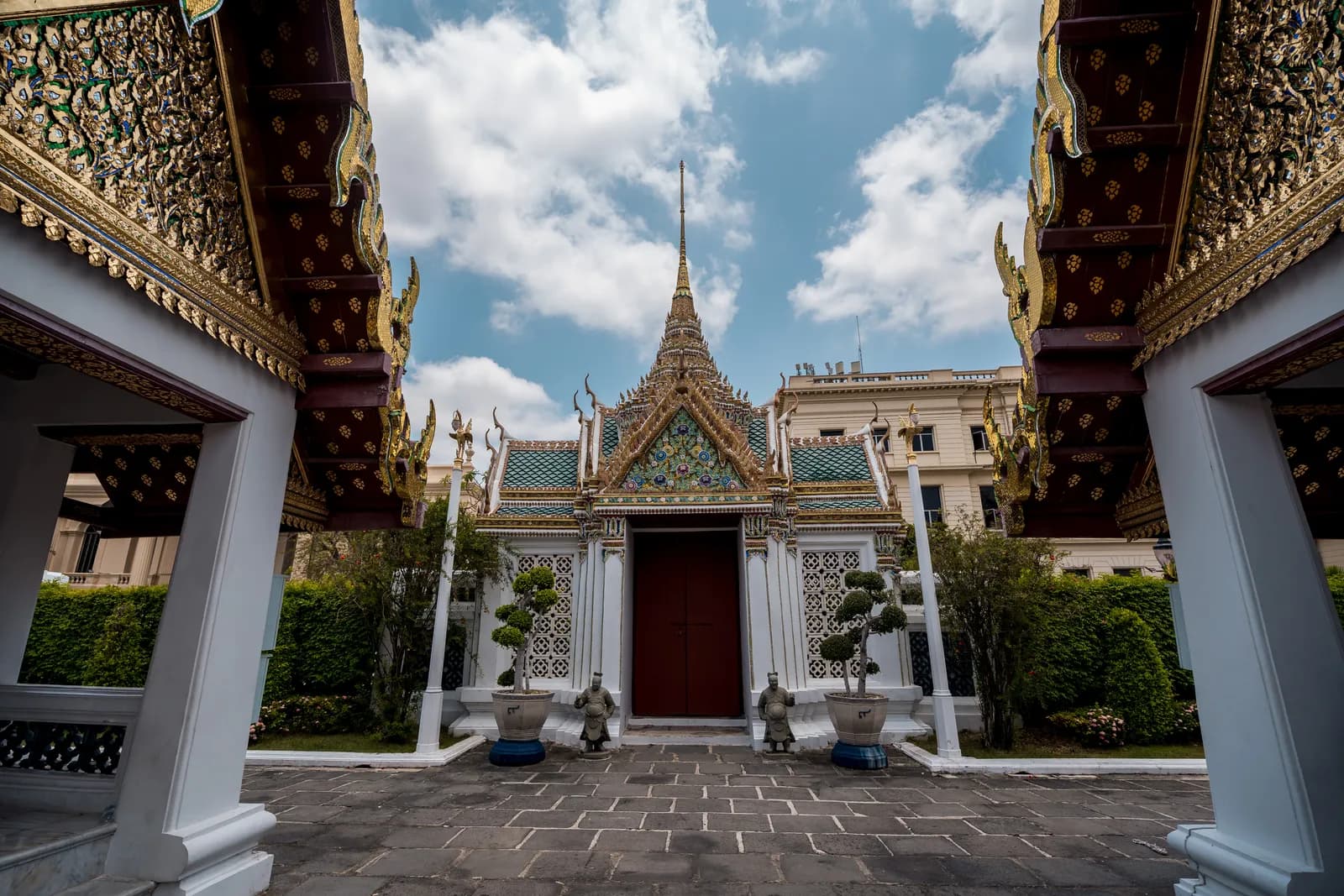
This is the palace's most famous image. Built from 1876 to 1882 under Rama V by the British architect John Clunis, the Chakri Maha Prasat combines a European-style main building, with balustrades and pedimented windows, with three Thai roofs and golden spires. It is often described as a European building wearing a Thai crown. The lawn and cloud-pruned trees make the best photo frame. As a rule, the interior is not open to visitors.
Dusit Maha Prasat
Further west, the Dusit Maha Prasat throne hall is one of the oldest buildings in the palace: Rama I had it built in 1789 and 1790, after a storm destroyed the previous hall. This is where royal remains lie in state before cremation. Since October 2025, it has held the funeral urn of Queen Mother Sirikit, who died on 24 October 2025. Her cremation is scheduled for 16 December 2026 at Sanam Luang, the large open ground beside the palace.
The Aphorn Phimok pavilion
Set against the enclosing wall of the Dusit Maha Prasat, this small gilded wooden pavilion with four gables is often cited as the finest example of traditional Thai architecture. Rama IV had it built so he could change his regalia before climbing into his palanquin. Rama V loved it so much that he had a copy made at Bang Pa-In Palace. In April 2024, scaffolding stood right next to it, but the pavilion itself was clear.
Dress code and visiting rules
The Grand Palace applies the strictest dress code in Thailand, and it is checked at the entrance. The rules:
- Shoulders covered: no vest tops, no sleeveless tops, no see-through shirts.
- Knees covered: no shorts, no short or knee-length skirts, no cropped trousers.
- No tight trousers, leggings or tights worn on their own.
- No ripped jeans.
The simplest option: light, loose trousers or a long skirt, a T-shirt with short sleeves and shoes that are easy to slip off for the ordination hall. There is a counter near the entrance that lends or rents clothing against a deposit, but it is often overrun at peak times, so do not count on it. Shops in the surrounding streets also sell trousers and sarongs.
On site, do not sit on the railings, do not touch the statues and keep your voice down in the ordination hall. The same rules apply in every temple in the country, from Wat Chalong in Phuket to the temples of the north.
The 'palace is closed' scam and the real closures
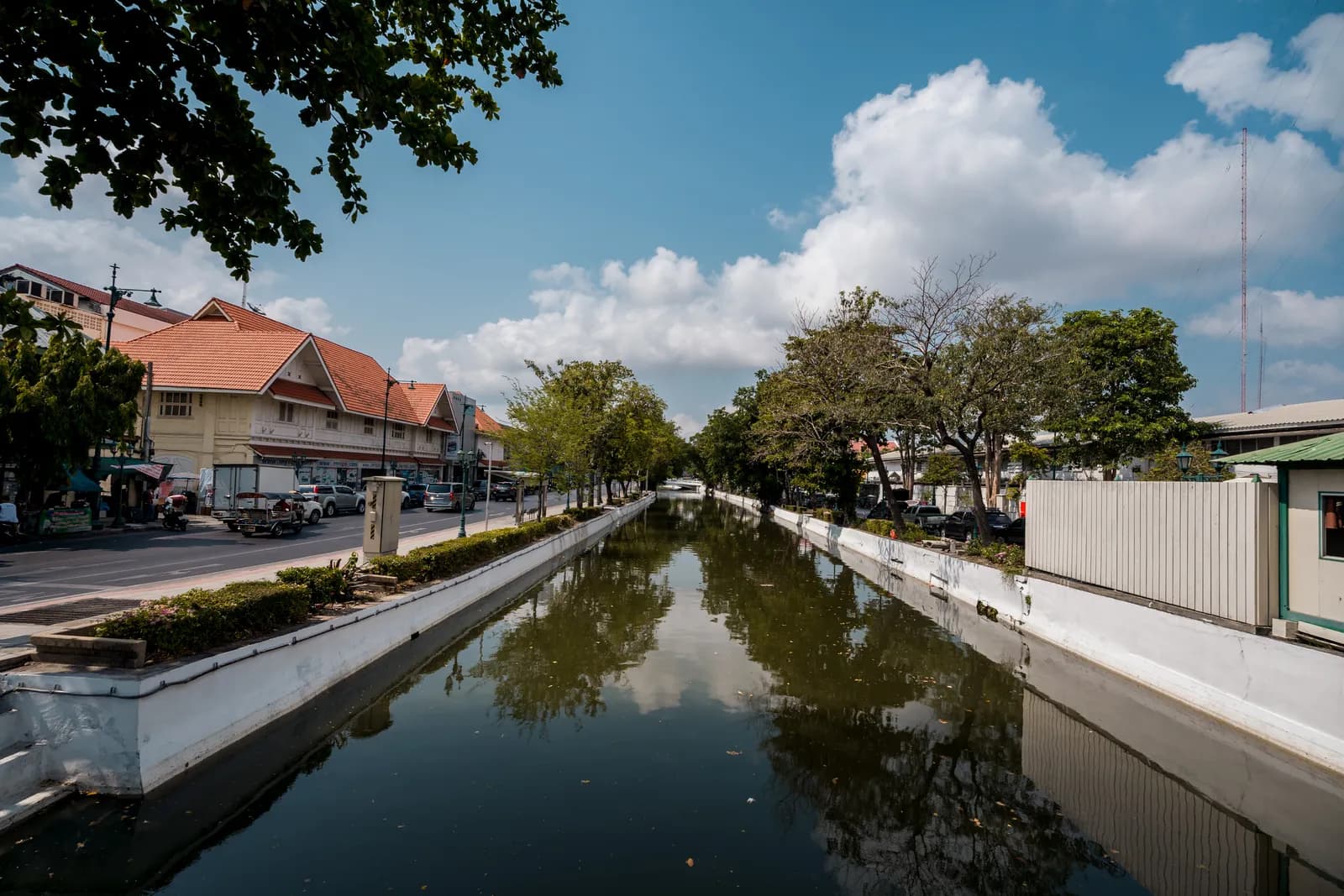
It is the oldest scam in Bangkok, and it still works. Near the palace, a well-dressed man, sometimes in uniform or with a badge, approaches you kindly: 'The palace is closed this morning for a ceremony, it reopens at 1pm.' In the meantime, he suggests a ridiculously cheap tuk-tuk tour to a 'lucky temple'. The tour ends at a jewellery shop, a tailor or a travel agency, where the driver earns a commission on whatever you buy. The gems on sale are overpriced, or even fake.
How to avoid it:
- Trust only what you see at the official entrance, on Na Phra Lan Road, opposite Sanam Luang. The other gates in the walls are closed to the public, which does not mean the palace is.
- Politely refuse any unsolicited offer of a tuk-tuk, a guide or a 'shortcut' around the palace and Wat Pho.
- Check announcements the day before on the official website (royalgrandpalace.th) or its Facebook page.
Genuine closures do happen, though. They are decided by the Bureau of the Royal Household and announced a few days ahead. In 2026, the palace was closed from 13 to 19 June for royal funeral ceremonies, and access was reduced from 28 to 31 July, around the King's birthday: palace side closed, visits limited to half a day, ordination hall closed. The cremation ceremonies for Queen Mother Sirikit, from 15 to 19 December 2026, are expected to bring road closures around Sanam Luang and changes to palace access. If you are in Bangkok on those dates, plan your visit before 15 December or after 19 December, and check. For other classic travel traps, I have gathered my tips for travelling safely.
Best time, heat and how long to stay
Come at opening time, 8.30am. My photos from late April show what awaits you later: courtyards full of groups, a tight queue at the door of the ordination hall and visitors sheltering under umbrellas in every patch of shade. The first hour is the quietest and the coolest. Also avoid weekends and Thai public holidays, when local visitors add to the tourist crowds.
Heat is the real issue. The site is almost entirely stone, with very few trees: paving, marble and white walls throw the sun back at you. From March to May, the hot season, it is over 35°C in the shade and the ground burns. Bring water, a hat and sunscreen. The best season remains November to February.
As for timing, allow:
- 1.5 to 2 hours for Wat Phra Kaew, taking your time in the gallery and on the terrace;
- 30 to 45 minutes for the palace courtyards;
- 45 minutes to 1 hour for the textile museum, if you go.
For a full visit without rushing, plan on 3 hours, including the walk out.
How to get to the Grand Palace
The visitor entrance is on Na Phra Lan Road, on the north side of the walls, opposite the open ground of Sanam Luang.
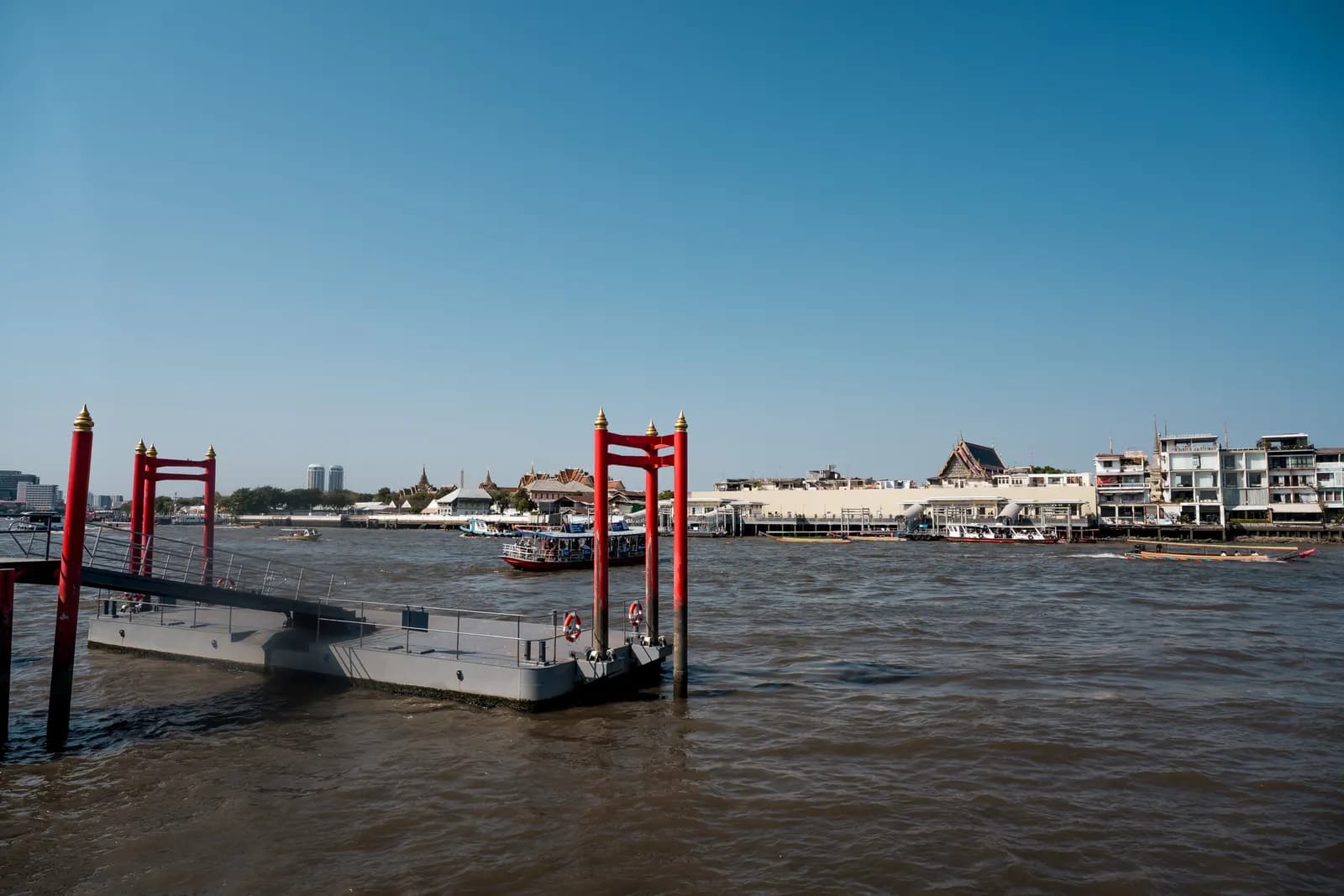
- Boat on the Chao Phraya: the most pleasant option. Get off at Tha Chang (N9); the entrance is a few minutes' walk away. During the day, the yellow flag boat runs the line (about 20 to 25 baht depending on the flag in October 2026; fares have changed several times this year). From Silom or Sathorn, take the BTS to Saphan Taksin and the boat from Sathorn Pier.
- MRT metro: Sanam Chai station, on the Blue Line, is about a kilometre from the entrance. The walk runs along the wall of Wat Pho: allow 15 minutes.
- Taxi or Grab: handy from outlying districts. Ask for 'Grand Palace, Na Phra Lan Road'. With Grab, the price is fixed in advance, so there is no haggling. A travel eSIM is all you need to order a car from the airport.
- Tuk-tuk: best avoided for getting to or from the palace because of the scams described above, or else agree the price before you get in.
Saily eSIM
Stay connected with the best secure eSIM
With Saily, the secure eSIM with superpowers, say goodbye to roaming abroad! -5% with code AMEBOHEME.
Grand Palace, Wat Pho and Wat Arun in one day
Bangkok's three most visited sights are less than 2km apart. On 28 April 2024, I did them in this order, starting with Saranrom Park and finishing in Chinatown. Here is the plan I recommend, starting earlier than I did.
| Time | Stop | Tip |
|---|---|---|
| 8.15am | Arrive at Tha Chang or Sanam Chai | Proper clothes, water, ticket bought online if possible |
| 8.30am to 10.30am | Wat Phra Kaew | Start with the ordination hall before the crowds, then the terrace |
| 10.30am to 11.15am | Palace courtyards | Chakri Maha Prasat, Dusit Maha Prasat, Aphorn Phimok |
| 11.15am to 12pm | Textile museum (optional) or Saranrom Park | Air conditioning at the museum, shade in the park |
| 12pm to 1.30pm | Lunch at Tha Tien or Tha Maharaj | A break in the shade during the hottest hours |
| 1.30pm to 3pm | Wat Pho | Reclining Buddha, chedis, traditional massage |
| 3.15pm | Tha Tien ferry to Wat Arun | A few baht, a few minutes |
| 3.30pm to 5pm | Wat Arun | Climb to the terrace of the prang |
| 5.30pm | Boat to Ratchawong, then Chinatown | Yaowarat Road lights up at nightfall |
Saranrom Park, right next door
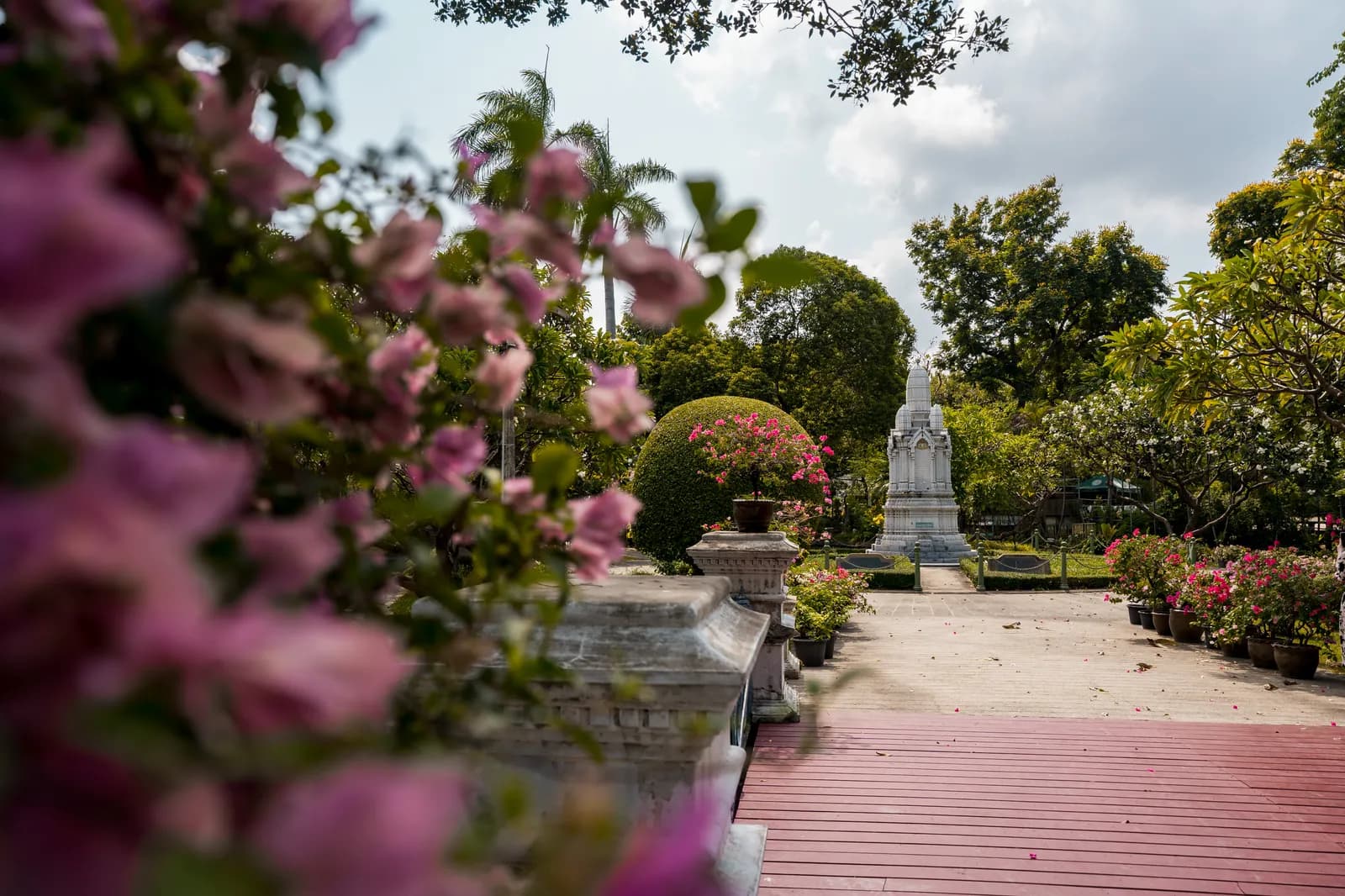
A short walk from the south-east corner of the palace, Saranrom Park is the former garden of the palace of the same name, built under Rama IV to receive foreign guests and turned into a European-style botanical garden under Rama V. Entry is free and it opens early in the morning. I started my day here: pink bougainvillea over a wooden bridge, ponds, a golden fountain among yellow flowers and small white monuments, with hardly anyone around. It is the best place to cool off in the shade between two visits.
Wat Pho and the Reclining Buddha
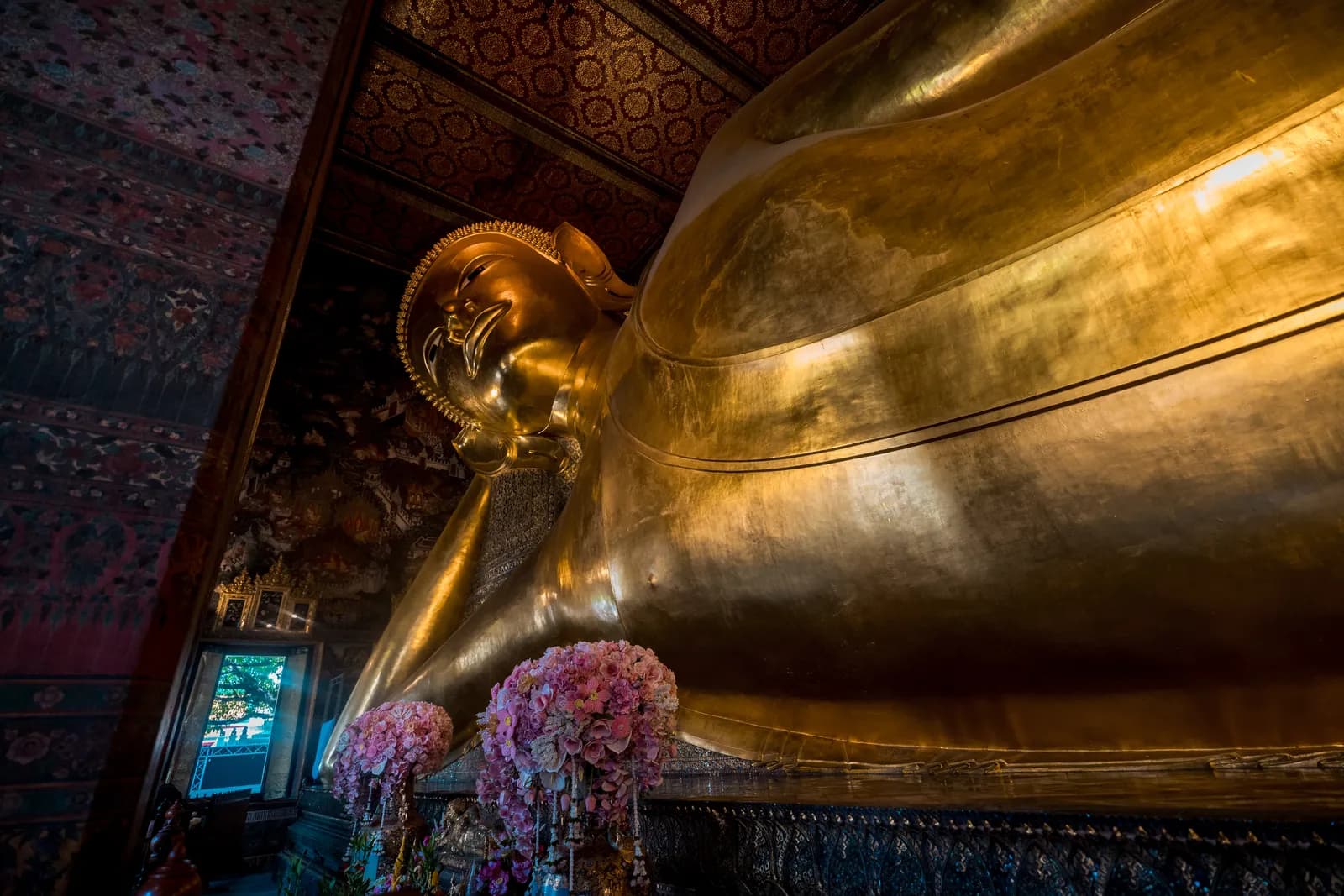
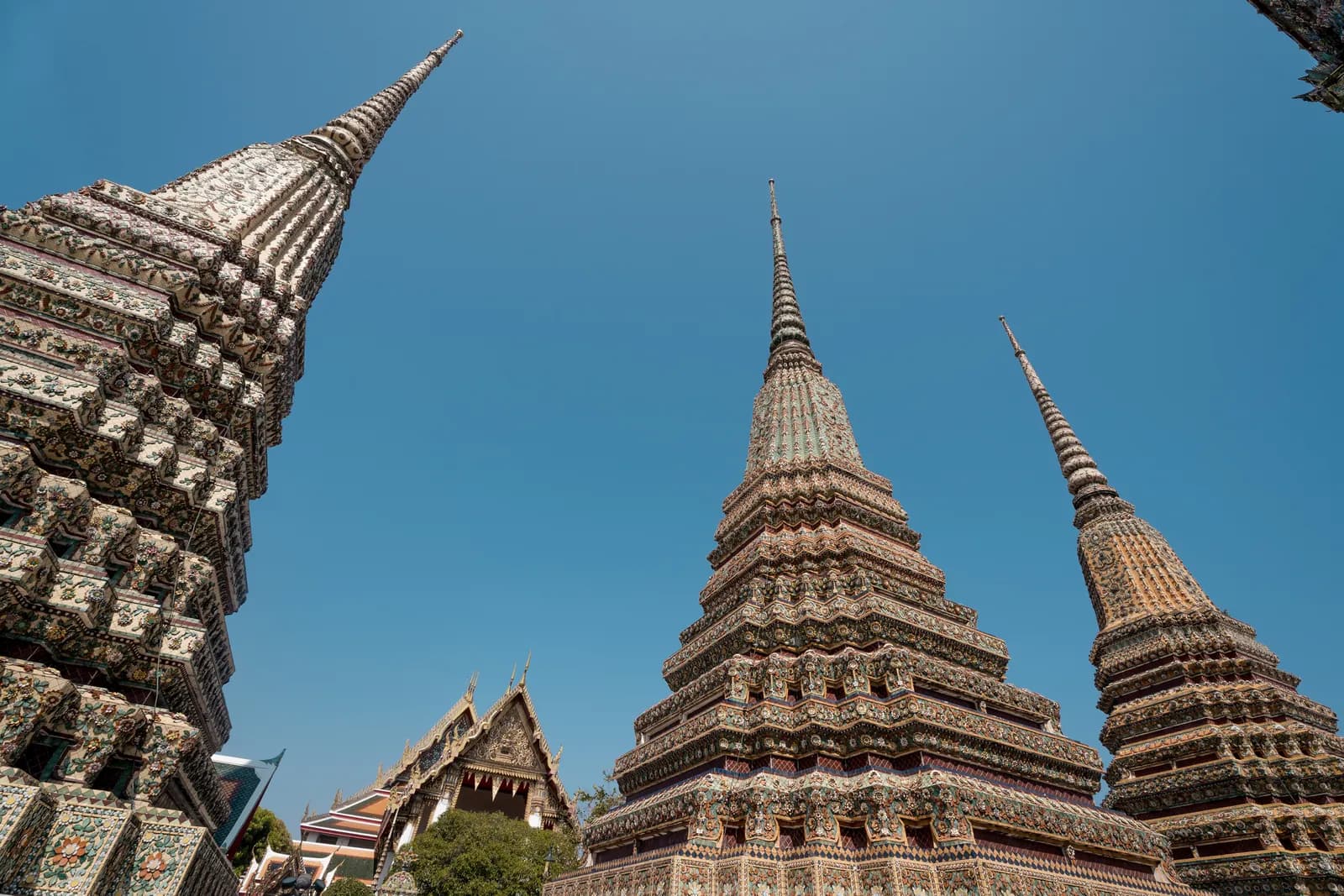
Wat Pho is about ten minutes' walk south of the palace. Entry: 300 baht (the price has gone up in recent years, so check at the ticket office), open from about 8am to 6.30pm. The Reclining Buddha is 46 metres long: you walk along its golden body in a narrow hall to the soles of its feet, inlaid with mother-of-pearl in spiral patterns. Around it, a maze of courtyards holds dozens of ceramic-covered chedis, four of them very large. The temple is also home to the leading school of traditional Thai massage. In my photos, Wat Pho is far less crowded than Wat Phra Kaew, and every bit as beautiful.
Photos : Pierre Bouyer
Wat Arun, the Temple of Dawn
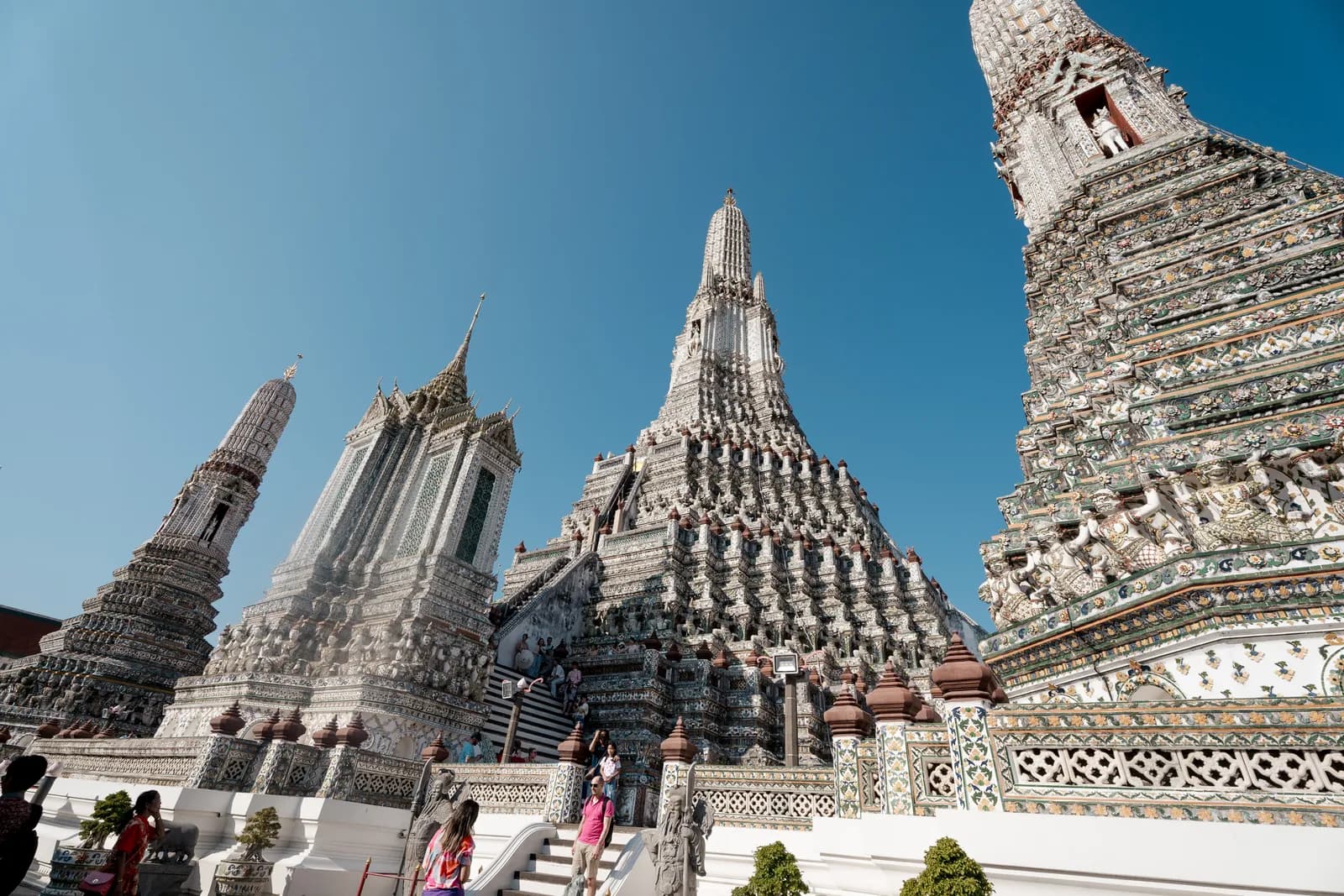
From the Tha Tien pier, by the exit of Wat Pho, a ferry crosses the Chao Phraya in a few minutes for about 4 baht. Wat Arun entry: 200 baht, open from about 8am to 6pm. The central prang, about 70 metres high, is entirely covered in fragments of coloured Chinese porcelain that form flowers when you look closely. You can climb to its first terrace up very steep steps. Around it, shops rent traditional Thai costumes for photos: in April 2024, a good share of visitors were wearing them. To see it whole, look at it from the Tha Tien bank too.
Where to eat near the Grand Palace
Two areas are handy around the palace, plus Chinatown in the evening.
- Tha Maharaj: a small riverside shopping arcade next to Tha Phra Chan pier, a 10-minute walk north of the palace. It has around twenty places to eat, from Thai food (Savoey) to noodles and coffee, in air-conditioned rooms or on terraces over the water. Open from 10am to 10pm.
- Tha Tien: around the pier, between Wat Pho and the river, old shophouses hold street stalls and a few restaurants with terraces facing Wat Arun: Eat Sight Story, Supanniga Eating Room, the restaurant at the Sala Rattanakosin hotel or The Deck at Arun Residence. You pay for the view; book for sunset.
- In the evening, Chinatown: the boat drops you at Ratchawong in a few minutes, and Yaowarat Road turns into a huge open-air food hall at nightfall. The metro also gets you there from Sanam Chai (Wat Mangkon station).
To be at the gates for the 8.30am opening, staying in one of the small riverside hotels at Tha Tien is ideal.
Prices, opening hours and budget
| Site or item | Price in 2026 | Hours |
|---|---|---|
| Grand Palace and Wat Phra Kaew | 500 baht (free for Thai nationals) | 8.30am to 4.30pm, tickets until 3.30pm |
| Queen Sirikit Museum of Textiles | Included (150 baht on its own) | 9am to 4.30pm, last entry 3.30pm |
| Khon show, Sala Chalermkrung | Included with shuttle (400 baht on its own) | Monday to Friday, 1pm, 2.30pm and 4pm |
| Wat Pho | About 300 baht | About 8am to 6.30pm |
| Wat Arun | About 200 baht | About 8am to 6pm |
| Express boat (yellow flag) | About 20 to 25 baht | During the day |
| Tha Tien ferry to Wat Arun | About 4 baht | All day |
For the full day, allow about 1,000 baht for entry fees and transport, plus meals: a dish at a street canteen costs a few dozen baht, a terrace dinner facing Wat Arun a lot more.
What the ticket includes
The 500 baht ticket is sold at the ticket office, at self-service kiosks or on the official website. It is valid for 7 days, with one entry per venue, and includes:
- Wat Phra Kaew and the palace courtyards;
- the Queen Sirikit Museum of Textiles, inside the grounds, which shows the Queen's wardrobe and weaving from Thailand's regions: an hour in the cool, welcome in the middle of the day;
- the khon show at Sala Chalermkrung, a 25-minute masked dance drama drawn from the Ramakien, Monday to Friday. A free shuttle leaves from the Phiman Deves Gate, at the palace exit, 30 minutes before each performance. Note that there are no shows on 13, 23 and 28 October 2026;
- the Arts of the Kingdom Museum at Bang Sai, near Ayutthaya, further out of Bangkok.
Frequently asked questions
500 baht for foreign visitors, free for Thai nationals with their ID card. The ticket covers Wat Phra Kaew, the Queen Sirikit Museum of Textiles and the weekday khon show at Sala Chalermkrung. It is valid for 7 days, with one entry per venue.
The site is open every day from 8.30am to 4.30pm, but the ticket office closes at 3.30pm. Hours change on days of royal ceremonies, so check the official website or the palace's Facebook page the day before your visit.
Shoulders and knees covered, no exceptions. Shorts, short skirts, vest tops, tight trousers, leggings and see-through clothing are turned away at the entrance. The easiest option is loose long trousers or a long skirt with a T-shirt that has sleeves.
Almost never. It is a long-running scam: a stranger claims the palace is closed for a ceremony and offers a cheap tuk-tuk ride that ends at a jewellery shop or a tailor. Walk to the official entrance on Na Phra Lan Road and check for yourself.
Allow 2.5 to 3 hours for Wat Phra Kaew and the palace courtyards, plus an hour if you want to see the textile museum. A full day lets you carry on to Wat Pho and Wat Arun.
No, photography is forbidden inside the ordination hall, which you enter barefoot and where you sit without pointing your feet at the statue. You can, however, photograph the temple from outside and the rest of the site.
The Chao Phraya express boat stops at Tha Chang (N9), a few minutes' walk from the entrance. MRT Sanam Chai station (Blue Line) is about a kilometre away, along the walls of Wat Pho.
It is not essential: the main buildings are signposted and a good written guide is enough to understand what you are looking at. If you want a guide, book a licensed one in advance, and turn down the 'guides' who approach you in the street around the walls.
My verdict on the Grand Palace
Of all my Thailand albums, Wat Phra Kaew is where the decoration is densest: in my photos, there is not a square metre without gilding, mosaic or carving. The temples I describe in my guide to Chiang Mai's temples are more intimate, older and calmer; here, everything is designed to impress, and it works. The upper terrace, with the golden chedi, the blue-mosaic pantheon, the kinnari and the model of Angkor, is worth the ticket on its own.
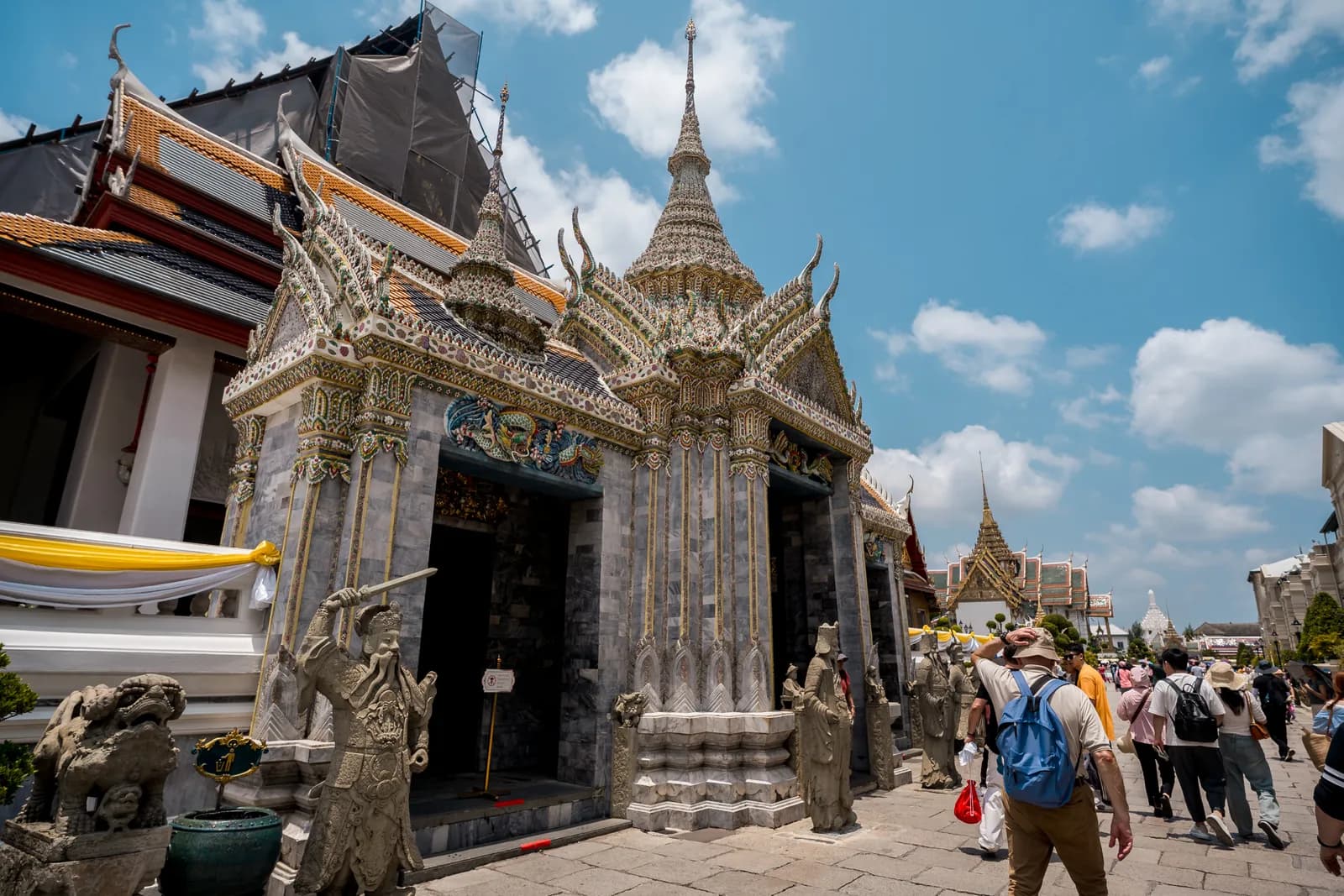
The downside is the crowds. In my late-April photos, you have to hunt for angles to avoid groups, umbrellas and selfie sticks. The Ramakien gallery, which deserves an hour of reading, is walked in a constant flow. And the palace side is a little disappointing by comparison: you see beautiful facades but enter none of the throne halls. At 500 baht, it is the most expensive sight in Bangkok, three times the price of Wat Pho for a shorter visit. It is still worth it, especially if you make the most of the textile museum and the khon show included.
What I liked:
- the sheer density of decoration at Wat Phra Kaew, which no photo fully captures;
- the golden kinnari and the chedis carried by demons, under a blue sky;
- the Aphorn Phimok pavilion, small and perfect;
- how close Wat Pho and Wat Arun are, making a full day on foot and by ferry easy;
- the calm of Saranrom Park, right next door.
What I liked less:
- the midday crowds, which make the Ramakien gallery hard to appreciate;
- the heat reflected off the paving, with almost no shade;
- the sheeting and scaffolding of restoration work, unavoidable but visible;
- the closed palace halls, which limit the second part of the visit to exteriors.
It is for you if this is your first trip to Bangkok, if you love architecture or photography and if you are willing to get up early. It is less for you if you hate crowds or are travelling with young children in the hot season: in that case, favour Wat Pho, which is more spacious.
Continuing your trip
Bangkok was the last stop of my trip, after almost three months in the country: you will find where it fits in my 3-month Thailand itinerary. If you are heading north next, my guide to things to do in Chiang Mai takes over. And every stop in the country is gathered on the Thailand page.
Sources and fact-checkingInformation checked on 9 October 2026 · 15 sources consulted
- Grand Palace Bangkok: official website (hours, price)
- Grand Palace: tickets and what they include
- Grand Palace: Queen Sirikit Museum of Textiles
- Grand Palace: khon performance at Sala Chalermkrung
- Thailand PRD: revised Grand Palace access from 28 to 31 July 2026
- The Nation: Queen Sirikit's royal cremation on 16 December 2026
- Wikipedia: Wat Phra Kaew
- Wikipedia: Emerald Buddha
- Wikipedia: Grand Palace
- Thailex: Aphorn Phimok Prasat pavilion
- TAT News: the old city and Yaowarat on the MRT Blue Line
- Thaiest: Chao Phraya yellow flag boat (2026 fares)
- Thaiest: Chao Phraya cross-river ferries
- Your Thai Guide: Bangkok entry fees
- Your Thai Guide: the Grand Palace and Wat Phra Kaew
Âme Bohème exists thanks to you
Some links in this article are affiliate links. This means that if you book or purchase a product through these links, we receive a small commission, at no extra cost to you. It's thanks to this support that we can continue creating free, quality content.
You can also buy us a coffee, or follow us on Instagram and Facebook.