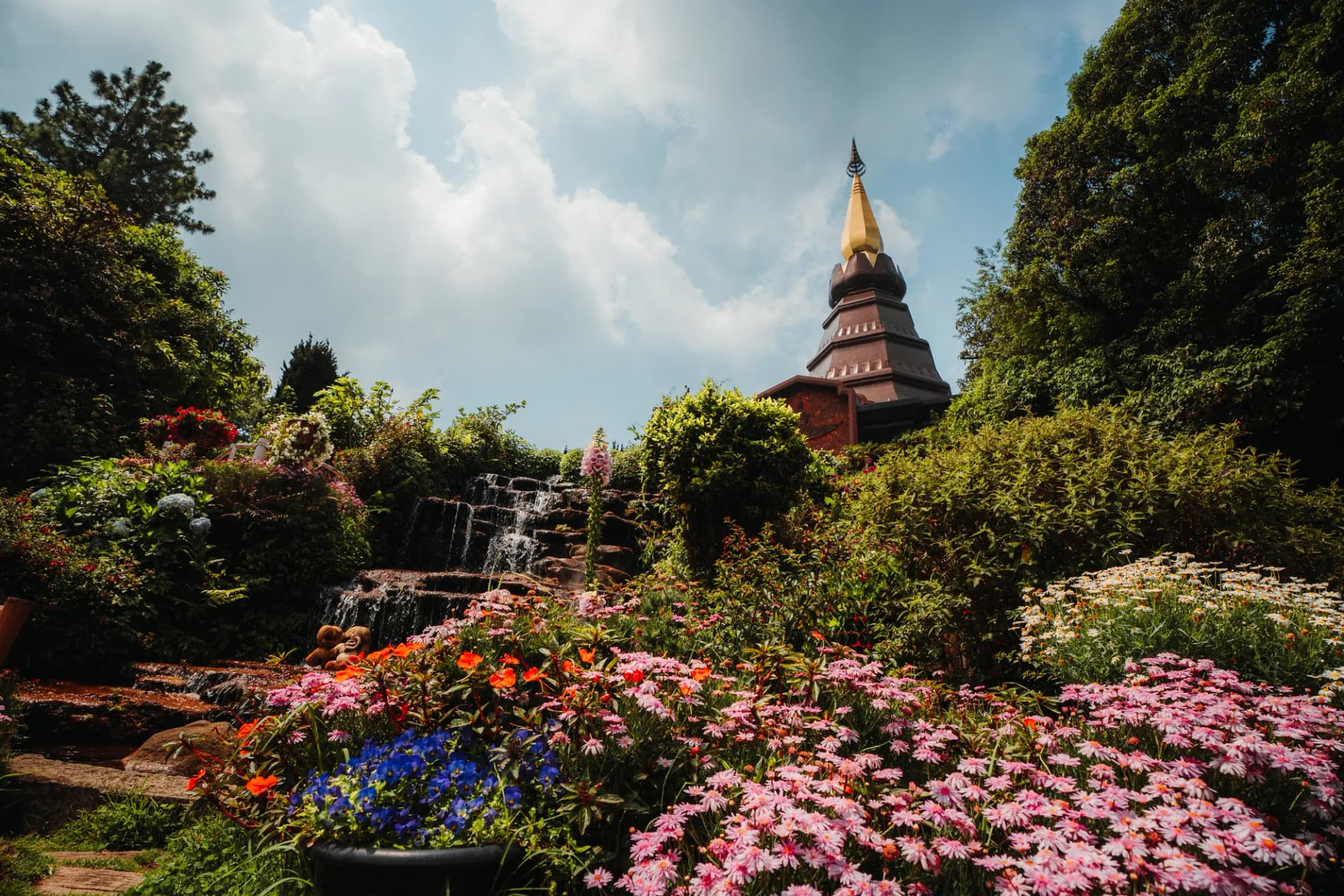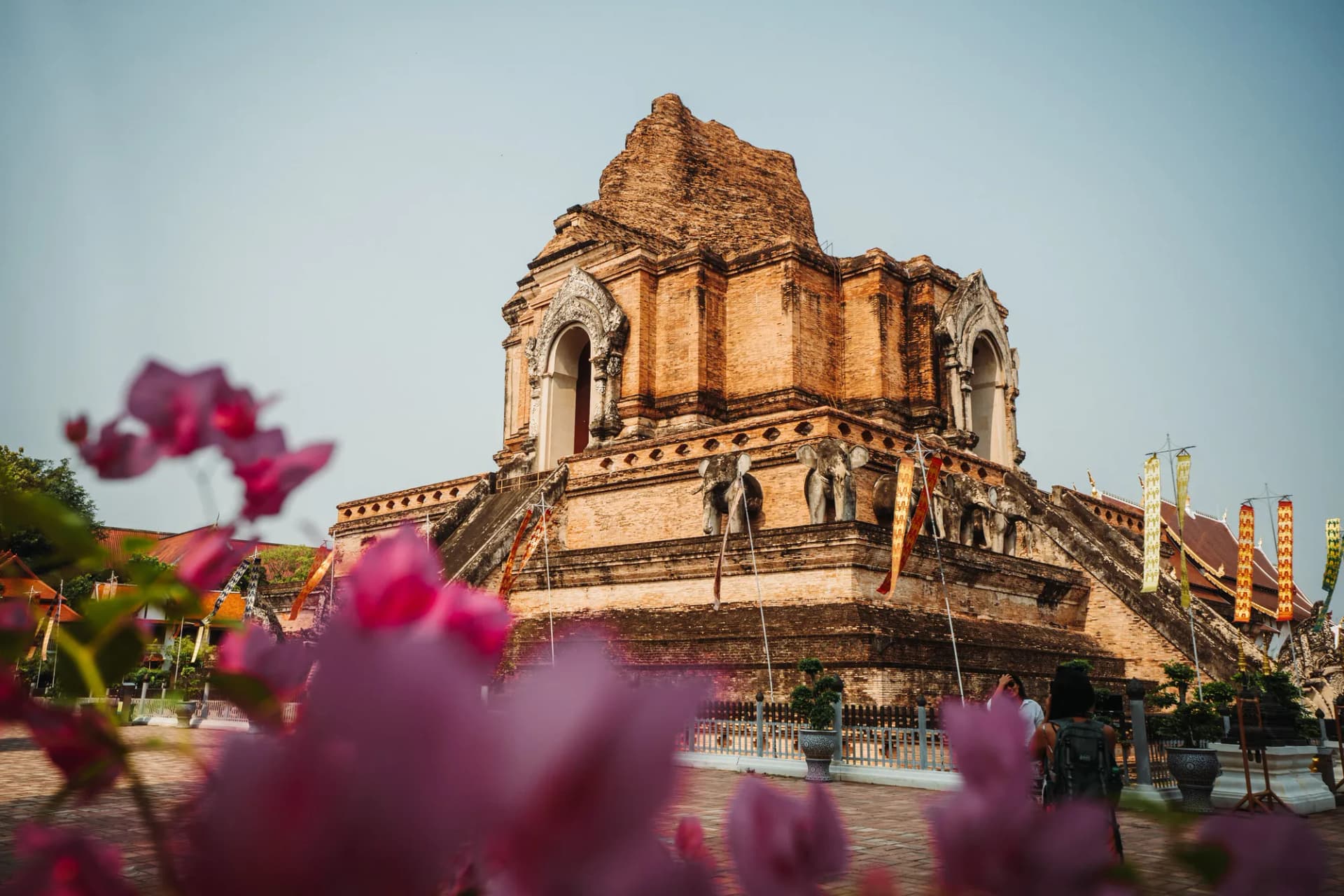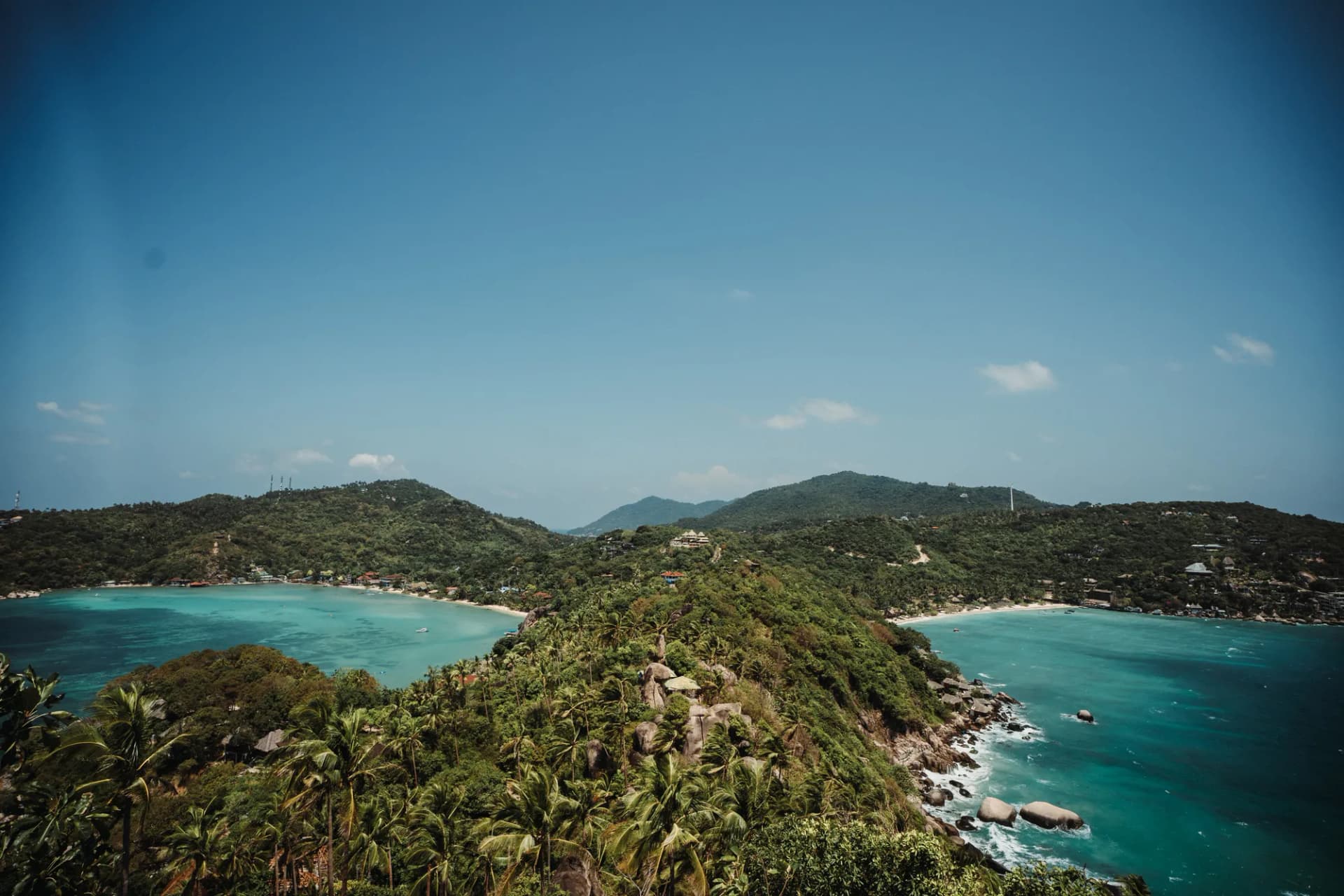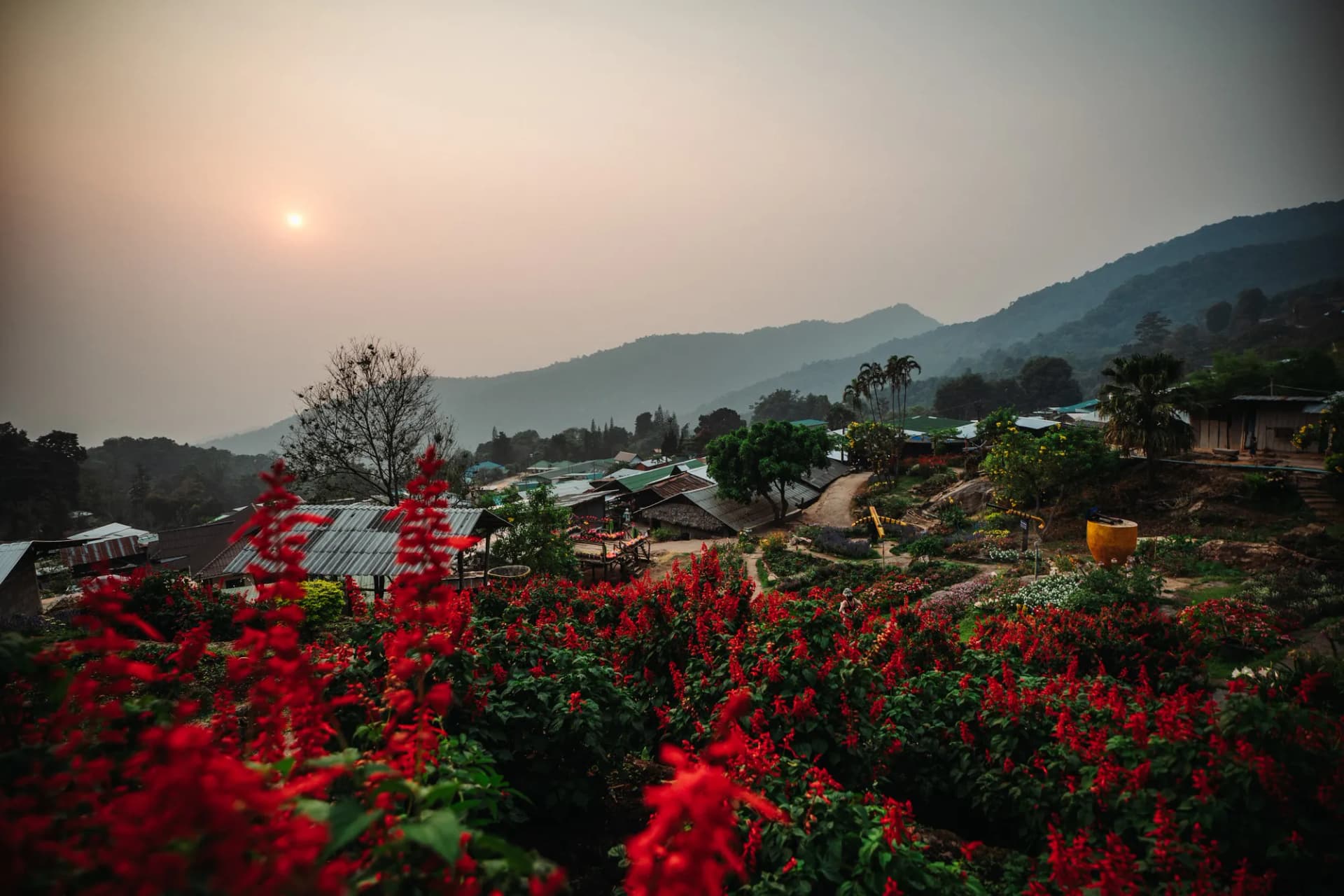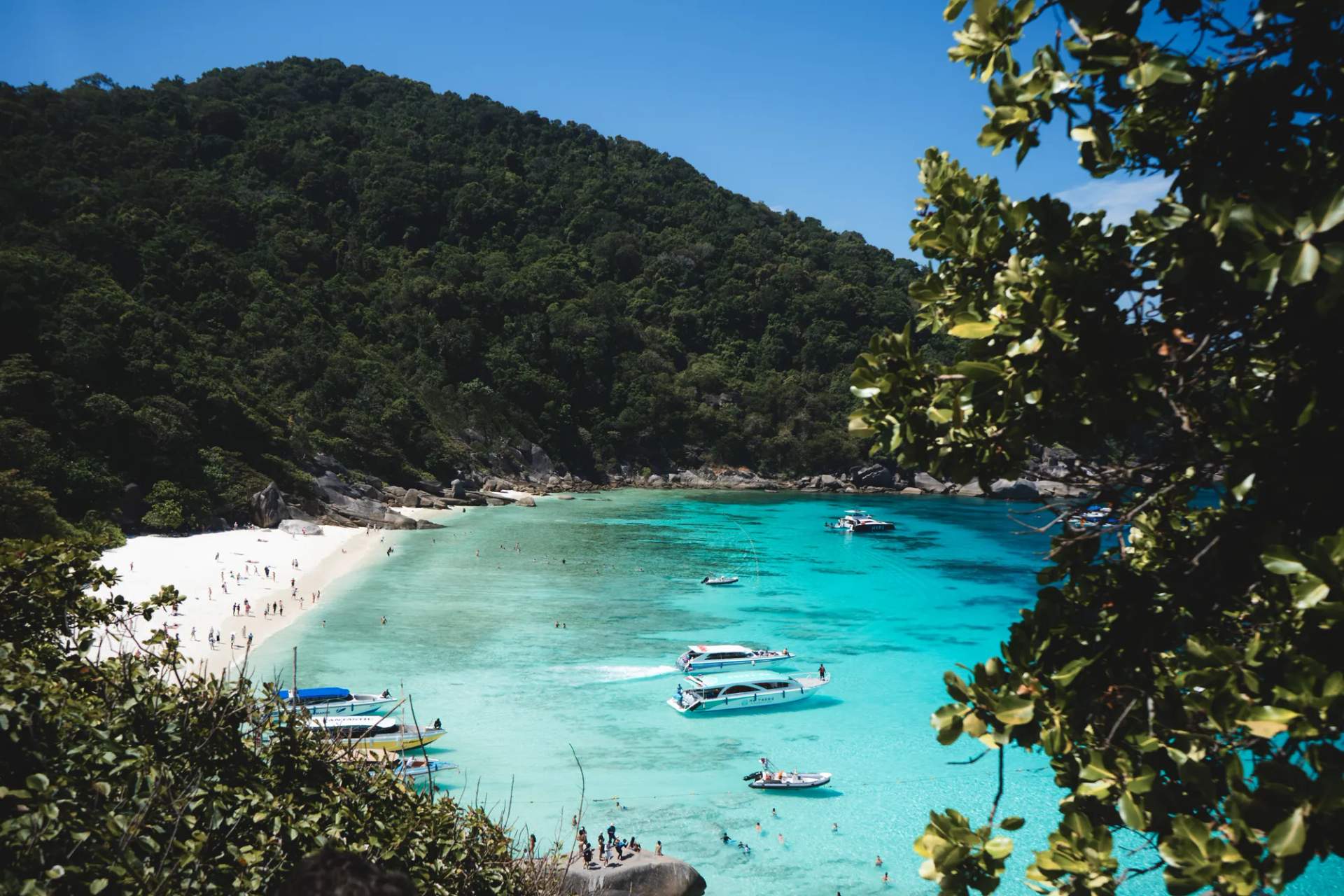

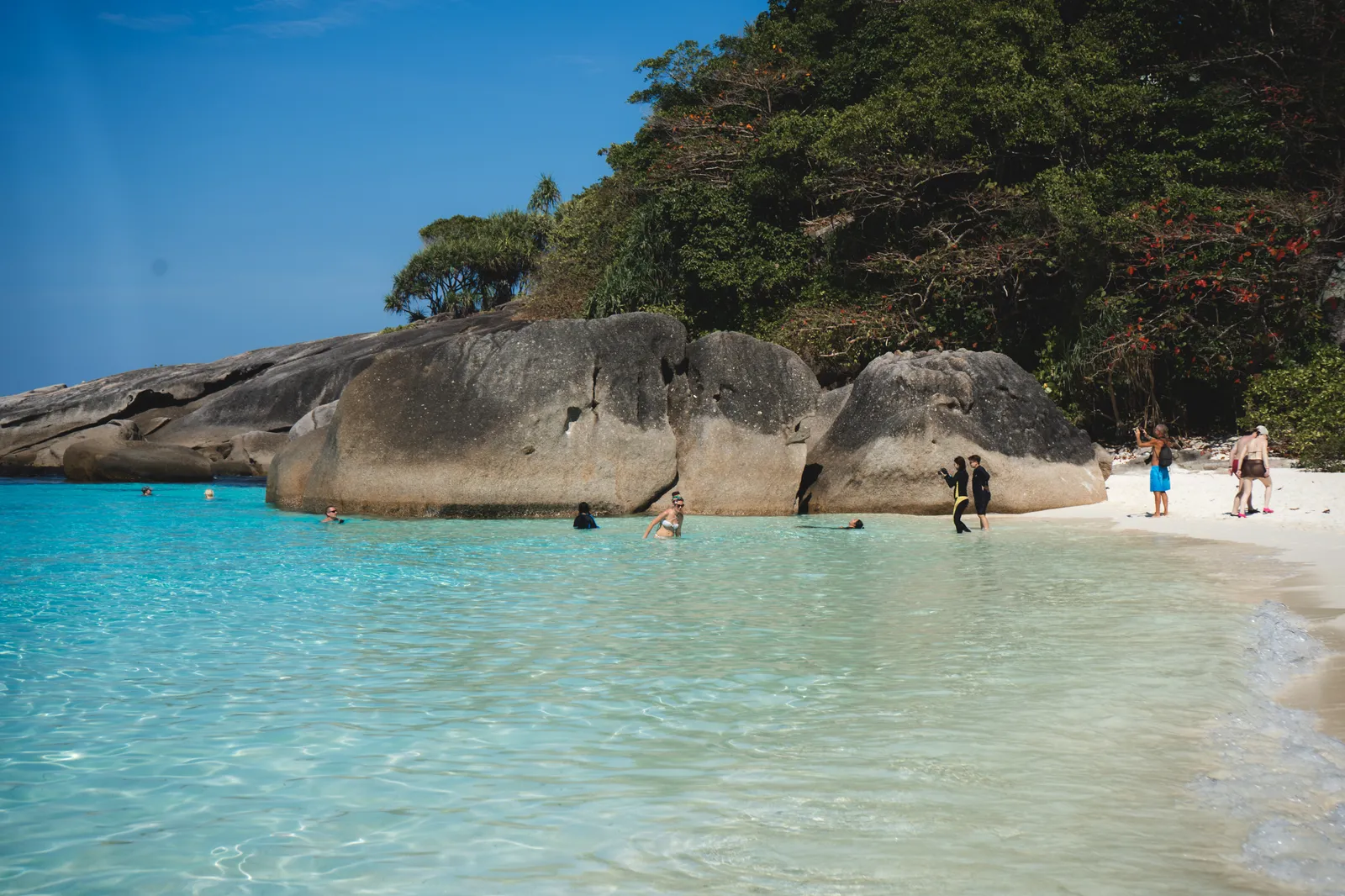
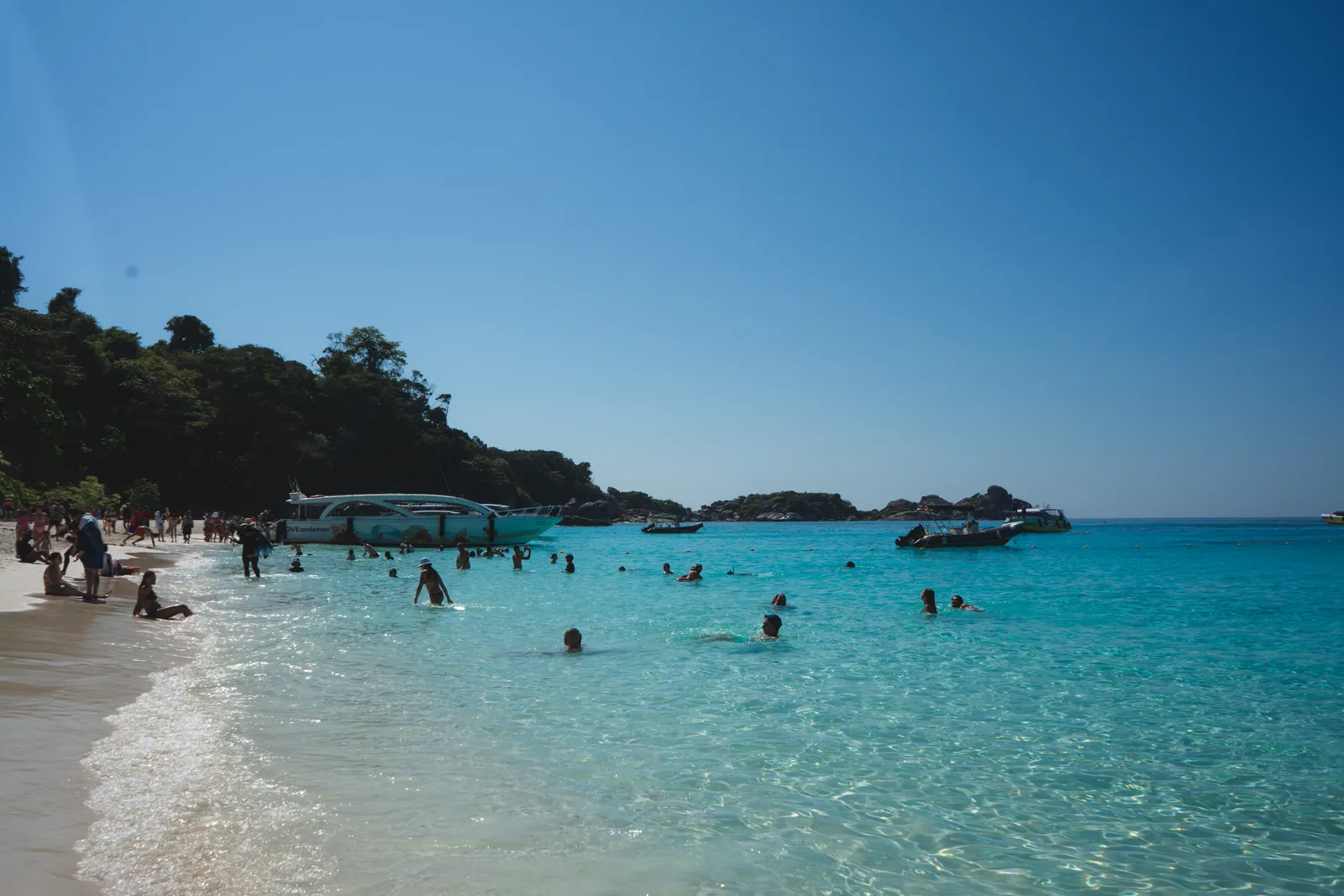
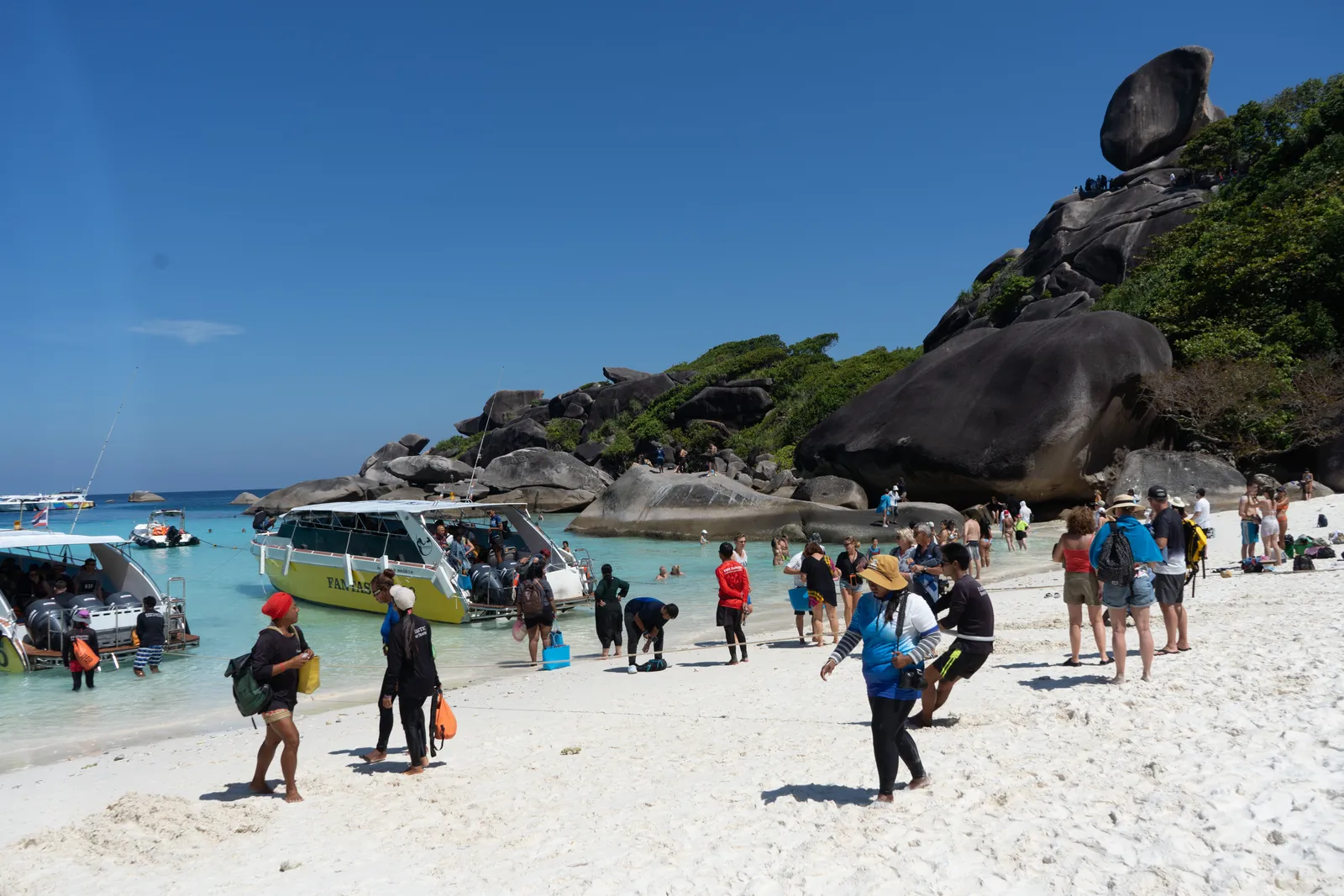
On 17 March 2024, right in the high season, I spent the day in the Similan Islands. I came back with 37 photos, and almost all of them share the same colour: a turquoise I never saw anywhere else in Thailand, over sand so white it makes you squint. There is also a less flattering picture, of the landing beach on island no. 8, where speedboats pull up straight onto the sand among the groups coming ashore.
The Similans are the most spectacular archipelago in the Andaman Sea, but also a tightly managed national park: open seven months a year, with a daily quota, a named ticket and strict rules. The day needs planning: Khao Lak or Phuket, a cheap big boat or a small group that leaves early, which islands you will actually see and which are closed.
Mu Ko Similan National Park at a glance
The Similan Islands are a granite archipelago set in the open Andaman Sea, about 65km from Thap Lamu pier, off Khao Lak in Phang Nga province. The name is said to come from Yawi, the Malay spoken in southern Thailand, in which "sembilan" means nine: the number of islands in the original archipelago.
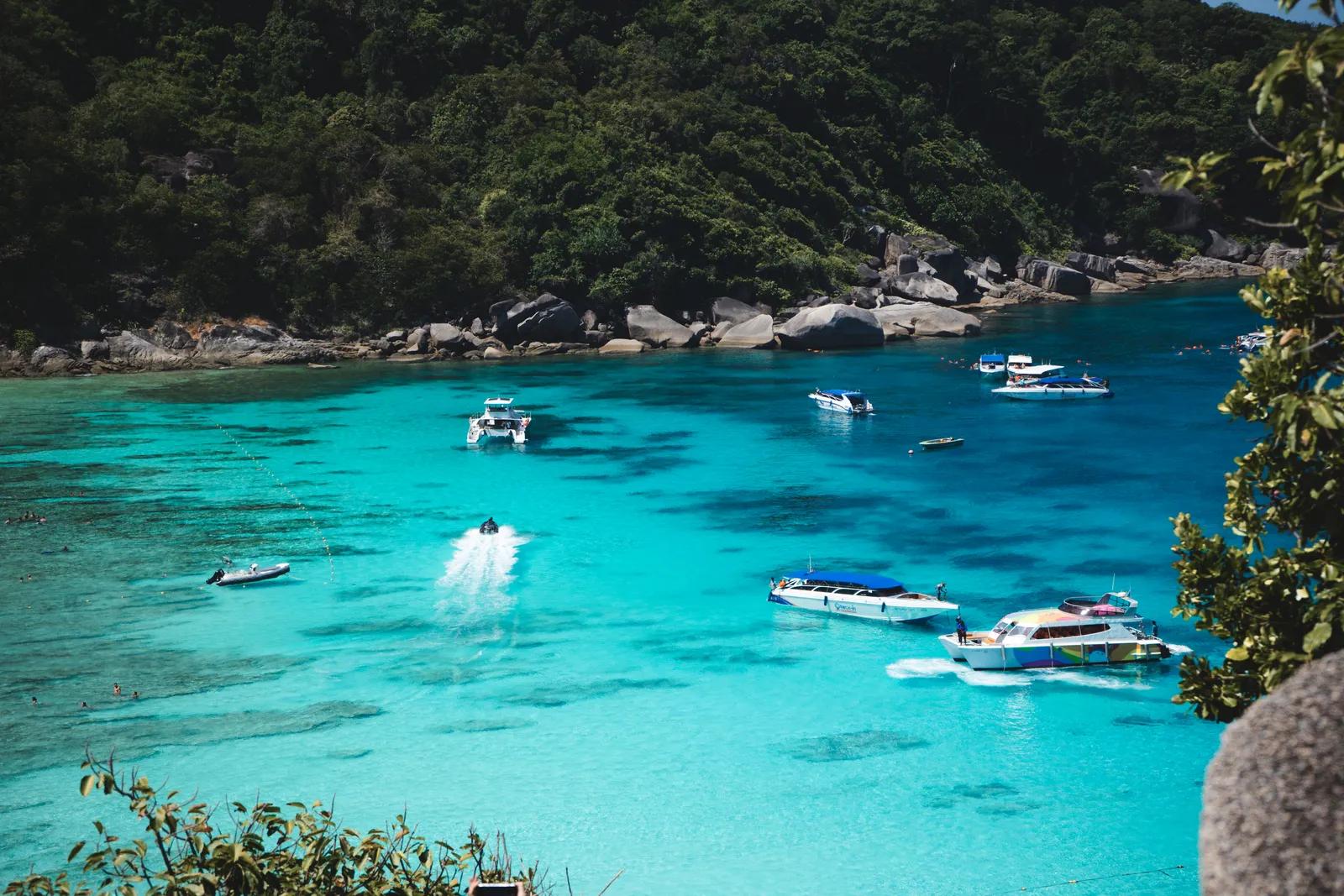
The national park was created in 1982. It covers about 140km², of which only 26km² is land. In 1998 two islands further north were added: Koh Bon and Koh Tachai. The park therefore has eleven islands, which the Department of National Parks (DNP) numbers from south to north. Locally, people talk about "island no. 8" or "island no. 4" rather than their Thai names.
By the late 2010s the park was receiving five to six thousand visitors a day in high season, and both reefs and beaches were suffering. Since 2018 a quota has capped entries at 3,325 day visitors and 525 divers, 3,850 people a day in total. Overnight stays on the islands were scrapped the same year. Since 15 October 2025, entry has been through an e-ticket (QueQ app or DNP portal) issued before 8am on the day, with your passport number: in practice your tour operator handles it, but will ask for your details in advance.
The park closes every year from 16 May to 14 October, during the south-west monsoon. It can also close earlier if the weather demands it.
The islands you will actually see
A day trip only shows you three or four of the eleven islands, always the same ones. Only two islands allow landings: island no. 8 and island no. 4. The other stops are snorkelling from the boat, without setting foot ashore.
Koh Similan, island no. 8: Donald Duck Bay and Sail Rock
This is the largest island in the archipelago and the reason for the whole trip. Its main bay, Donald Duck Bay, is a long crescent of white sand fringed by forest, in front of shallow water of an almost unreal turquoise. The nickname is said to come from the outline of a rock which, seen from a certain angle, recalls the head of the Disney duck.
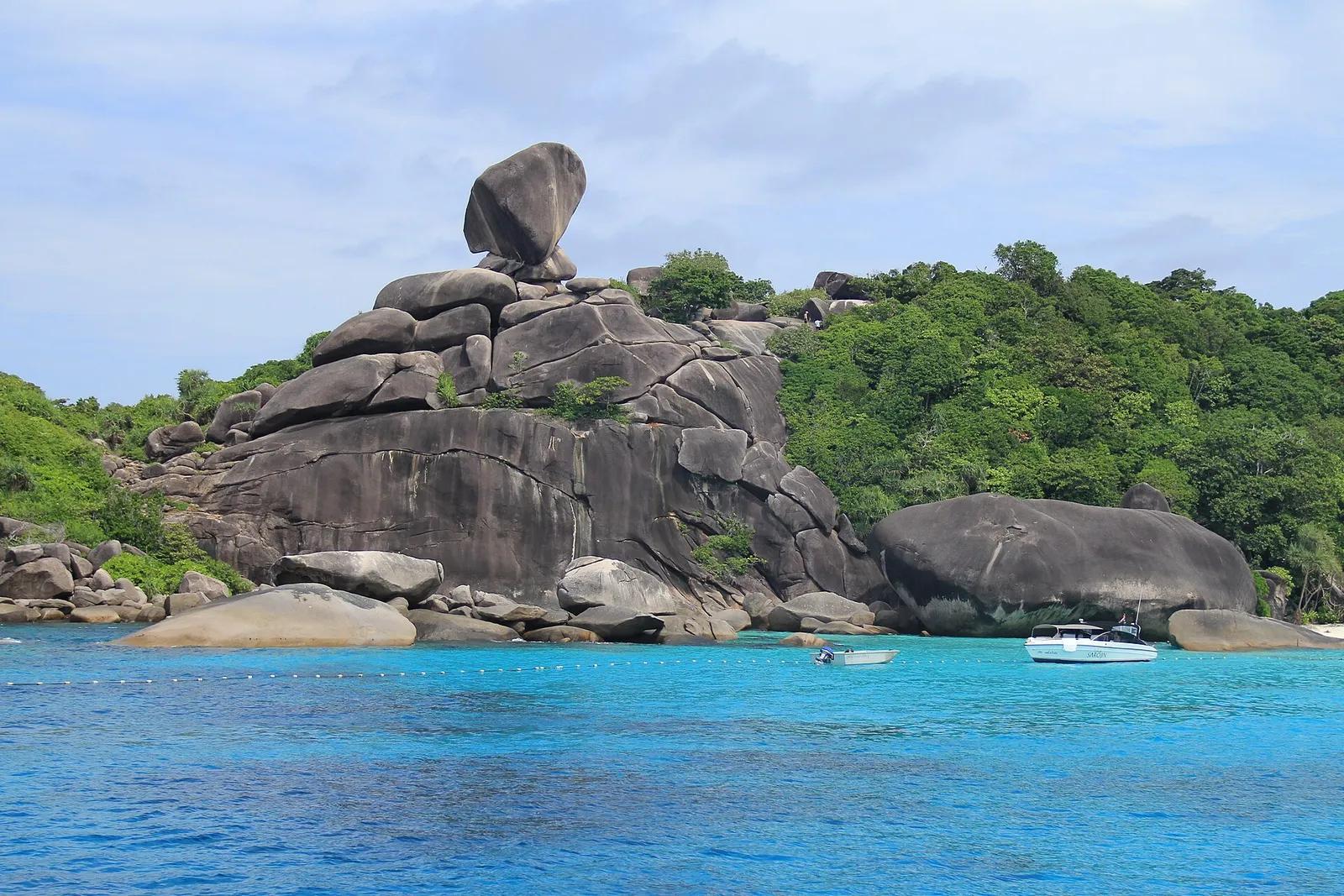
At the northern end of the beach, a pile of granite boulders is topped by a balancing rock, Sail Rock (Hin Ruea Bai). On the day I visited, the speedboats were pulling up on the beach at the foot of this rock, exactly where the crowds gather.
The Sail Rock viewpoint
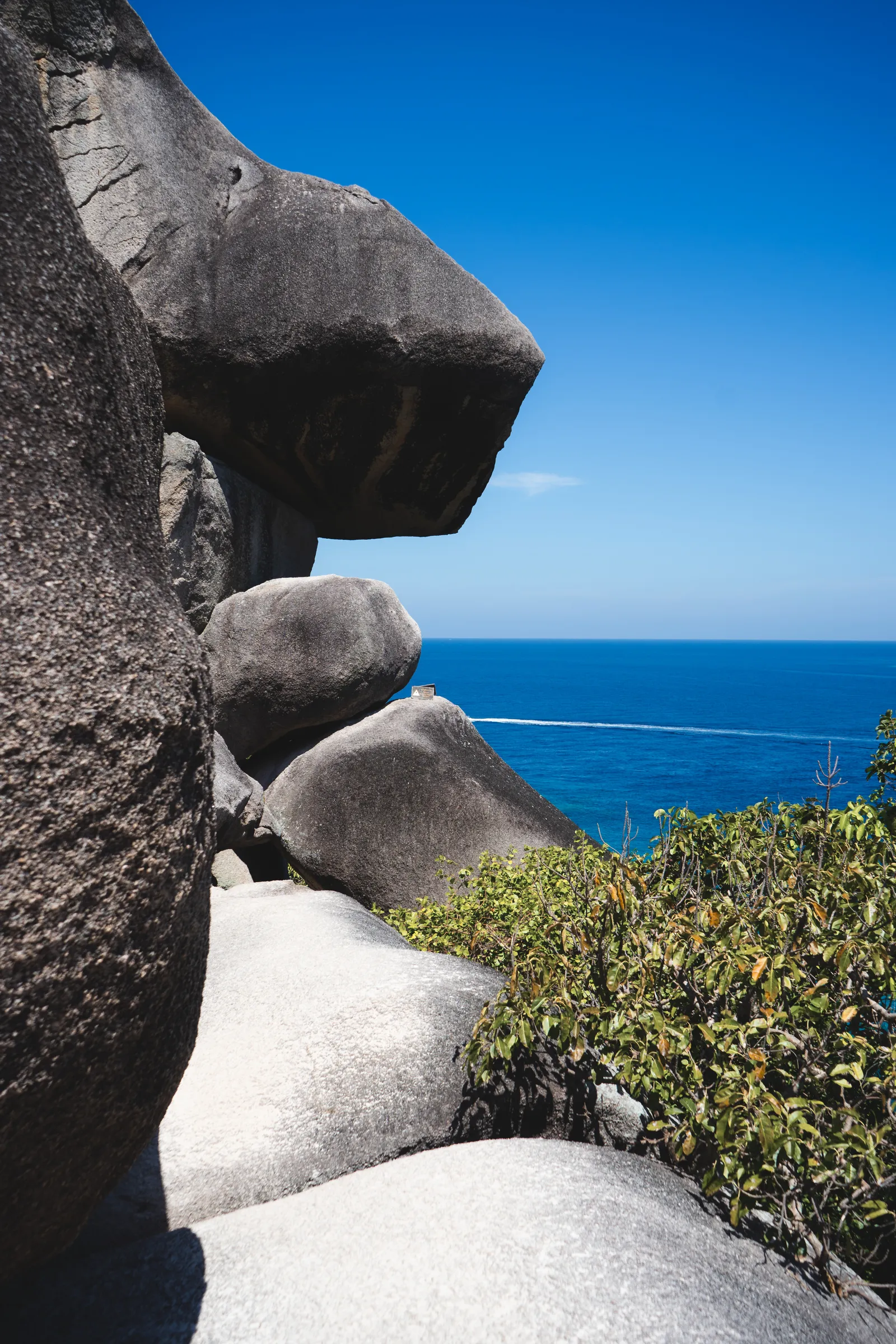
From the beach, a short, partly built path climbs between the granite boulders to the viewpoint above the bay. The climb is short, with a few sections where you use your hands on the smooth rock: wear sandals that stay on your feet rather than flip-flops.
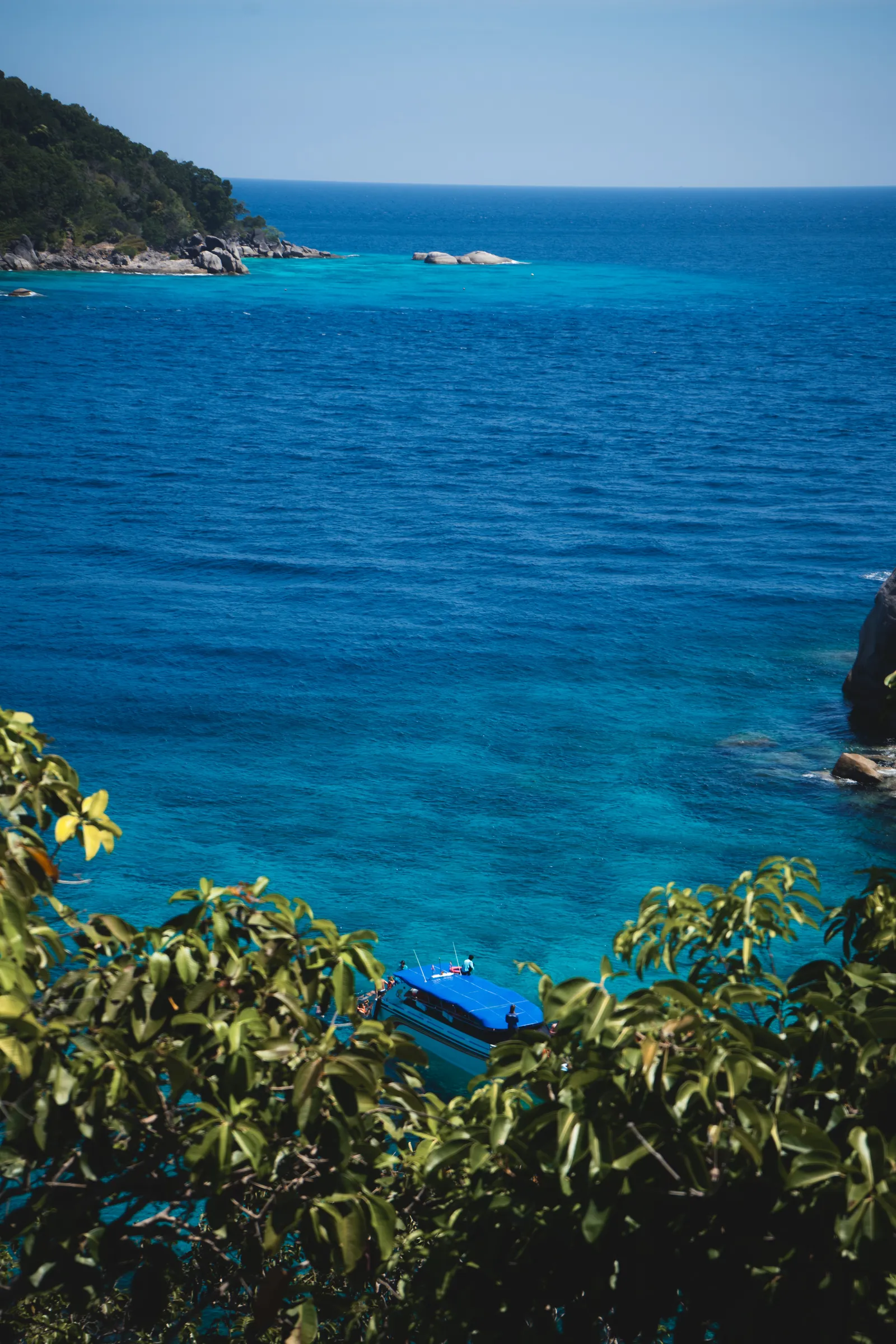
Photos : Pierre Bouyer
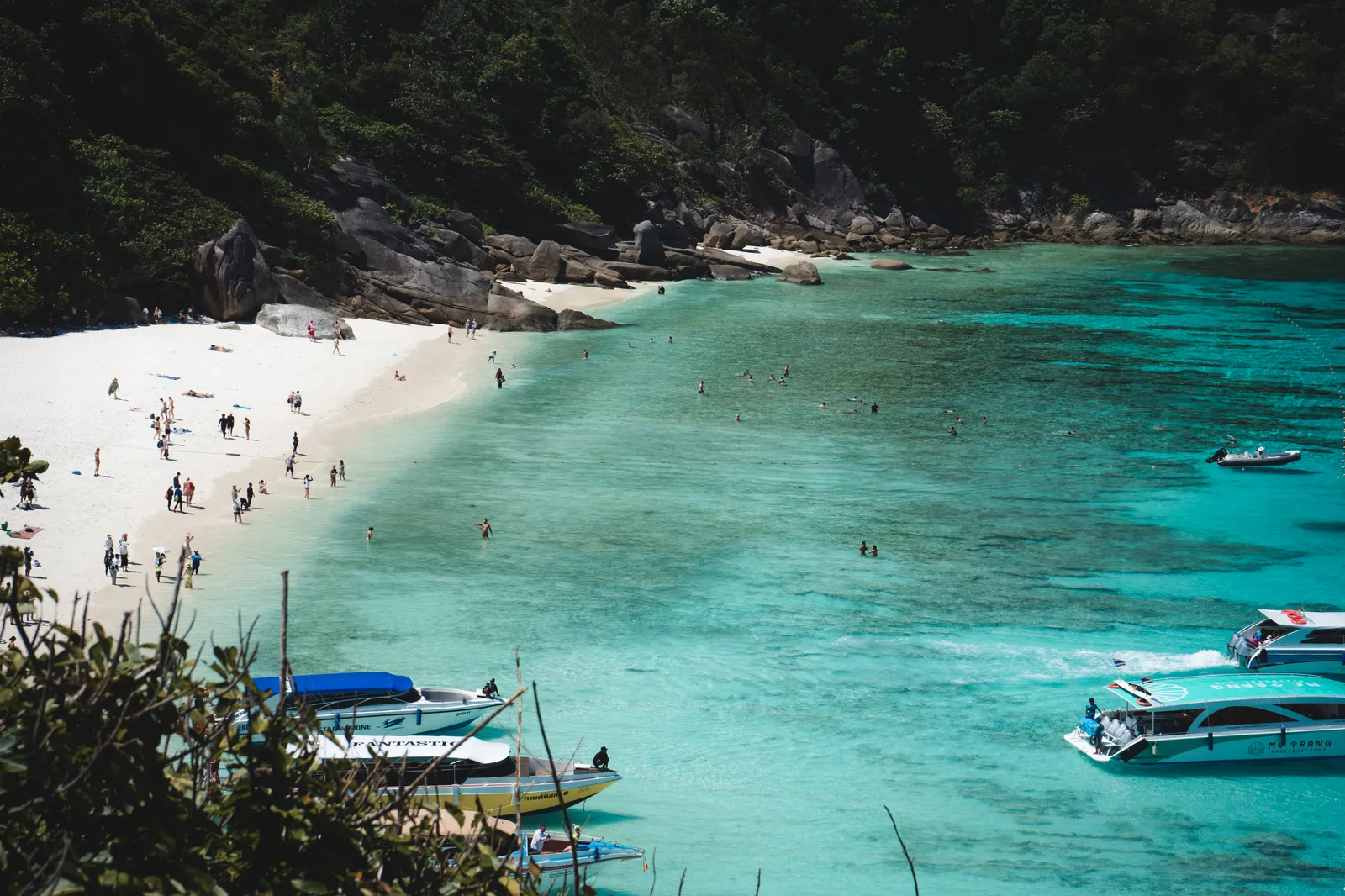
The view is worth the effort: the whole bay from above, water shifting from turquoise to deep blue, boats that seem to float because the water is so clear. On the other hand, the platform is small, and on the day I visited it was packed: you had to wait your turn to reach the edge. If your boat reaches island no. 8 early, climb first, before swimming.
Koh Miang, island no. 4
The second-largest island in the archipelago, Koh Miang is home to the park headquarters, the only restaurant on the islands (open 8am to 2pm) and the former facilities where you could stay until 2018. This is where most boats stop for lunch.
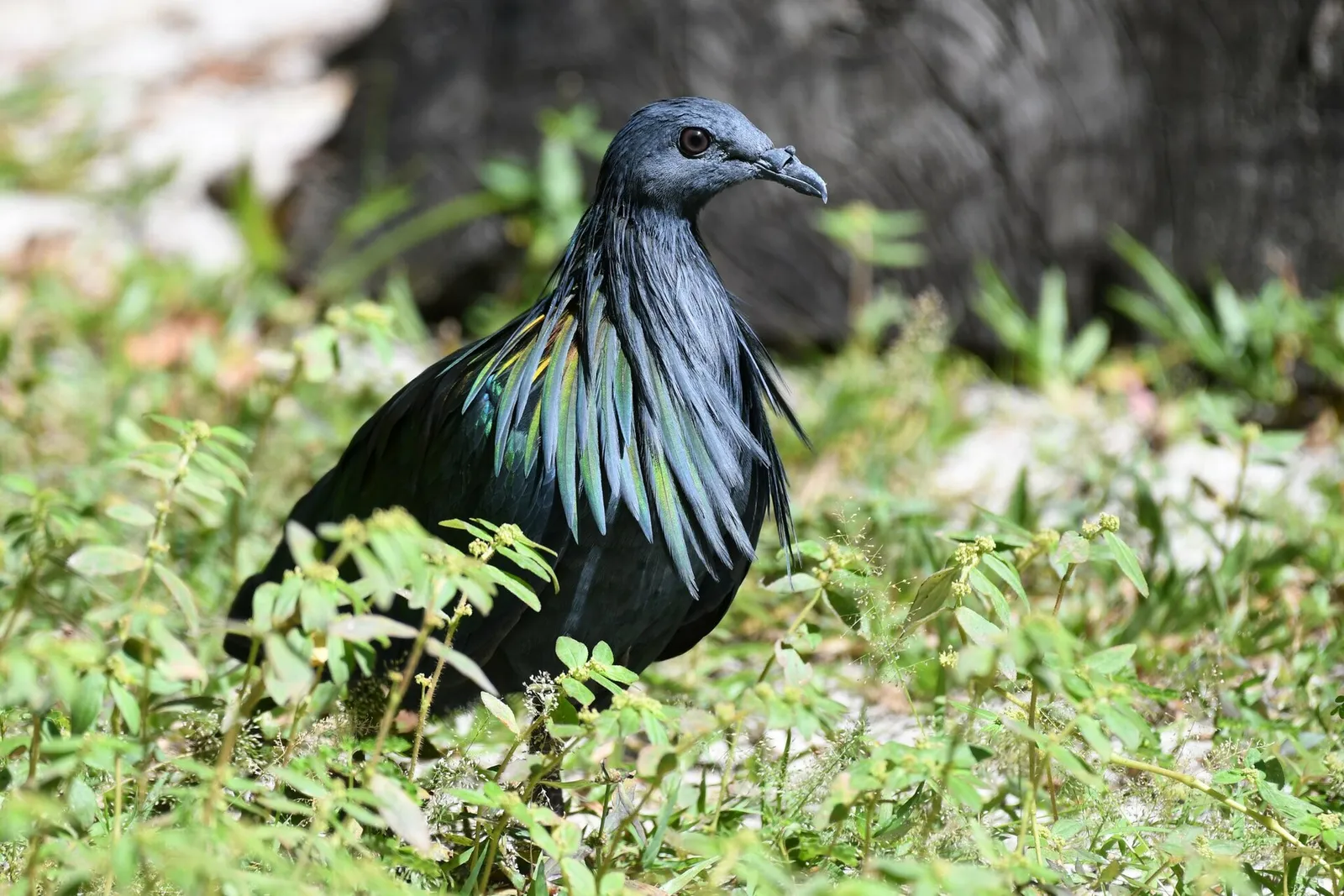
The island is also your best chance of spotting the Nicobar pigeon, a bird with metallic green plumage that forages on the ground. Koh Miang's beaches are quieter than the one on island no. 8, but also less spectacular.
Koh Ba Ngu, island no. 9, and the snorkelling stops
North of island no. 8, Koh Ba Ngu is the most common snorkelling stop. You swim from the boat, often as the first or last stop. Many itineraries add a similar stop at Koh Payu, which tour operators call island no. 7. These stops last about half an hour, and their quality depends a lot on the current and where the captain moors.
Koh Bon, the manta ray island
Koh Bon, island no. 10, lies about twenty kilometres north of the main group. There are no landings: it is a dive and snorkelling site, famous for the ridge on its western side, where manta rays come to be cleaned by small fish. It is mainly a stop for dive boats.
Koh Tachai, closed since 2016
Koh Tachai, island no. 11, used to be the star stop on day trips: a huge white sand beach and superb underwater scenery. A victim of its own success, it was closed to visitors on 15 October 2016 to let the beach and reefs recover. As of October 2026 it is still closed, and no reopening date has been announced, although a plan with a very small quota regularly resurfaces in the press.
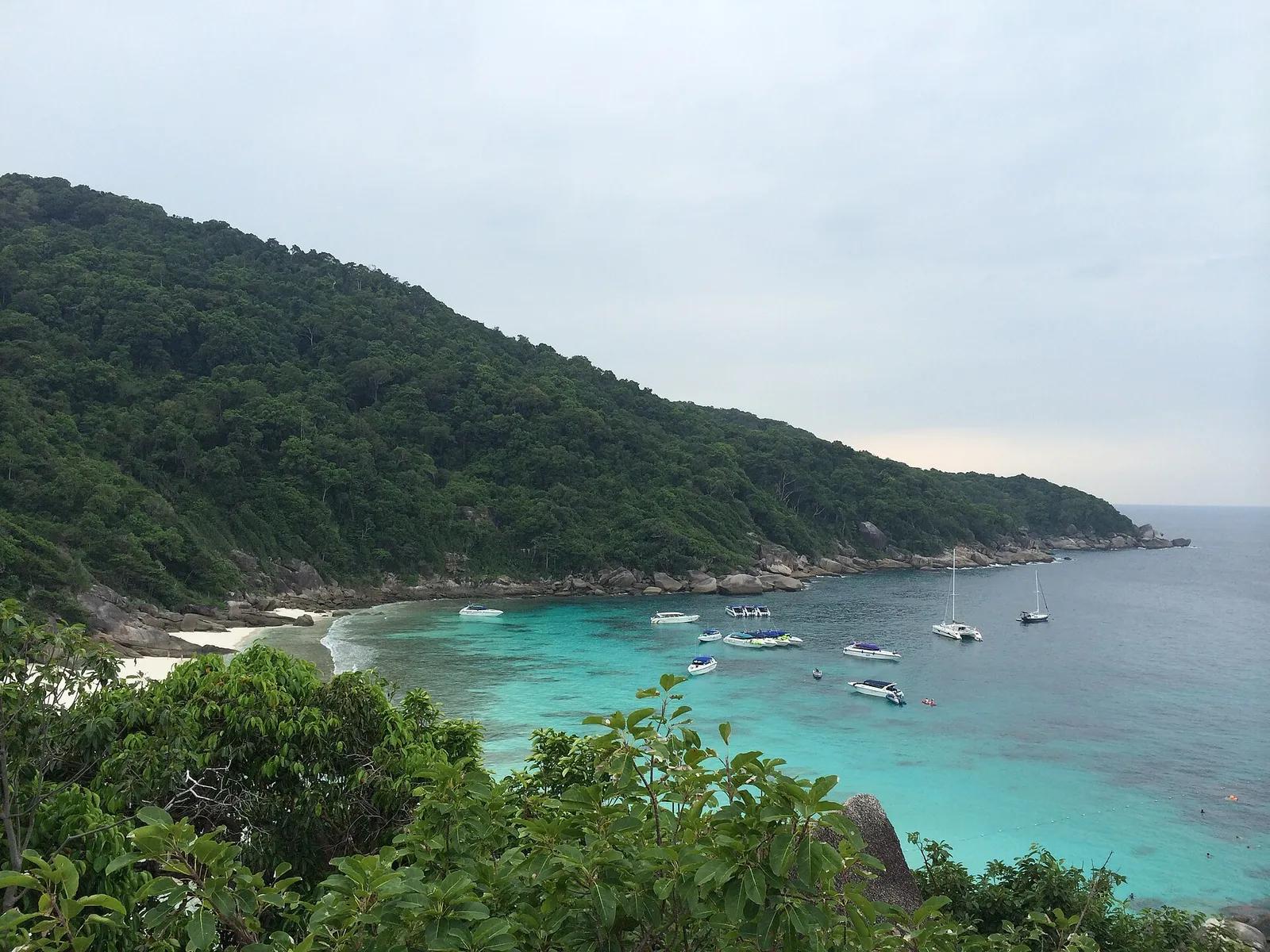
Be wary of itineraries that still promise "Similan and Tachai": outdated descriptions or a stop at sea. Divers, for their part, still visit Tachai Pinnacle, an underwater peak off the island known for big fish.
How a speedboat day trip unfolds
All tours follow roughly the same pattern, because the park imposes the same hours on everyone: no arrivals before 8am, departure from the islands by 4pm at the latest. Here is a typical itinerary for a speedboat leaving Thap Lamu, with pick-up in Phuket.
| Time | Stop |
|---|---|
| 5.30am to 7.30am | Hotel pick-up in Phuket (6.30am to 7.15am from Khao Lak) |
| 8am to 9am | Arrival at the pier, check-in, light breakfast, briefing |
| 9am | Speedboat departs |
| 10.20am | Koh Ba Ngu (island no. 9): snorkelling from the boat |
| 11am | Koh Similan (island no. 8): Donald Duck Bay beach, climb to the Sail Rock viewpoint |
| 1pm | Koh Payu (island no. 7): snorkelling from the boat |
| 2pm | Koh Miang (island no. 4): lunch, beach, walk |
| 3pm | Departure from the islands |
| 4.30pm | Back at the pier |
| 6pm to 7pm | Back at your hotel in Phuket |
The order of the stops varies between operators, and it matters. Most boats reach island no. 8 between 11am and noon: that is peak time. "Early bird" options leave earlier and get there first, or do the reverse, island no. 8 in the late afternoon once the big groups have gone.
In total, allow about two and a half hours at sea and four hours on the islands or in the water, plus three to four hours by minibus from Phuket.
Seasickness: how to limit the damage
The 1hr15 to 1hr30 crossing in open sea is the most dreaded part of the day. A speedboat at full throttle slams into the swell, and the bow takes every wave. A few simple tips:
- Take motion sickness medication before departure, following the instructions; it does not work once the nausea has set in.
- Sit at the back or in the middle of the boat, never at the front, and look at the horizon.
- Eat a light breakfast and avoid alcohol the night before.
- If you are very sensitive, choose a catamaran, which is more stable, and avoid the start of the season, when the sea is still rough after the monsoon.
- In heavy swell, departures may be cancelled: reputable operators refund or rebook.
From Khao Lak or from Phuket
Boats to the Similans almost all leave from the Khao Lak coast: Thap Lamu pier, the main one, and a few private piers nearby. Tours sold in Phuket therefore include a minibus transfer of about 1hr30 to 2 hours to the pier, depending on where you are staying.
| Starting point | Road to the pier | Boat to the islands | Pick-up | Back at the hotel |
|---|---|---|---|---|
| Khao Lak | 15 to 30 min | 1hr15 to 1hr30 | 6.30am to 7.15am | around 5pm |
| Phuket | 1hr30 to 2 hours depending on area | 1hr15 to 1hr30 | 5.30am to 7.30am, earlier in the south of the island | 6pm to 7pm |
My advice is simple: if your trip allows it, spend a night or two in Khao Lak. You save three to four hours on the road, and for the same service departures from Khao Lak are often slightly cheaper. If you stay based in Phuket, choose a hotel in the north of the island, such as Kamala Beach or Bang Tao, rather than Rawai or Kata, and check that your area is not charged extra: some operators ask 200 baht per person for Rawai, Nai Harn, Cape Panwa or Ao Po.
Prices and choosing an operator
Prices can double for an itinerary that looks very similar on paper. Here is what I found with several operators in October 2026, park fees included.
| Option | Adult price | Child price | Group size |
|---|---|---|---|
| Large speedboat from Phuket | 2,500 baht | 2,000 baht (ages 3 to 11) | 35 people maximum |
| Standard speedboat from Khao Lak | 3,500 to 3,900 baht | 2,400 to 2,700 baht | 15 to 40 people |
| Fast catamaran from Khao Lak | 3,800 to 4,200 baht | 2,700 to 3,000 baht | 45 to 66 people |
| Small "early bird" group from Khao Lak | 5,900 baht | 4,900 baht | 25 people maximum |
| Day of diving at Koh Bon | from 6,600 baht | not suitable | varies |
| Four-night dive liveaboard | from 21,500 baht + 1,800 baht park fees | not suitable | varies |
How to choose an operator
Before paying, ask these questions.
- How many passengers? This is what changes the experience most: with 35 or 40 on board the speedboat is full, with 20 or 25 it stays pleasant.
- What time do we reach island no. 8? A boat that gets there before 10.30am or after 2.30pm spares you the peak crowds.
- Speedboat or catamaran? The catamaran, which is more stable, is recommended early in the season and for anyone prone to seasickness.
- Are park fees included? Almost always, but insist on seeing it in writing.
- What does lunch include? Usually a Thai buffet on island no. 4, with fruit and drinks. Mention any dietary needs in advance.
- Is snorkelling gear provided, and in good condition? Mask, snorkel and life jacket are included; fins not always. Your own mask is still the best guarantee of a good seal.
- Is there insurance and an English-speaking guide? Reputable operators include accident insurance and a guide who accompanies the snorkelling.
The operator's accident insurance rarely covers repatriation or a long hospital stay. An evacuation from an island 65km offshore is expensive: good travel insurance is worth it, especially if you dive.
Chapka Insurance
Travel with peace of mind with the best travel insurance
Stay covered in every situation with the best insurance for your next trip.
Snorkelling and marine life
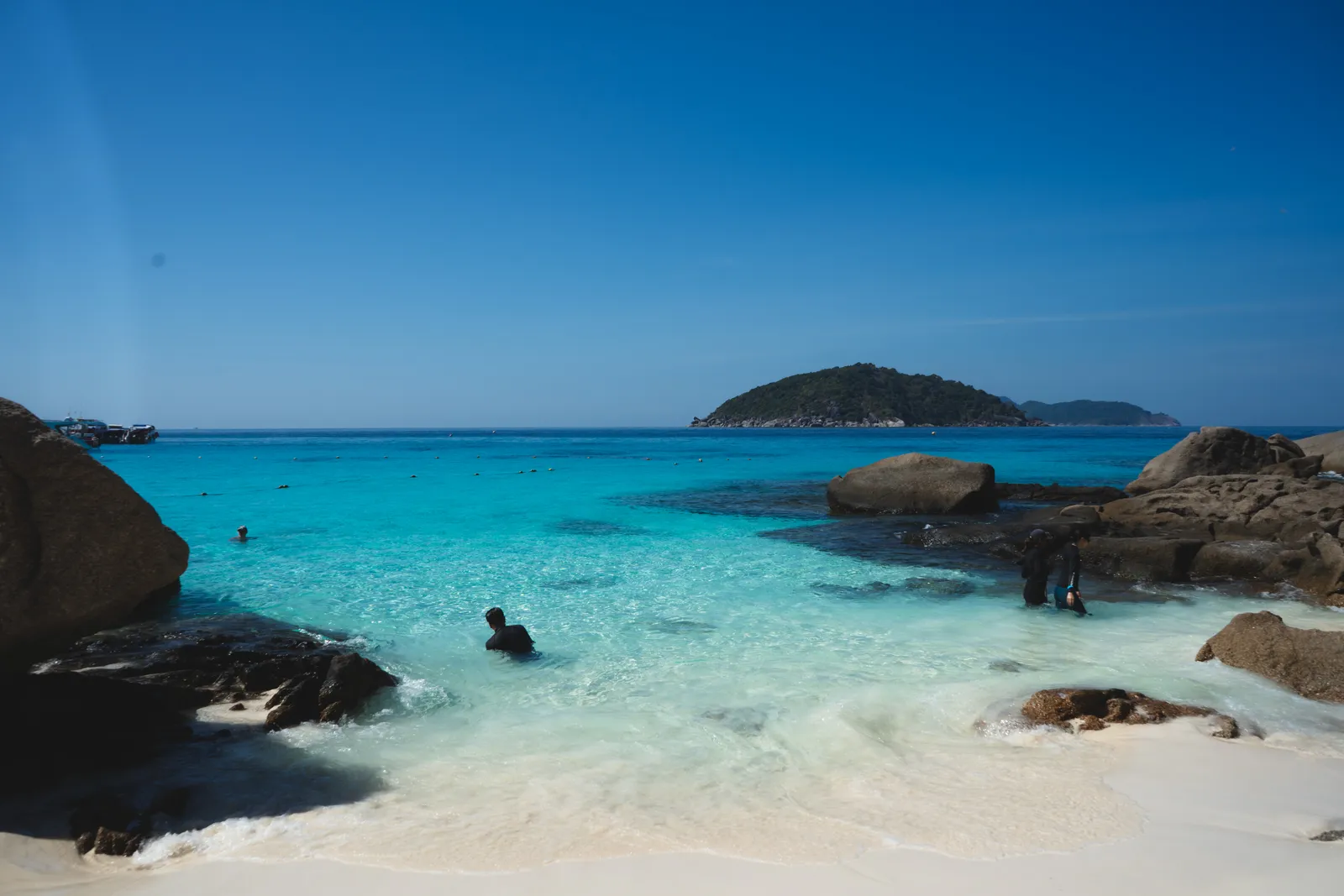
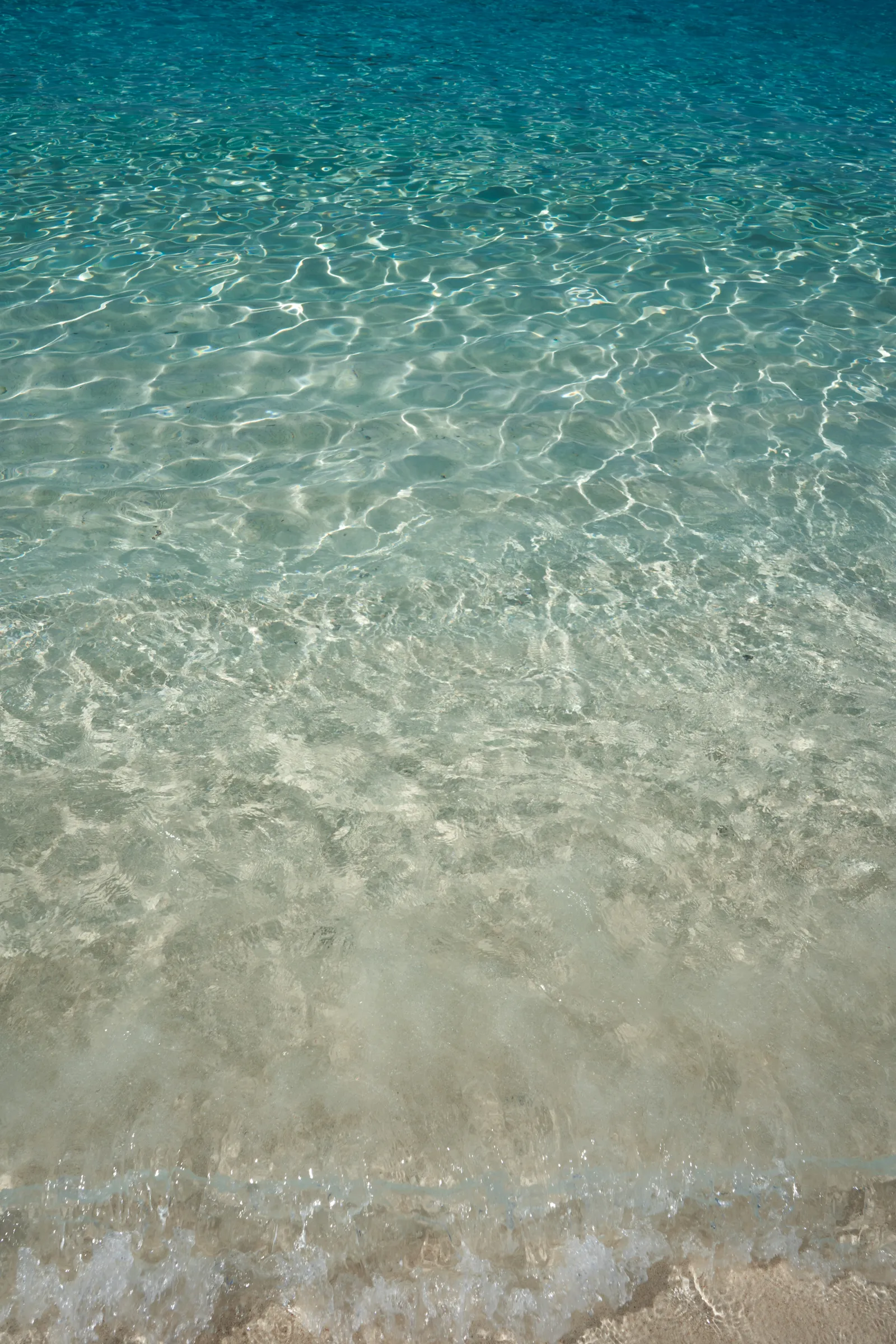
Snorkelling is the Similans' great strength, even for those who do not dive. At Donald Duck Bay you walk straight into the water from the beach, into a clarity my photos barely capture, and the granite boulders along the shore already shelter reef fish.
Photos : Pierre Bouyer
The real reefs are a little further out, at the snorkelling stops off Koh Ba Ngu and Koh Payu: hard corals, sea fans, anemones with their clownfish, and sometimes a sea turtle coming up to breathe. Visibility regularly reaches 20 to 30m in the dry season, with water at 28 to 30°C.
What you might see underwater
Beyond the reef fish, it is the big animals that make the islands' reputation: manta rays, whale sharks, whitetip and blacktip reef sharks, barracuda and trevally. Do not get your hopes up, though: on a snorkelling day trip, manta rays and whale sharks remain rare encounters, mostly reserved for divers visiting Koh Bon, Koh Tachai or Richelieu Rock between February and April.
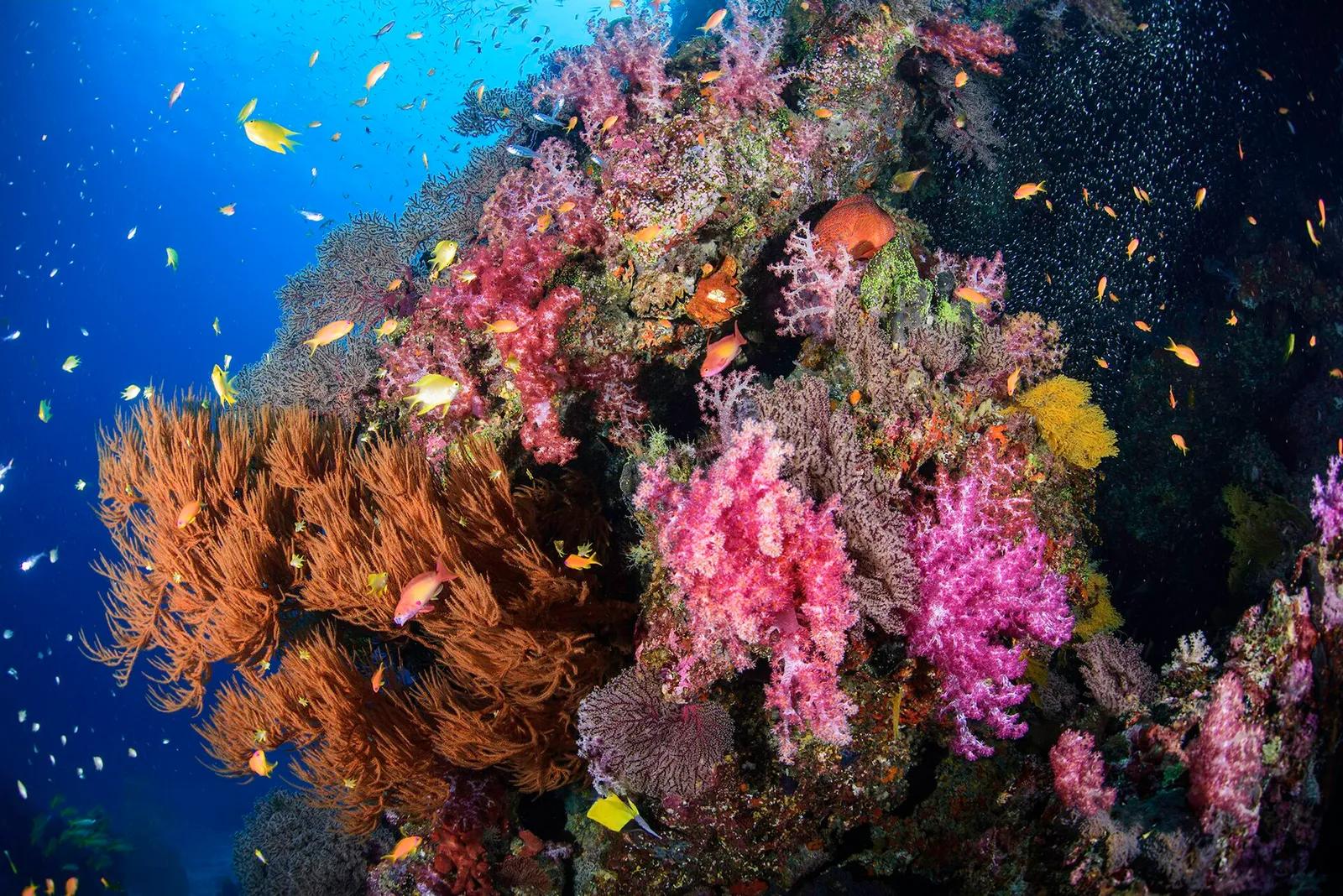
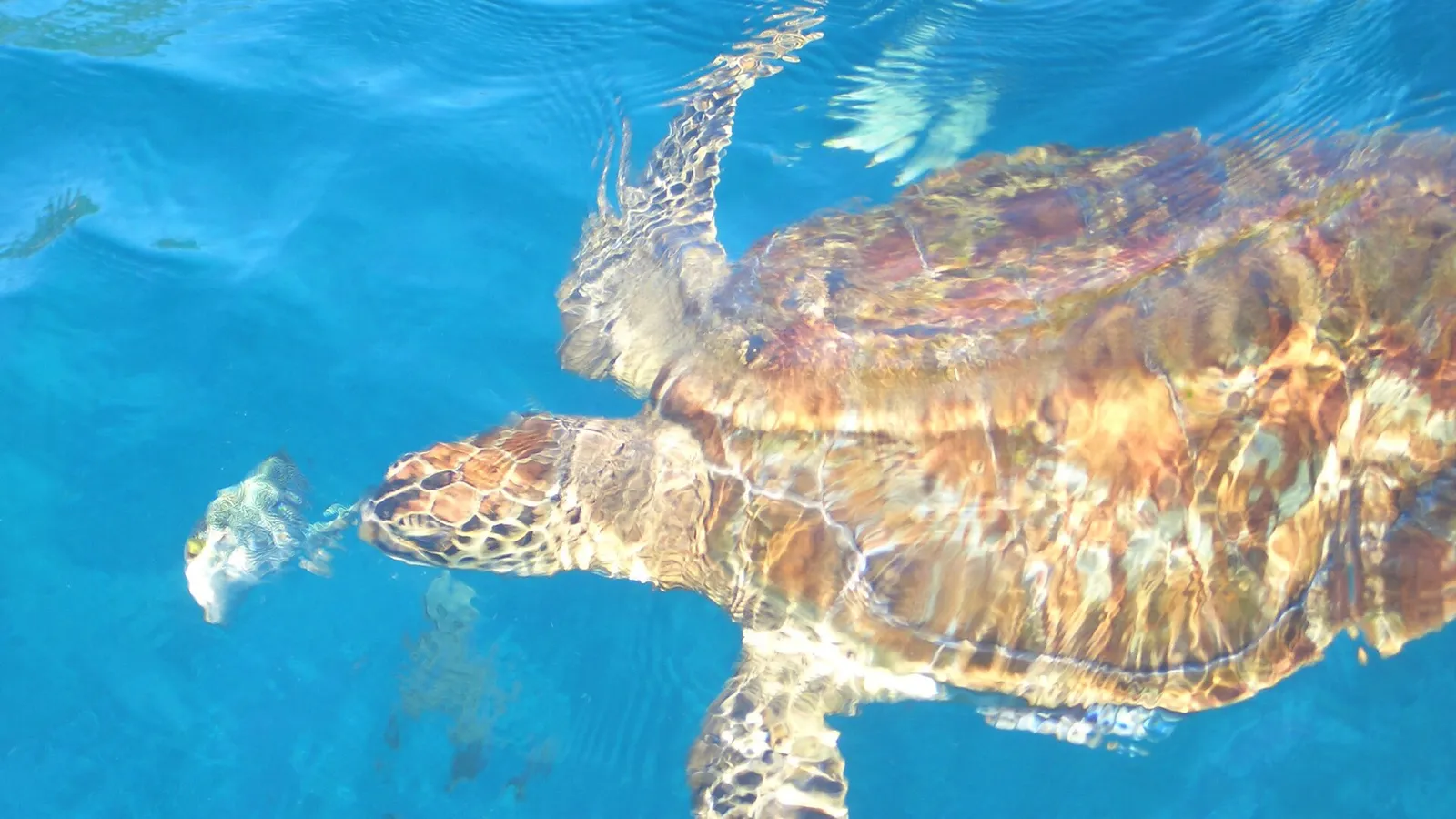
Photos : Supachaiv / Wikimedia Commons, CC BY-SA 4.0 · Reinhard Link from Germany / Wikimedia Commons, CC BY-SA 2.0
Some of the shallow corals have suffered from bleaching events, and you will see grey patches next to healthy coral.
Diving and liveaboard cruises
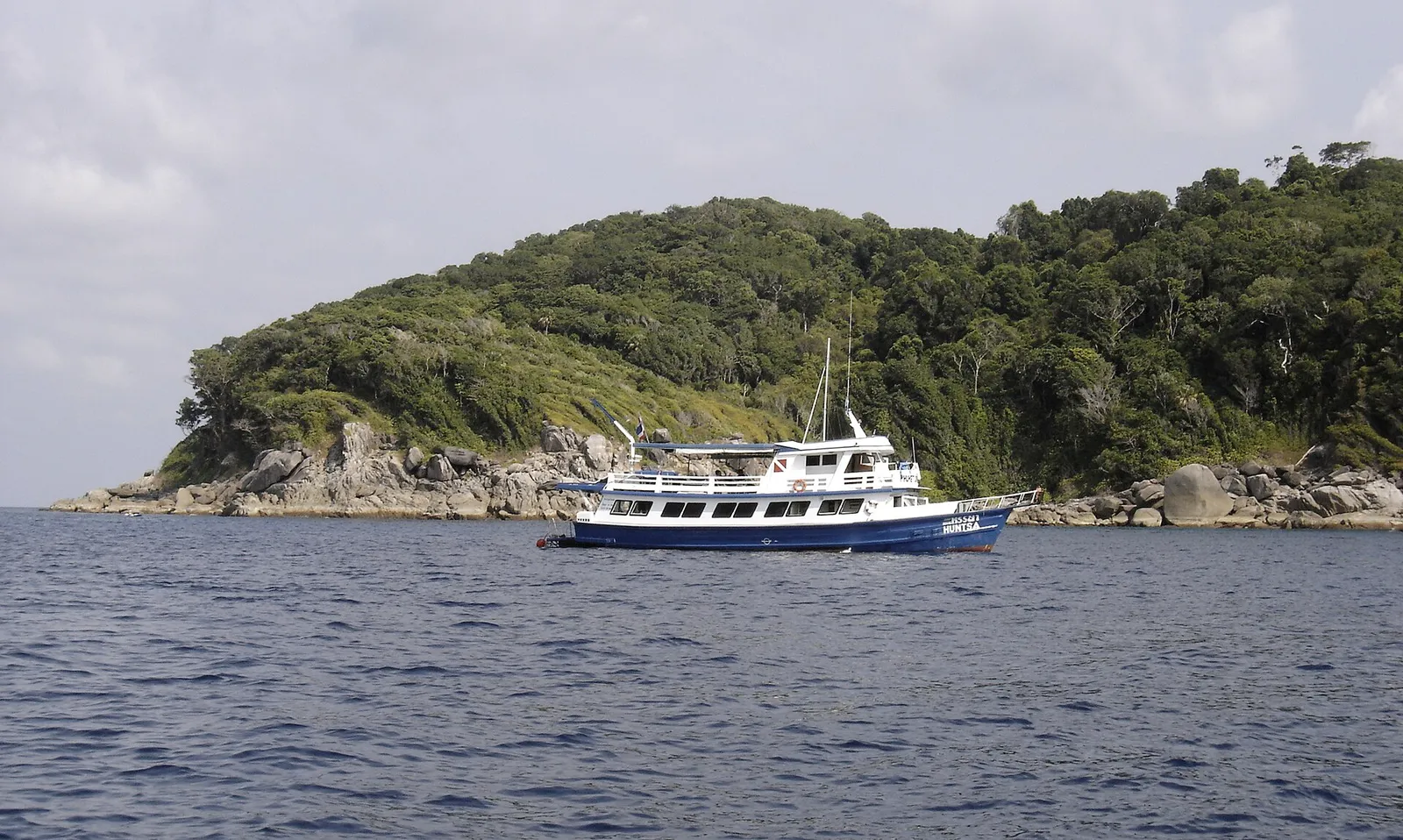
The Similans are among the best dive destinations in South-East Asia. There are two options: day diving from Khao Lak, with two or three dives, or a cruise of several nights aboard a floating hotel, known as a liveaboard. Since the ban on overnight stays on the islands, a liveaboard is the only way to spend the night in the archipelago: three to five nights on board, three or four dives a day, and access to remote sites that speedboats do not reach. Prices start at around 17,500 baht for three nights and 21,500 baht for four nights on a budget boat, rising to 40,000 baht and more on a high-end boat. Park fees are often extra, 1,600 to 2,000 baht depending on the length, as is equipment hire. There are also short cruises of around 36 hours for non-divers, from 9,400 baht according to one agency.
Famous dive sites
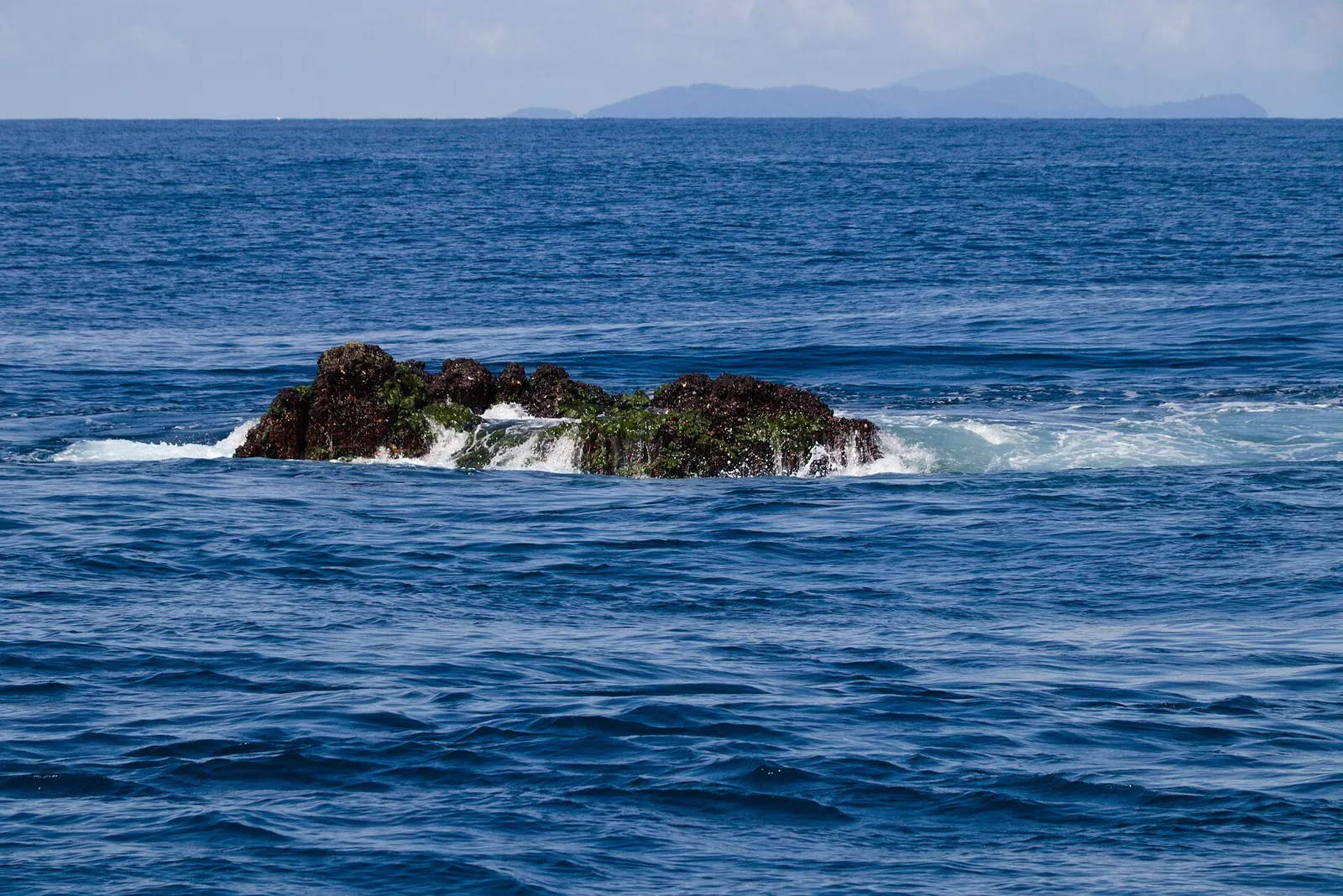
Photos : Mr.CMBurns / Wikimedia Commons, CC BY-SA 4.0 · Supachaiv / Wikimedia Commons, CC BY-SA 4.0 · Tim Sheerman-Chase / Wikimedia Commons, Public domain
- Elephant Head Rock (Hin Pusar): a pile of granite boulders south-west of island no. 8 that forms arches, swim-throughs and tunnels. Currents can be strong; for experienced divers only.
- Christmas Point and Breakfast Bend: two sites around Koh Ba Ngu; Christmas Point, at the island's north-western tip, is a maze of giant boulders and swim-throughs.
- East of Eden: on the eastern side of Koh Payu, one of the most celebrated coral reefs in the archipelago.
- Koh Bon: the west ridge, a manta ray cleaning station, is one of the best chances of seeing them in Thailand.
- Tachai Pinnacle: an underwater peak off Koh Tachai, with current and big fish.
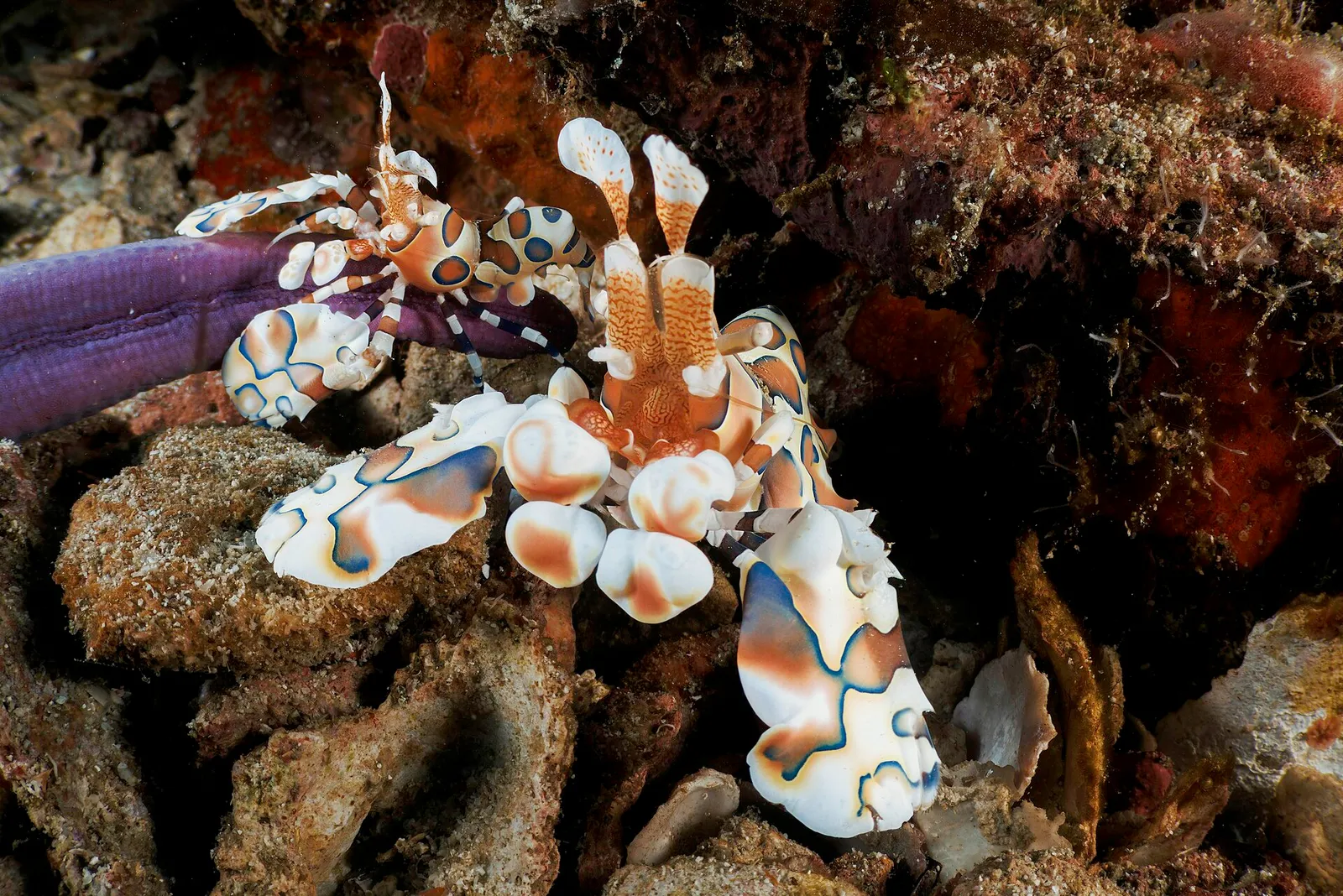
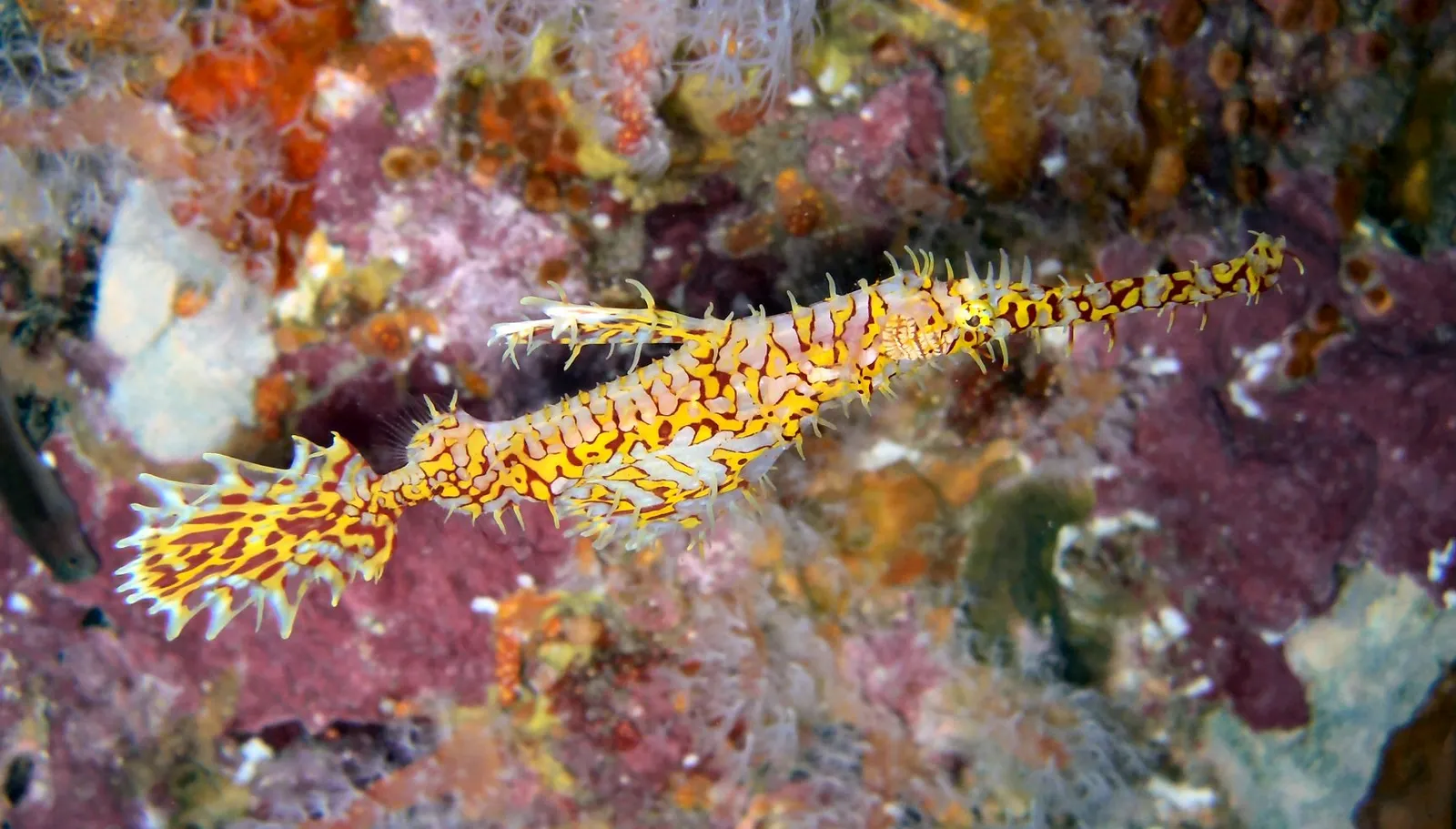
- Richelieu Rock: note that this site is not part of the Similans. This pinnacle, barely visible at the surface, lies in Mu Ko Surin National Park, about 80km to the north and nearly 200km from Phuket. Dives go down to 40m among purple soft corals, seahorses, ghost pipefish and harlequin shrimp, and it is one of the best places in the country to meet a whale shark. It can only be reached on a cruise of at least four nights that adds it to the Similans.
Park rules
The Similans are a marine national park with strict rules. Here are the ones that affect you directly.
- Sunscreen: since August 2021, sunscreens containing oxybenzone, octinoxate, 4-methylbenzylidene camphor (4-MBC) or butylparaben have been banned in all Thai marine parks. Check the ingredients before you go, or wear a long-sleeved rash vest.
- Do not feed the fish and do not touch coral, turtles or starfish. Never stand on the reef.
- Take nothing: no sand, shells or pieces of coral. The Similans' white sand is largely crushed coral.
- Plastic: since 6 April 2022, plastic bags thinner than 36 microns, single-use plastic food containers, cups, straws and cutlery, as well as polystyrene packaging, have been banned in national parks. Bring a water bottle.
- Life jacket: most operators make it compulsory while snorkelling. It stops you grabbing the coral to rest.
- Do not climb on off-limits rocks, especially around Sail Rock, where a no-entry sign is visible in my photos of the viewpoint.
The best time to go
The park only opens from 15 October to 15 May, and not every part of the season is equal.
| Period | Sea and weather | Crowds | My advice |
|---|---|---|---|
| Mid-October to November | Possible leftover swell early in the season, very clear water | Low | A good choice if the sea is calm; prefer a catamaran |
| December to February | Calm sea, clear skies | Very high, especially at Christmas, New Year and Chinese New Year | Book a month ahead and leave early |
| March | Calm sea, heat, excellent visibility | High | What I experienced: stunning but packed |
| April to mid-May | Calm sea then the first storms, manta rays and whale sharks more frequent until April | Moderate, falling at the end of the season | A good compromise, especially for divers |
For the crowds, November and late April are much more pleasant. Also avoid weekends and Thai public holidays.
My verdict on the Similan Islands
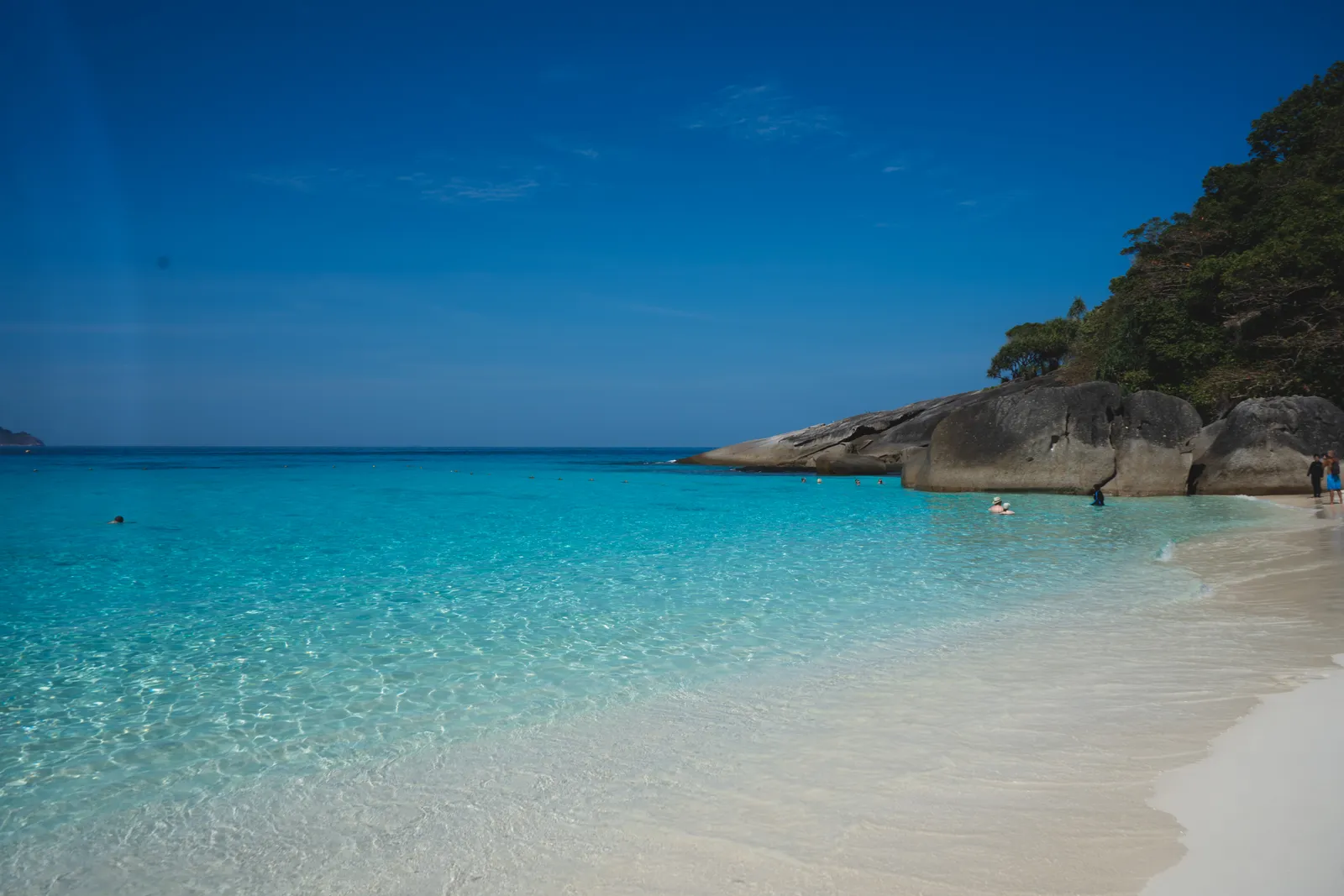
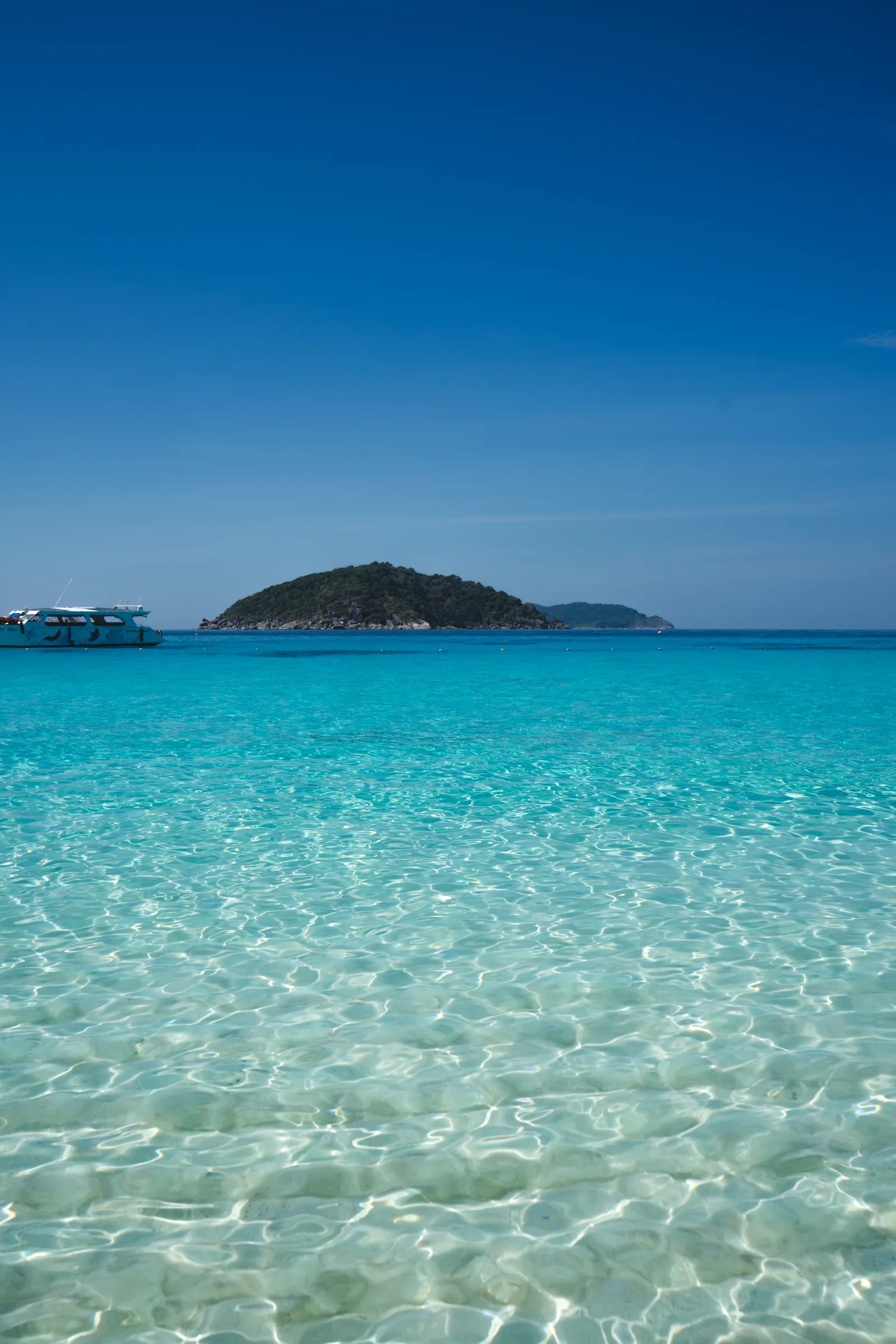
Let us start with what is beyond question: the beauty of the place. In my photos from 17 March 2024, the sky is a cloudless blue, the water shifts from white to turquoise to deep blue within a few metres, and the Sail Rock viewpoint offers a spectacular panorama over the bay. For the water alone, the Similans are worth the trip.
Photos : Pierre Bouyer
But I have to be honest about the other side. In March, the landing beach on island no. 8 looks like a railway platform: speedboats pulled up side by side on the sand, dozens of visitors coming ashore at the same time, bags in hand. At the viewpoint, you queue for your photo. From above, the bay is dotted with boats. The quota of 3,325 visitors a day is a good thing, but 3,325 people concentrated on two beaches between 11am and 2pm is still a lot. If you are picturing a desert island, you will be disappointed.
The day is also long and expensive: 12 to 13 hours from southern Phuket, half of it in a minibus or a boat, for about two hours on island no. 8. Hence my advice to stay in Khao Lak.
What I liked:
- The colour of the water, exceptionally clear, and the dazzling white sand.
- The Sail Rock viewpoint, the best view of the day for a short climb.
- Snorkelling straight from the beach, accessible even to average swimmers.
- A genuinely protected park: quota, annual closure, enforced rules.
What I liked less:
- The crowds on the landing beach and at the viewpoint in high season.
- The logistics: up before dawn and hours on the road from Phuket.
- How little time you actually spend on each island, at the pace set by the boat.
- Cheap tours with 35 or 40 people, where you feel like you are on a conveyor belt.
Who is it for? The Similans suit those who want to see the clearest water in Thailand and accept a structured, shared day, as well as divers, who will have a completely different experience on a liveaboard. Not for those looking for a quiet beach. My advice: a small boat leaving early from Khao Lak, in November or late April, or a dive cruise.
Alternatives to the Similans
If the crowds or the price put you off, there are other options in the Andaman Sea.
- The Surin Islands: further north, about 55km from Khuraburi pier, this national park opens on the same dates, 15 October to 15 May, with the same 500 baht fee. Less visited, it offers excellent snorkelling in the channel between its two main islands and is home to a village of Moken sea nomads on Koh Surin Tai.
- Koh Racha: less than an hour by speedboat from Chalong Bay, in the south of Phuket. The water is less spectacular than in the Similans, but the island needs no 5am alarm and you can stay overnight. I went on 23 March 2024 and describe it in my article on Koh Racha.
- The Gulf of Thailand: if you travel between May and September, when the Similans are closed, the Gulf islands take over. Koh Tao is the capital of beginner diving, and the west coast of Koh Phangan has good snorkelling spots, such as Koh Ma.
Practical information and budget
Booking: a week ahead is enough in November, but allow a month for December to February.
What to bring: sunscreen without the banned filters, rash vest or UV T-shirt, hat, sunglasses, water bottle, towel, sandals that stay on your feet for the Sail Rock path, dry bag, seasickness medication, some cash for the Koh Miang restaurant and any fins deposit. For photos, a wide-angle lens is ideal at the viewpoint, and a waterproof phone case is enough for snorkelling.
Where to stay: Khao Lak is the logical base, with hotels at every level along the beaches of Nang Thong, Bang Niang and Khuk Khak, 15 to 30 minutes from the piers. In Phuket, choose the north-west coast, from Nai Yang to Kamala.
| Item | Budget | Comfort |
|---|---|---|
| Day trip (park fee included) | 2,500 baht | 5,900 baht |
| Transfer supplement from southern Phuket | 200 baht | included |
| Drinks, snacks, tip | 200 baht | 400 baht |
| Medication, permitted sunscreen | 300 baht | 500 baht |
| Total per person | about 3,200 baht | about 6,800 baht |
Frequently asked questions
Mu Ko Similan National Park is open from 15 October to 15 May, then closes during the south-west monsoon to let the reefs recover. For the 2026-27 season it reopens on 15 October 2026 and closes on 15 May 2027. Visiting hours are 8am to 4pm.
500 baht per foreign adult and 250 baht per child aged 3 to 14, free under 3. Most tour operators include it in the price: check before paying, as some collect it separately at the pier.
No. The bungalows and campsite on island no. 4 closed in 2018 and visitors may no longer stay overnight. The only way to spend the night in the archipelago is on a dive liveaboard, from around 17,500 baht for three nights.
Almost all boats leave from piers around Khao Lak, such as Thap Lamu. From Phuket you add 1hr30 to 2 hours by minibus each way, with pick-ups between 5.30am and 7.30am. If you can spend a night or two in Khao Lak, the day is far more comfortable.
Expect around 2,500 baht for a large speedboat carrying up to 35 people, park fee included, roughly 3,500 to 4,200 baht for a speedboat or catamaran with an established operator, and up to 5,900 baht for a small group of 25 that leaves earlier. Transfers from some parts of Phuket cost extra.
No. Koh Tachai has been closed to visitors since 15 October 2016 to let its beaches and reefs recover. A reopening with a reduced quota is regularly discussed, but no date had been confirmed as of October 2026. The dive sites around the island remain open to dive boats.
Yes, mainly when diving at Koh Bon, whose west ridge is a manta ray cleaning station, and at Koh Tachai. The best period is February to April. On a snorkelling day trip by speedboat, an encounter remains rare.
Yes for the beach and snorkelling from the sand, as the water at Donald Duck Bay is shallow and very clear. The speedboat ride, however, can be hard on a child prone to seasickness: choose a catamaran and a calm day.
In short
The Similan Islands are the most beautiful day at sea on the Andaman coast, provided you plan it well: leave from Khao Lak rather than southern Phuket, choose a small boat and when you reach island no. 8, avoid the heart of the high season, and respect the rules of a park that needs them. To fit this trip into a longer journey, see my 3-month Thailand itinerary, and find all my articles on Thailand. For a simpler day at sea from Phuket, Koh Racha remains an excellent alternative.
Sources and fact-checkingInformation checked on 9 October 2026 · 14 sources consulted
- Thai National Parks: Mu Ko Similan National Park (season, fees, islands, quota, Koh Miang restaurant)
- Siam Tour and Realty: Similan and Surin 2026-27 season (dates, fees, hours, Koh Tachai)
- Tisland: the Similans reopen on 15 October 2026 (quota, e-ticket, open islands)
- Wikipedia: Similan Islands (park history, island numbering, Koh Tachai)
- Phuket Tours Direct: speedboat day trip from Phuket (price, timings, itinerary)
- Discovery Khao Lak: snorkelling trip from Khao Lak (options, group sizes, prices)
- Phuket 101: Similan Islands guide (journey times, seasons, crowds)
- Time Out Bangkok: reef-harming sunscreens banned in marine parks (August 2021)
- Pattaya Mail: single-use plastics banned in national parks (April 2022)
- Liveaboard.com: Richelieu Rock (location, depth, season)
- SSI: the best Similan Islands dive sites
- Wet Zone Divers: Koh Bon (manta rays, day trip)
- Oceanic Dive Center: budget Similan liveaboards (prices, park fees)
- Thai National Parks: Mu Ko Surin National Park

Âme Bohème exists thanks to you
Some links in this article are affiliate links. This means that if you book or purchase a product through these links, we receive a small commission, at no extra cost to you. It's thanks to this support that we can continue creating free, quality content.
You can also buy us a coffee, or follow us on Instagram and Facebook.