
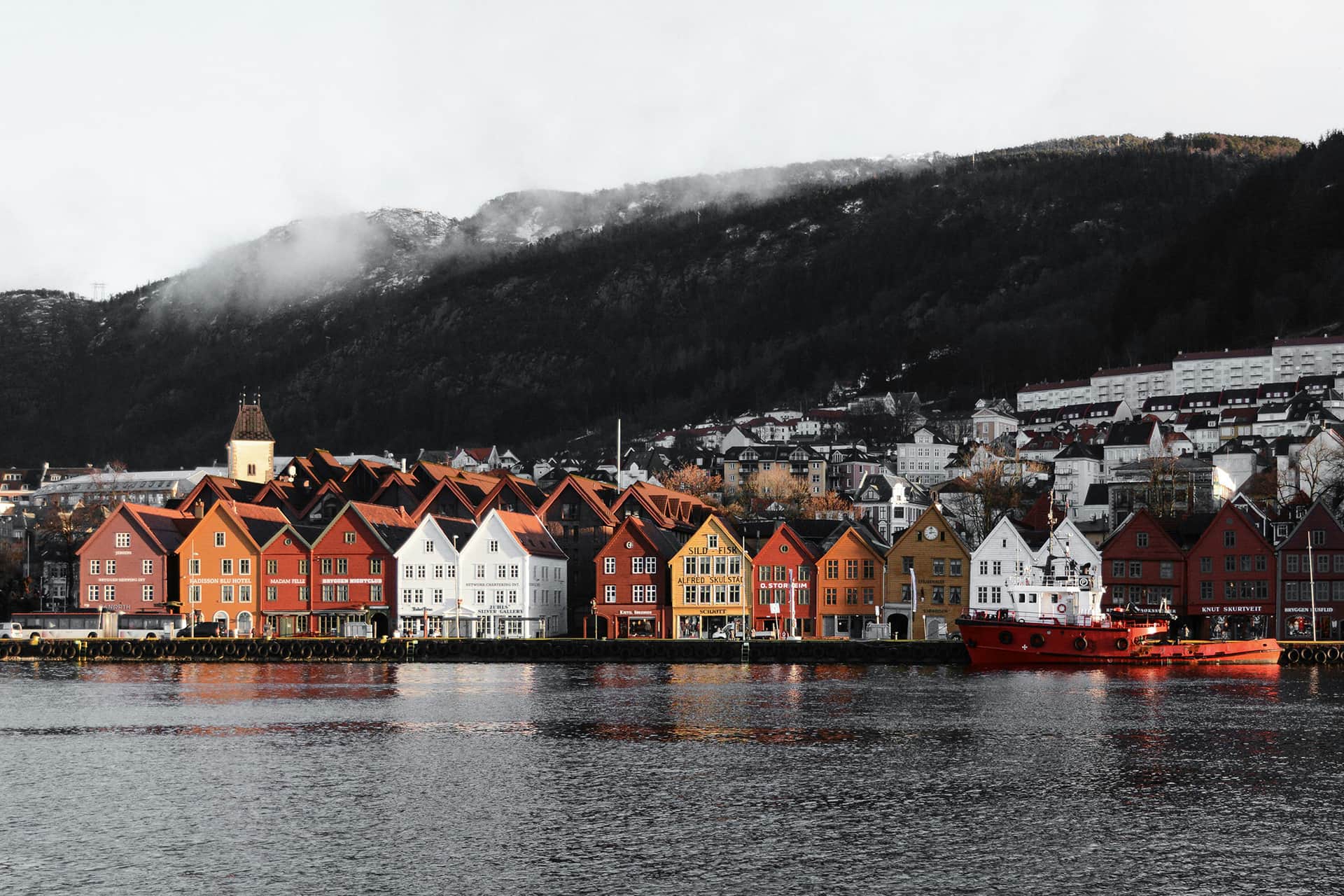

It was raining, of course. I arrived in Bergen on a Tuesday in June, under a mild drizzle that didn't so much fall as hang in the air. The Bryggen wharves smelled of wet wood, tar and fish. A blend I've found nowhere else.
That's where I understood something useful. You don't see Norway in a week. You choose one piece of it, and you inhabit it.
Most Norway itineraries you'll find head north: Ålesund, Geiranger, the classic loop. It's magnificent, and it's also what everyone does. The Bergen-to-Stavanger axis, on the other hand, stays strangely under the radar. Yet it packs the Nærøyfjord, Stegastein, the Hardanger and Preikestolen into less than 600 kilometres.
Here's the one-week Norwegian fjords itinerary I'd do again tomorrow, with its deliberate trade-offs and its misfires.
- Duration: 7 days, 6 nights, starting in Bergen (BGO) and returning from Stavanger (SVG)
- Distance: around 600 km, never more than 4 hr of driving in a day
- Vehicle: essential outside Bergen, an automatic gearbox strongly advised
- Ferries: 1 to 2 crossings depending on the variant chosen, no booking
- Season: from late May to early September, with a preference for June
- Budget: around €1,400 to €2,200 per person, flights included
- New in 2026: a municipal visitor tax of up to 3% may apply to some overnight stays
The Bergen-to-Stavanger itinerary at a glance
Before the details, the big picture. This Norwegian fjords road trip follows a simple logic: you start with the densest city and end with the rawest nature.
| Day | Stage | Drive | Highlight |
|---|---|---|---|
| 1 | Bergen | – | Bryggen, Fløibanen |
| 2 | Bergen and its fjord | – | Cruise to Mostraumen |
| 3 | Bergen → Flåm | 170 km, 2 hr 45 | Gudvangen, Nærøyfjord |
| 4 | Flåm and the Aurlandsfjord | 60 km | Stegastein, kayaking, Aurlandsfjellet |
| 5 | Flåm → Hardanger (Odda) | 200 km, 3 hr 30 | Vøringsfossen, Rv 13 |
| 6 | Odda → Preikestolen | 200 km, 4 hr | Rv 13 road, Nesvik ferry |
| 7 | Preikestolen → Stavanger | 40 km | Dawn hike, Gamle Stavanger |
Six hundred kilometres over seven days. It sounds like little. It's already a lot here, where 200 km never takes just two hours.
Why this direction and not the other way round
Three reasons, in order of importance.
First, Bergen is the best decompression chamber. You land, you walk, you eat, you sleep. The car doesn't come into play until day 3, once the jet lag and travel fatigue are behind you. Driving in Norway on your arrival day, with the tunnels and narrow roads, is a bad idea.
Next, the build-up in intensity works better this way. Bryggen, then a first fjord, then Stegastein, then Preikestolen. The reverse produces an anticlimax.
Finally, return flights from Stavanger are often cheaper than from Bergen, and Sola airport is fifteen minutes from the centre. Look at both combinations before booking; the difference can reach €80 per person. Our guide to finding flights to Bergen will set you up with the right habits, and the Bergen airport guide will save you hunting for the Flybussen bus in the rain.
The three possible variants
This itinerary isn't dogma. Here are the variations that genuinely hold up.
- 01The loop: Bergen → Flåm → Hardanger → Stavanger, then back to Bergen on the coastal express boat (about 4 hr 30). You avoid the car drop-off fee if you return it in Stavanger, but you lose half a day.
- 02The compressed 5-day version: you skip the Hardanger and drive from Flåm to Stavanger on the E39 in one day (6 hr 30 with two ferries). Doable, but it's a day sacrificed behind the wheel.
- 03The reverse direction, Stavanger → Bergen: only relevant if you want to end in a big city and fly out of Bergen. Preikestolen the day after landing, with travel legs, is something I wouldn't recommend.
Day 1: Bergen, the gateway to the fjords
Bergen doesn't give itself away at once. It's wet, a little sullen, and you have to give it a morning.
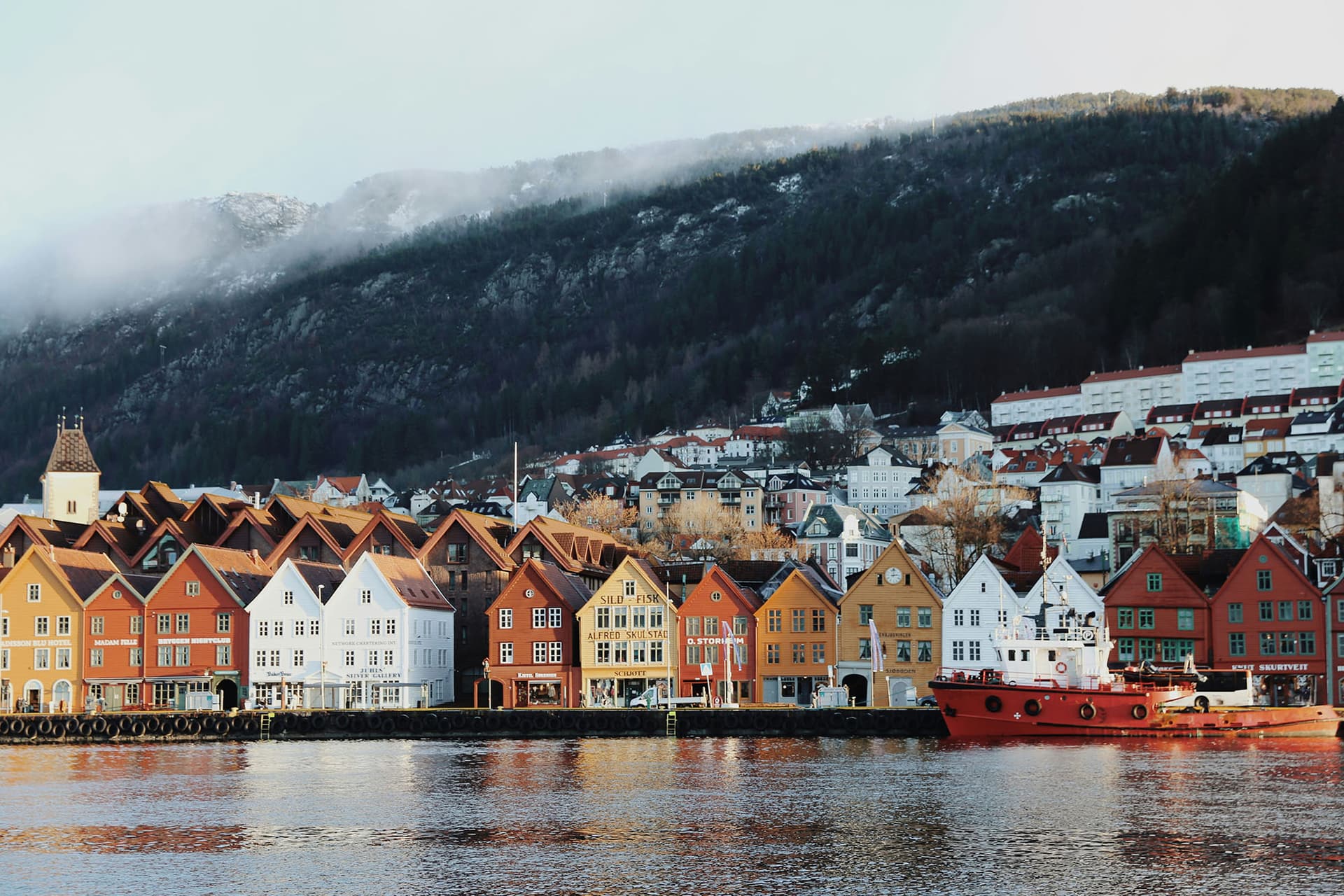
Start with Bryggen, the UNESCO-listed Hanseatic wharf. Not the façade everyone photographs. The alleys behind it. They're narrow, sloping, and the wood is still working: it creaks, it groans, it leans. The planks are several centuries old and they let you know it.
Then the Fisketorget, the fish market, around midday. Here I'll be blunt: it's expensive and very touristy. Expect €35 to €45 for a portion of king crab that will leave you with a vague sense of having paid for the setting. I went once. The second time, I went and ate a hot dog in the alleys behind it, for a tenth of the price, and enjoyed it more. Our article on the Bergen Fish Market details what's genuinely worth it and what's just for show.
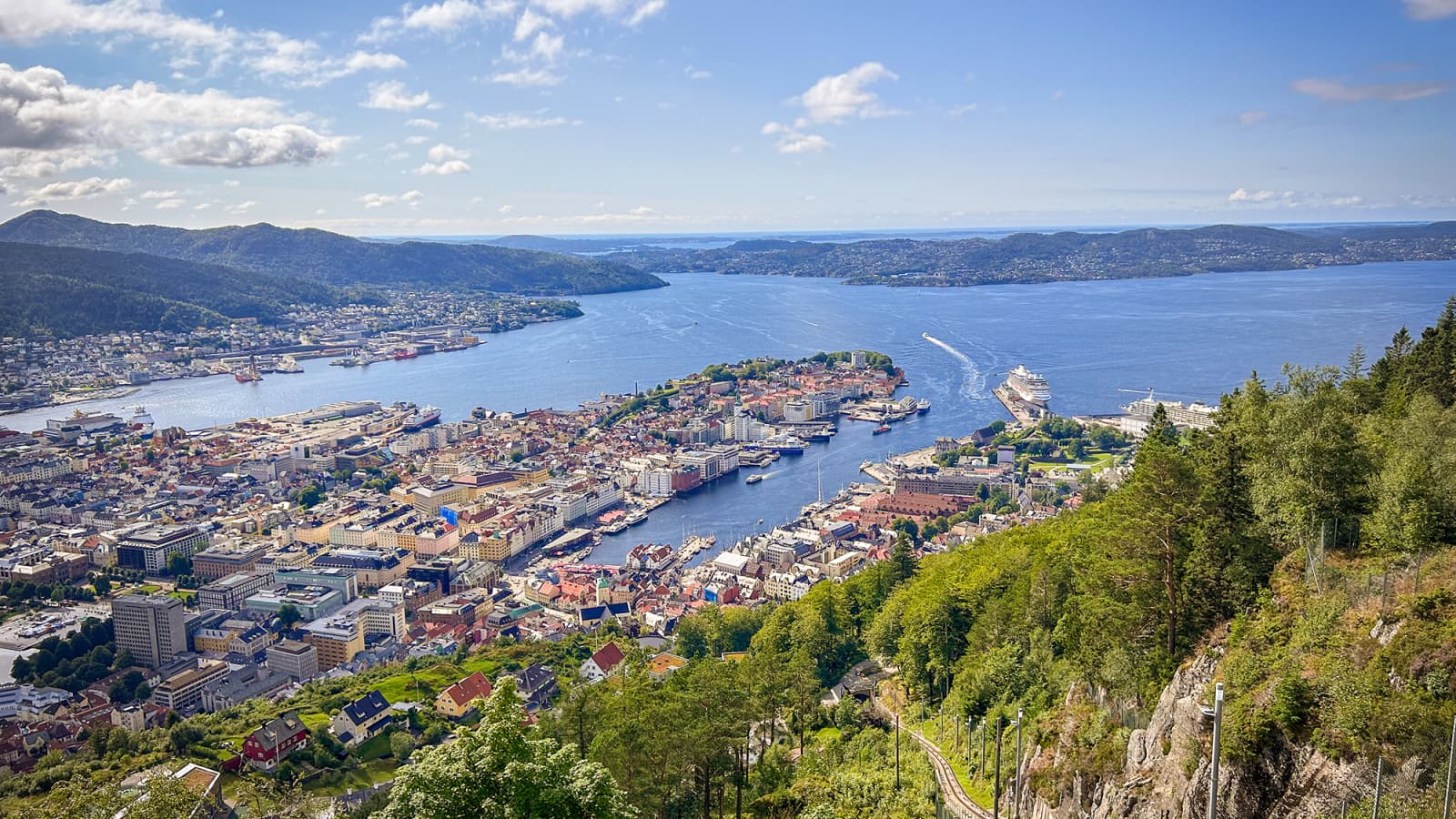
Finish with the Fløibanen, the funicular that climbs Mount Fløyen in seven minutes. Aim for late afternoon, when the light skims the rooftops and the fjord turns to metal. The Fløibanen funicular costs about €15 to €18 return, and there's a queue between 11 am and 3 pm.
If you still have energy, Bergenhus Fortress and Bergen Cathedral are within walking distance. But honestly, on day 1, walking with no goal is the best plan. Our complete guide to Bergen covers everything else, and Bergen public transport is simple and reliable if you want to go further afield.
Where to stay in Bergen
Two nights here is the minimum. The centre is small and everything is walkable, so pay for location rather than square metres. The Clarion Hotel Admiral has a head-on view of Bryggen, and our best luxury hotels in Bergen cover the top of the range.
Day 2: your first fjord, without leaving Bergen
Bergen has a rare privilege: the fjord starts at the end of the wharf. You don't need a car to reach it.
The option I recommend is the cruise to Mostraumen, on the Osterfjord. Three hours, a reasonably sized boat, and one precise moment that justifies the ticket: passing through the Mostraumen strait, where the tide creates a visible current, a river within the sea. The boat draws close to a waterfall and the captain fills a glass of water straight from the rock face. It's a little theatrical. It works anyway. All the details in our guide to the Bergen to Mostraumen cruise.
Three ways to see a fjord from Bergen
- The Mostraumen cruise: about 3 hr, €60 to €75, for those who want comfort and a wide sweep of landscape. The best time-to-impact ratio.
- Kayaking at Øygarden: half a day, about €90 to €120, for those who want silence. At water level, a fjord doesn't sound the same. Our account of kayaking at Øygarden explains why.
- Mount Ulriken: 2 hr, about €30, for those who prefer to see it from above. The Ulriken cable car climbs to 643 m, and the ridge trail to Fløyen is one of the best hikes in Bergen.
In the evening, do as the Norwegians do: a scorching sauna then a plunge into the icy fjord. The Heit Bergen Sauna and the Nordnes Sjøbad pool are two ways to experience this ritual. The first time, the 12-degree water takes your breath away for exactly eight seconds. After that, it's euphoric.
Day 3: Bergen to Flåm, the road that changes everything
On the morning of day 3, you pick up the car. This is the real start of the Norwegian fjords road trip.
You leave Bergen on the E16 towards Voss. The first fifty kilometres are dull: tunnels, traffic, suburbs. Don't be discouraged. Then the road opens onto the Sørfjord, and the scenery shifts.
A possible stop at Tvindefossen, just past Voss, a fan-shaped waterfall visible from the car park. A three-minute stop, a photo, and off again. It's the kind of waterfall that elsewhere would have its own toll booth and gift shop. Here, it's a pull-in on the verge. You'll pass twenty like it.
If you pass through Voss and you're curious about the region's winter side, our article on skiing in Voss gives the context.
Gudvangen and the Nærøyfjord
Then comes the moment. You emerge from the Gudvangen tunnel and the Nærøyfjord appears, UNESCO-listed, two kilometres wide at most, walls 1,200 metres high, waterfalls tumbling from everywhere. It's the narrowest arm of the Sognefjord and, to my mind, the most impressive landscape reachable by car in Europe.
In Gudvangen, the Njardarheimr Viking village is worth the detour if you're travelling with children, or if you're up for the lived-in re-enactment. It's not a theme park: the inhabitants live there the whole season. Our visit to the Gudvangen Viking village captures the atmosphere.
Between Gudvangen and Flåm, make a detour to Undredal, a village of 80 people clinging to the fjord, famous for its goat's cheese and for its little stave church, the smallest still in use in Scandinavia. Twenty minutes off the route. They're worth more than half the official programme.
Renting the car: the trade-offs that matter
Three points, and they change the trip.
Get an automatic gearbox. Norwegian roads are narrow and winding, with tunnels several kilometres long and passing points where you have to squeeze by. A manual adds a mental load you don't need. Hybrids have become the local norm.
Don't go too big. A large SUV becomes unwieldy on the Rv 13. A compact is more than enough for two.
Check the drop-off fees. It's the number-one trap on this itinerary.
Our guide to 10 tips for renting and driving a car in Norway is the essential companion to this section, and renting a car in Bergen details the agencies and pick-up locations.
DiscoverCars
Car rental comparison — 150+ countries
Compare prices from Hertz, Avis, Sixt and local providers. All fees included, free cancellation. Rated 4.6/5 on Trustpilot.


Day 4: Flåm, Stegastein and the snow road
Day 4 is the only day of the week where you barely drive at all. Make the most of it; this is where Norway lets itself be looked at.
The morning: kayaking on the Aurlandsfjord
Two to three hours of paddling from Flåm. The fjord is 800 metres deep beneath the hull, the wall rises a kilometre above, and you're in the middle, in a three-metre plastic shell.
You stop paddling, and there's nothing left. No engine, no wind, no bird. Just, far above, a thread of water falling from a glacier you can't see. It's the densest silence I've heard in Europe.
It's all in our guide to kayaking in Flåm.
The afternoon: Stegastein
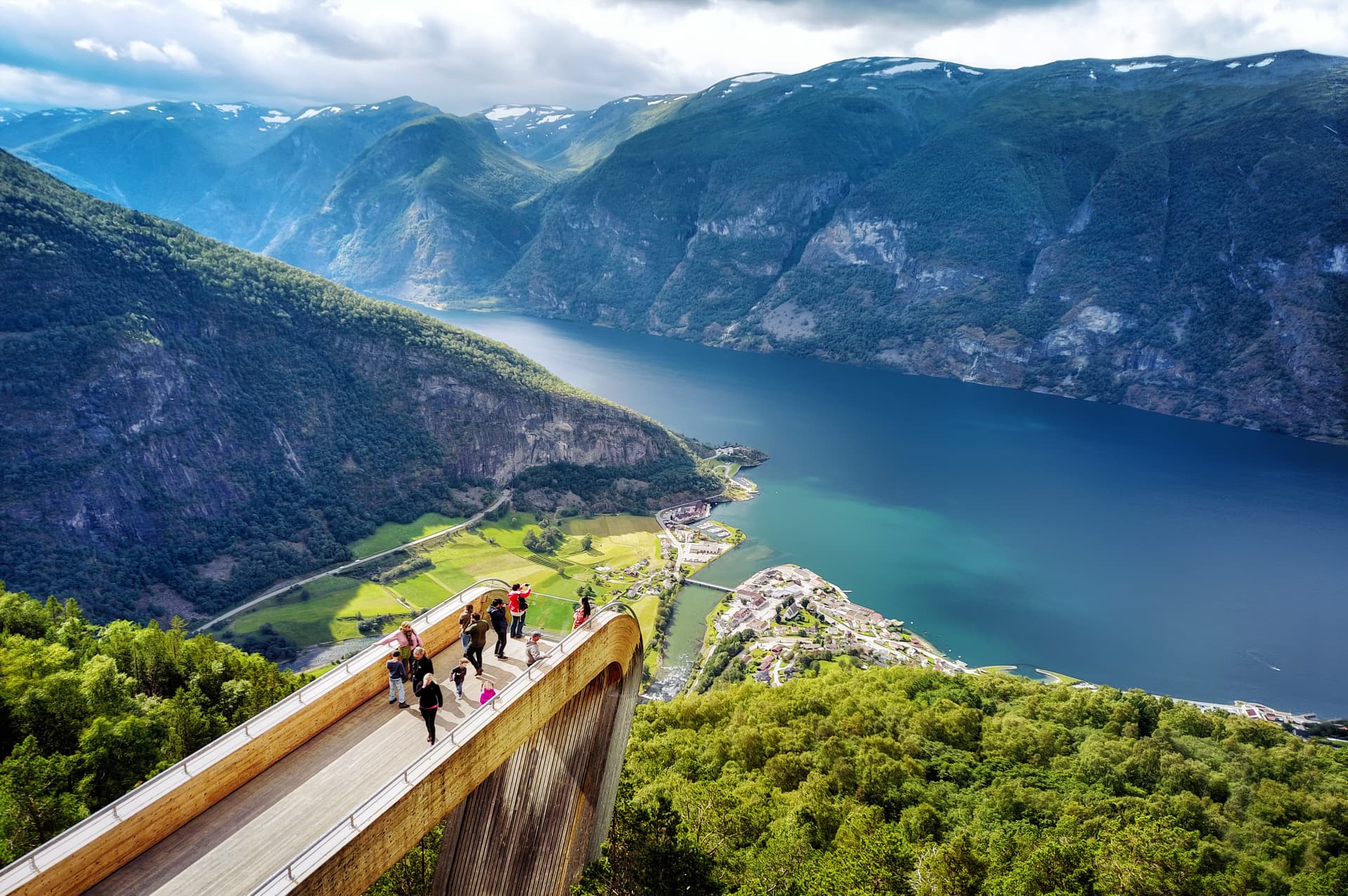
The Stegastein viewpoint is a walkway of wood and steel that juts out into the void 650 metres above the Aurlandsfjord. The floor ends on a glass panel and your gaze drops away. It's dizzying and it costs nothing.
The road that leads there matters as much as the viewpoint: ten kilometres of tight hairpins from Aurland. Our article on the Stegastein viewpoint gives the opening times and shuttle access for those without a car.
If the season allows: Aurlandsfjellet
Beyond Stegastein, the Aurlandsfjellet road, nicknamed the snow road, crosses a lunar plateau to Lærdal. Walls of snow at the roadside in June, a landscape of stone and lichen, not a single tree. Nothing like the fjords, and that's precisely the point.
Day 5: the descent through the Hardanger
Here begins the part no one documents properly. And this is where I have to be honest with you.
Flåm and Preikestolen are about 380 kilometres and 6 hr 30 of real driving apart, with two ferries. You'll see online itineraries claiming to link the two in half a day. That's false. In Norway, a 60 km/h average is optimistic: the speed limit is often 60 or 70, the roads wind, the tunnels set their own pace, and the ferries add waiting time.
Hence splitting it over two days, with a night in the Hardanger.
Flåm to Odda, the route
From Flåm, head back up the E16 to Voss, then switch to the Rv 13 towards Granvin. A detour on the Rv 7 towards Eidfjord brings you to Vøringsfossen, a 180-metre waterfall that plunges into the Måbødalen canyon, now fitted with a footbridge suspended over the drop. It's the most visited waterfall in Norway and it deserves its reputation.
Then the Rv 13 runs alongside the Hardangerfjord to Odda, through the orchards. In spring, this fjord is lined with apple trees in blossom for tens of kilometres. It's a world away from Norway's stark, mineral imagery, and it's a contrast that surprises.
Reckon on 200 kilometres and 3 hr 30 of driving without stops. With Vøringsfossen and the photo breaks, plan for the whole day.
How Norwegian ferries really work
It's the question that worries readers most, and I haven't found a single guide that explains it properly. Here's the reality.
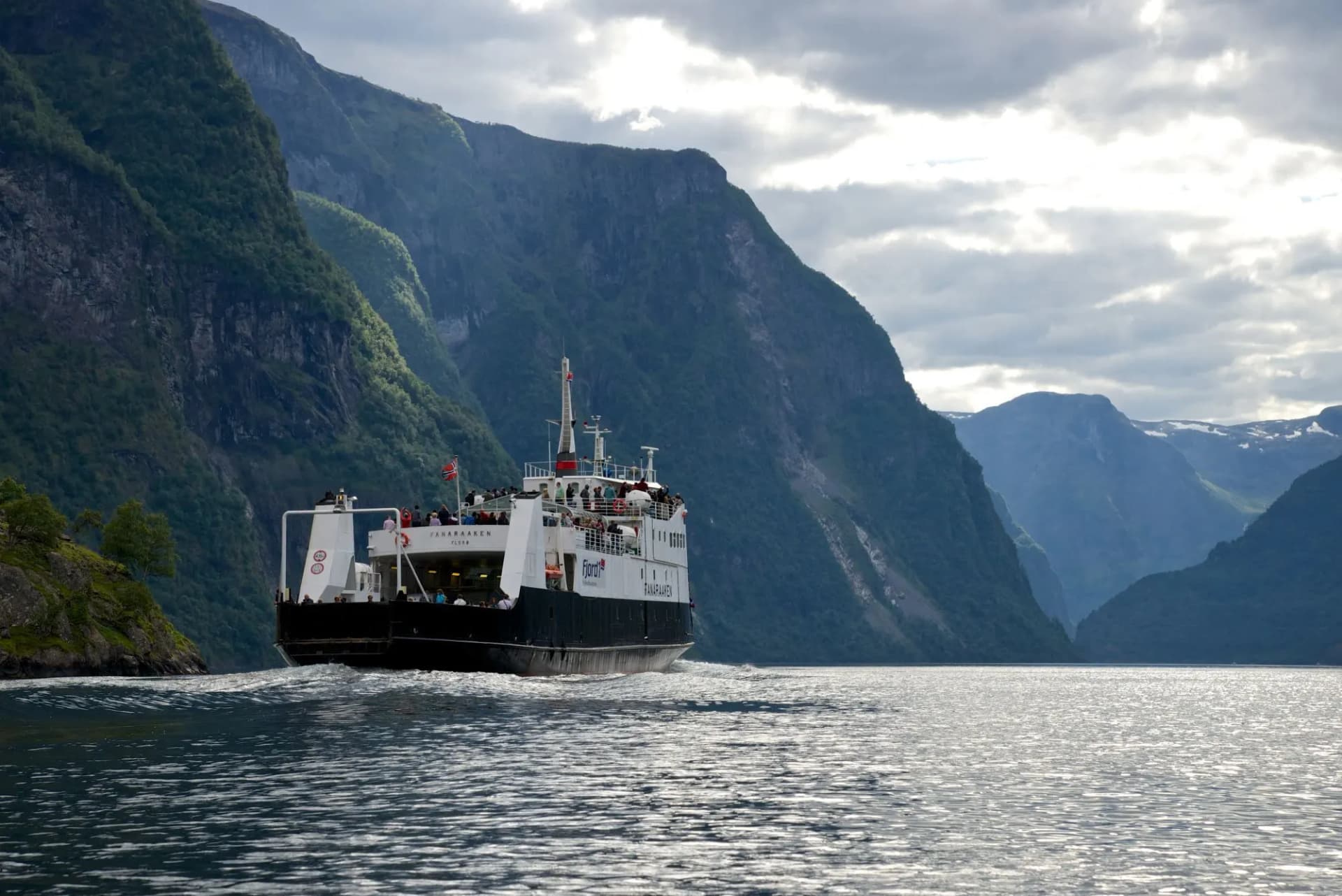
- 01You don't book. On the crossings of this itinerary, there's no ticket and no advance booking. You arrive, you join the queue.
- 02You queue on the road. The boarding lanes are marked on the ground just before the ramp. You switch off the engine and wait.
- 03Payment is automatic. The AutoPASS camera reads your plate and the bill goes to the rental company, which then passes it on to you with a commission. You pay nothing on the spot; no one comes to see you.
- 04You board when signalled. Handbrake on, engine off, and you head up to the deck. Stay in the car and you'll have missed the crossing.
- 05Frequencies are high in summer. Between 20 and 40 minutes' wait at most during the day. In the evening, it's another story.
Day 6: Odda to Preikestolen, the Rv 13 road
Two hundred kilometres, about 4 hours, one ferry. It's one of the most beautiful roads in the country and no one talks about it.
The Rv 13 leaves Odda heading south, crosses a plateau, drops back down to Sauda, runs along the Sandsfjord, then crosses by ferry Nesvik to Hjelmeland (a crossing of about ten minutes) before reaching the Ryfylke region. The landscape changes three times in one day: green fjord, bare plateau, jagged coast.
Spend the night at the foot of Preikestolen, in Jørpeland or at the Preikestolen Fjellstue. That's the whole point of the manoeuvre: to set off at dawn the next day.
Day 7: Preikestolen at dawn, then Stavanger
The alarm goes off at 5 am. It's the only bad moment of the week, and it's the best investment of the trip.
The hike
Eight kilometres round trip, about 4 hours, 350 metres of ascent. Preikestolen isn't a difficult hike. It's a crowded one. An essential distinction: what will tire you isn't the gradient, it's the 3,000 people climbing the same trail on the same day in August.
The trail alternates stone steps built by Nepalese sherpas, rock slabs and boardwalk sections over the peat. Nothing technical. But the polished rock becomes an ice rink in wet weather, and it rains often.
At the top, a granite platform 25 metres by 25, and 604 metres of empty air below the edge. No barrier. No railing. Nothing.
And yet, the best moment isn't up there. It's twenty minutes before, on the plateau, when the trail flattens and the Lysefjord appears all at once between two boulders, without warning, with the mist still trailing over it. At the summit, there's a queue for the photo at the edge. On the plateau, there's no one.
Our complete guide to the Preikestolen hike details the parking, the timings and the gear.
Plan B, if the weather closes everything in: the Lysefjord cruise with a view of Pulpit Rock from Stavanger. You see the rock from below, which gives you the true scale of the thing. It's an excellent fallback, not a consolation prize.
The afternoon: Stavanger
Back down, forty minutes' drive, and you enter Stavanger with legs like cotton wool and the feeling of having earned a beer.
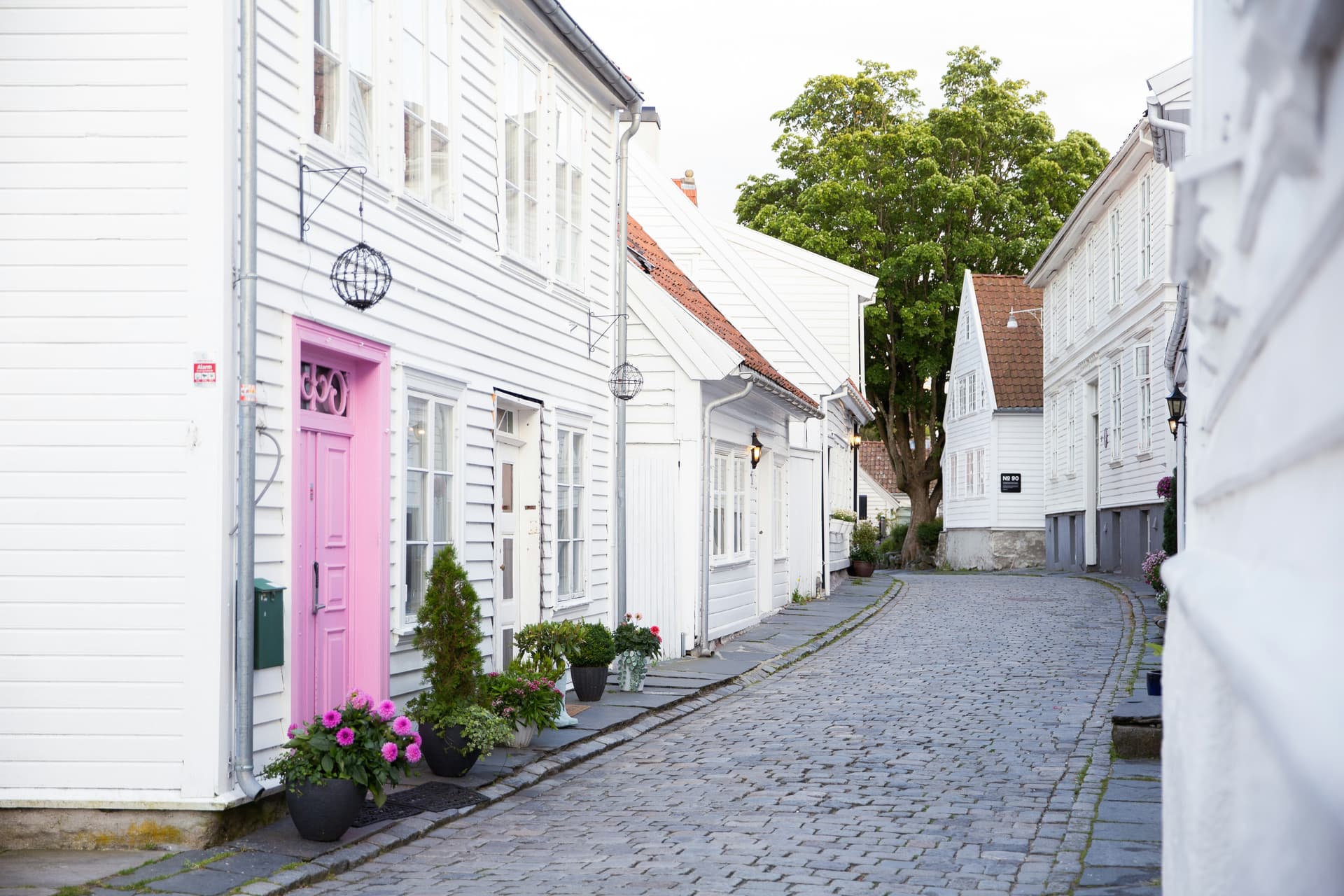
Gamle Stavanger, the old quarter, lines up 170 white wooden houses along cobbled lanes, with climbing roses and lattice windows. It's neat, almost too neat. It's still the largest preserved group of wooden houses in Northern Europe. Our stroll through the charm of Gamle Stavanger tells of the contrast with the oil city right next door.
What to do in Stavanger in half a day
- Gamle Stavanger (1 hr): the white lanes, best done by wandering without a map
- Street art (1 hr): Stavanger is a quiet European capital of murals, with monumental frescoes on industrial façades. Our guide to street art in Stavanger sets out the route
- Sverd i Fjell (30 min): three ten-metre swords planted in the rock at the fjord's edge, fifteen minutes from the centre. Our article on Sverd i Fjell explains what they commemorate
- The petroleum museum (1 hr 30): yes, an oil museum. And it's one of the best designed in the country, honest about the ambiguities of the subject. See our visit to the Stavanger petroleum museum
- The Fisketorget (1 hr): the local fish market, less staged than Bergen's. Our lunch at the Stavanger Fisketorget
- Dinner: our 8 best restaurants in Stavanger, and for a final evening, the bistro Re-Naa Matbaren
For everything else, our complete guide to Stavanger and our 10 best things to do in Stavanger take over. And if you have an extra night, the islands of Vassøy and Lindøy are thirty minutes by boat from the centre.
What budget for a week in the Norwegian fjords?
Let's talk money, because it's the first thing that holds people back and a lot of nonsense gets told about it.
Norway is expensive. Less so than people say, provided you know where the money really goes.
| Item | Budget version | Comfort version |
|---|---|---|
| Return flights | €150 to €220 | €250 to €400 |
| Car (5 days, for two) | €175 to €250/person | €300 to €400/person |
| Fuel | €50 to €70/person | €60 to €80/person |
| Ferries and tolls | €30 to €50/person | €40 to €70/person |
| Accommodation (6 nights, for two) | €400 to €550/person | €700 to €1,000/person |
| Food | €200 to €300/person | €450 to €650/person |
| Activities | €120 to €180/person | €250 to €400/person |
| Total | ~€1,150 to €1,400 | ~€2,050 to €3,000 |
The two levers that change everything: food and accommodation. A restaurant main course runs between €25 and €45, a beer around €10 to €12. Shop at Rema 1000, Kiwi or Extra, picnic at midday with a view over a fjord, and you halve that item without losing a thing. No one remembers a restaurant lunch in Voss. Everyone remembers a sandwich eaten beside the Nærøyfjord.
What changes in 2026: the visitor tax
It's the new development that almost no guide has taken on board.
Norway long resisted a visitor tax. It has given in. The Visitor Contribution Act now allows municipalities in areas particularly affected by tourism to levy up to 3% on the price of the overnight stay, including hotels, guesthouses, hostels and short-term Airbnb-style rentals. The first applications are expected during the 2026 summer season.
Three things to understand.
It's not national and not automatic. Each municipality must demonstrate that its infrastructure is under strain and have its scheme approved by the government. Some destinations will choose not to apply it.
The revenue is earmarked. It doesn't go to the general budget: it funds tourist facilities exclusively, public toilets, car parks, trail maintenance, signage. When you climb Preikestolen, you understand why.
Campsites, tents, campervans and private boats are excluded from the scheme. A camping trip escapes it entirely.
In practical terms, on this itinerary? A €200 hotel night generates €6 of tax. Over six nights, the real impact comes to around €20 to €35 for two people. It's marginal. What's interesting is the signal: the Norway of the fjords is entering the age of regulated tourism. Our article on the Norwegian tourist tax tracks the rollout municipality by municipality.
It's one of the rare destinations where which payment card you use genuinely deserves a pause. Our full review of the Wise card explains the maths.
Wise Card
Travel smart with the best exchange rate
Say goodbye to banking hassles abroad with Wise, the multi-currency card with superpowers!
To put the Norwegian scale of things into perspective for another region, our budget for a trip to Tromsø makes a good point of comparison.
Driving this itinerary: what you need to know
AutoPASS tolls, stress-free
There are no toll barriers in Norway. Gantries photograph your plate, and that's it. You never pay on the spot.
For a rental vehicle, the bill goes automatically to the rental company, which passes it on to you, usually with an admin fee of €2 to €5 per transaction or a daily flat rate. Check this point in your contract: with some companies the flat rate is cheaper than per-toll billing, with others it's the opposite.
The tunnels
They're long, very long, sometimes more than 20 kilometres, and they sometimes pass under fjords, dropping to 250 metres below sea level. Some are single-lane with passing bays. A few habits: headlights on at all times (mandatory day and night in Norway), no U-turns, and keep a fuel margin before a long tunnel.
The five habits before hitting the road
- 01Fill up before the empty stretches, especially after Granvin and before Sauda
- 02Download your maps offline: network coverage regularly disappears in the valleys and tunnels
- 03Reckon on a 60 km/h average, not 90. It's the golden rule of any Norway itinerary
- 04Don't drive on the reserve tank before a mountain road
- 05Plan ahead for the ferries by checking the timetables that very morning
Our guide to 10 tips for renting and driving a car in Norway goes deeper into each of these points.
When to go for this itinerary?
The realistic window runs from late May to early September. Outside that period, the high-altitude roads close, the cruises thin out and the days shorten sharply.
June is my favourite month, by far. The waterfalls are swollen with snowmelt and roar. Daylight lasts until 11 pm. The Hardanger orchards are still in blossom early in the month. And the cruise-ship crowds haven't peaked. The only downside: Aurlandsfjellet may still be closed early in the month.
July and August offer the most stable weather and guaranteed access to everything. You pay for that comfort in crowds and accommodation prices, which can double.
September brings colour and calm. But the days shorten fast, some cruises switch to reduced schedules, and the weather becomes frankly unpredictable.
Can you do this itinerary without a car?
Yes, partly. And I'd rather be clear about what you lose.
What works without a car:
- Bergen entirely, with an excellent network of public transport and even electric scooters
- Bergen to Flåm on the Bergen train to Myrdal, then the Flåmsbana. This is the famous Norway in a Nutshell, and our article on the train between Bergen and Oslo covers the line
- The Bergen to Flåm cruise along the Sognefjord, a superb alternative to the road
- Stegastein by shuttle from Flåm
- Bergen to Stavanger on the coastal express boat, about 4 hr 30
- Preikestolen by shuttle from Stavanger
- Stavanger entirely on foot
What you lose: Aurlandsfjellet, the whole Hardanger, Vøringsfossen, the Rv 13, Undredal, and above all the freedom to stop. And in this country, it's the unplanned stops that make the trip.
My verdict: without a car, do Bergen, Flåm and Stavanger by train and boat. It's an excellent trip. It's simply not the same one described here.
The 5 mistakes I made
- 01Underestimating driving times. Two hundred kilometres is not two hours. Ever. I built my first day on an optimistic estimate and ended up arriving at 10 pm in a village where everything was closed.
- 02Trying to squeeze Trolltunga into the week. It's 28 kilometres and 10 to 12 hours of walking. It doesn't fit into a 7-day itinerary that already includes Preikestolen, unless you sacrifice two whole days. Save it for another trip.
- 03Not booking accommodation in Flåm. The village is tiny and its capacity is laughable given its visitor numbers. In July, I ended up forty minutes away, which scuppered the next morning's kayaking.
- 04Paying with a card that charges conversion fees. See above. Over a week, it adds up.
- 05Believing the weather means anything. In Bergen, a clear sky at 9 am predicts nothing for 11 am. Carry the waterproof layer every day, even when it seems absurd. Our 10 tips for travelling light will help you pack that bag.
Norway has no patience for your schedules. It imposes its rhythm on you from the first missed ferry, and once you give in, the trip begins.
Extending the trip
Three more days? Stay in the Hardanger, climb Trolltunga, come back down through Ryfylke without rushing.
Fancy something completely different? Head north. Our Lofoten road trip itinerary explores an archipelago that's a world apart, and the Hurtigruten cruise from Bergen to Tromsø bridges the two Norways. If the Arctic calls you, our complete guide to Tromsø is the starting point.
And for lovers of scenic routes, the Senja route and the Dovrefjell immersion extend the logic of this one, further north and wilder.
Frequently asked questions
Is a week enough to see the Norwegian fjords?
A week is enough to see one region of fjords, not Norway. On the Bergen-to-Stavanger axis, seven days let you see the Nærøyfjord, the Aurlandsfjord, the Hardangerfjord and the Lysefjord without driving more than 4 hours a day. Trying to add Geiranger or Lofoten would turn the trip into a race.
Should you start in Bergen or Stavanger?
In Bergen, for three reasons: the city is a better arrival buffer, the build-up in intensity works better this way, and return flights from Stavanger are often cheaper. Do check the rental company's drop-off fees before deciding, though.
How much does a week in Norway cost for two people?
Reckon on around €2,300 to €2,800 for two on the budget version, flights included, and €4,000 to €6,000 on the comfort version. The two items that tip the budget are accommodation and food, not transport.
Do you need to book the ferries in advance?
No. On this itinerary, none of the crossings can be booked. You arrive, you join the queue, the AutoPASS camera reads the plate and the bill goes to the rental company. In summer, the wait rarely exceeds 40 minutes during the day.
Does the Norwegian visitor tax apply on this itinerary in 2026?
Potentially, yes, but not everywhere. The law allows each municipality under tourist pressure to levy up to 3% on the overnight stay, after government approval, with the first applications expected in summer 2026. Bergen is among the likely candidates. The real impact over a week remains in the region of €20 to €35 for two. Campsites, tents and campervans are exempt.
Can you do this itinerary in April or October?
Only partly. Aurlandsfjellet is closed, some cruises run at a reduced pace, and Preikestolen becomes a serious winter hike, not to be attempted without crampons and a guide. Bergen, Flåm and Stavanger remain perfectly accessible. The rest, no.
Do you need special insurance for Preikestolen?
It's not a technical hike, but it's a mountain hike, with no barrier, 604 metres above a fjord, in a country where rescue and medical costs are high. Check the mountain and repatriation cover in your policy. Our review of Chapka travel insurance details this point.

Âme Bohème exists thanks to you
Some links in this article are affiliate links. This means that if you book or purchase a product through these links, we receive a small commission — at no extra cost to you. It's thanks to this support that we can continue creating free, quality content.
You can also buy us a coffee, or follow us on Instagram and Facebook.
